Credit: NASA
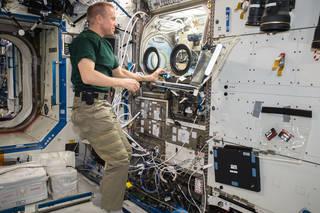
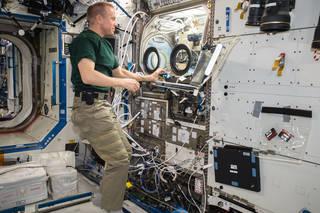
A growing number of commercial partners use the International Space Station National Lab. With that growth, we will see more discoveries in fundamental and applied research that could improve life on the ground.
Since 2011, when NASA engaged the Center for the Advancement of Science in Space (CASIS) to manage the ISS National Lab, CASIS has partnered with academic researchers, other government organizations, startups and major commercial companies to take advantage of the unique microgravity lab. Today, more than 50 percent of the CASIS flight manifest represents commercial research.
Here's a look at five ways the ISS National Lab is enabling new opportunities for commercial research in space:
1.Supporting commercial life sciences research: One of the main areas of focus for NASA in the early origins of the space station program was life sciences, and it is still a major priority for the agency today. Studying the effects of microgravity on astronauts provides insight into human physiology, and how it evolves or erodes in space. CASIS took this knowledge and began robust outreach to the pharmaceutical community, which could now take advantage of the microgravity environment on the ISS National Lab to develop and enhance therapies for patients on Earth. Companies such as Merck, Eli Lilly & Company, and Novartis have sent several payloads to the station, including investigations aimed at studying diseases such as osteoporosis, and examining ways to enhance drug tablets for increased potency to help patients on Earth. These companies are trailblazers for many other life science companies who are looking at how the ISS National Lab to advance their research aims.
2.Enabling commercial investigations in material and physical sciences: Over the past few years, CASIS and the ISS National Lab also have seen a major push toward material and physical sciences research by companies interested in enhancing their products for consumers. Examples range from Proctor and Gamble's investigation aimed at increasing the longevity of daily household products, to Milliken's flame-retardant textile investigation to improve protective clothing for individuals in harm's way, and companies looking to enhance materials for household appliances. Additionally, CASIS has been working with a variety of companies to improve remote sensing capabilities in order to better monitor our oceans, predict harmful algal blooms, and ultimately, to better understand our planet from a vantage point roughly 250 miles above Earth.
3.Supporting startup companies interested in microgravity research: CASIS has funded a variety of investigations with small startup companies (in particular through seed funding and grant funding from partnerships and funded solicitations) to leverage the ISS National Lab for both research and test-validation model experiments. CASIS and The Boeing Company recently partnered with MassChallenge, the largest startup accelerator in the world, to fund three startup companies to conduct microgravity research.
4.Enabling validation of low-Earth orbit business models: The ISS National Lab helps validate low-Earth orbit business models. Companies such as NanoRacks, Space Tango, Made In Space, Techshot, and Controlled Dynamics either have been funded by CASIS or manifested to send hardware instruments to the ISS National Lab that the research community can use, and that open new channels for inquiry. This has allowed the companies that operate these facilities to validate their business model with the space station while also building for the future beyond station.
5.Demonstrating the commercial value of space-based research: NASA has been a key partner in working with CASIS to demonstrate to American businesses the value of conducting research in space. Through outreach events such as NASA's Destination Station, where representatives from the International Space Station Program Science Office and CASIS select cities with several major companies and meet with the companies to discuss how they could benefit from space-based research. Over the past few years, this outreach mechanism has proven a terrific example of building awareness on the benefits of microgravity research.
###
Media Contact
Rachel Barry
[email protected]
@NASA_Johnson
http://www.nasa.gov/centers/johnson/home
Original Source
https://www.nasa.gov/mission_pages/station/research/news/national_lab_enables_research