• HOME
  • NEWS
  • EXPLORE
    • CAREER
      • Companies
      • Jobs
    • EVENTS
    • iGEM
      • News
      • Team
    • PHOTOS
    • VIDEO
    • WIKI
  • BLOG
  • COMMUNITY
    • FACEBOOK
    • INSTAGRAM
    • TWITTER
Thursday, December 25, 2025
BIOENGINEER.ORG
No Result
View All Result
  • Login
  • HOME
  • NEWS
  • EXPLORE
    • CAREER
      • Companies
      • Jobs
        • Lecturer
        • PhD Studentship
        • Postdoc
        • Research Assistant
    • EVENTS
    • iGEM
      • News
      • Team
    • PHOTOS
    • VIDEO
    • WIKI
  • BLOG
  • COMMUNITY
    • FACEBOOK
    • INSTAGRAM
    • TWITTER
  • HOME
  • NEWS
  • EXPLORE
    • CAREER
      • Companies
      • Jobs
        • Lecturer
        • PhD Studentship
        • Postdoc
        • Research Assistant
    • EVENTS
    • iGEM
      • News
      • Team
    • PHOTOS
    • VIDEO
    • WIKI
  • BLOG
  • COMMUNITY
    • FACEBOOK
    • INSTAGRAM
    • TWITTER
No Result
View All Result
Bioengineer.org
No Result
View All Result
Home NEWS Science News Chemistry

Fishing for a theory of emergent behavior

Bioengineer by Bioengineer
July 9, 2020
in Chemistry
Reading Time: 2 mins read
0
IMAGE
Share on FacebookShare on TwitterShare on LinkedinShare on RedditShare on Telegram

Researchers at the University of Tsukuba study the collective swimming of ayu fish and quantify the degree of group cohesion using information theory, which may help researchers better understand the origin of emergent dynamics
IMAGE

Credit: University of Tsukuba

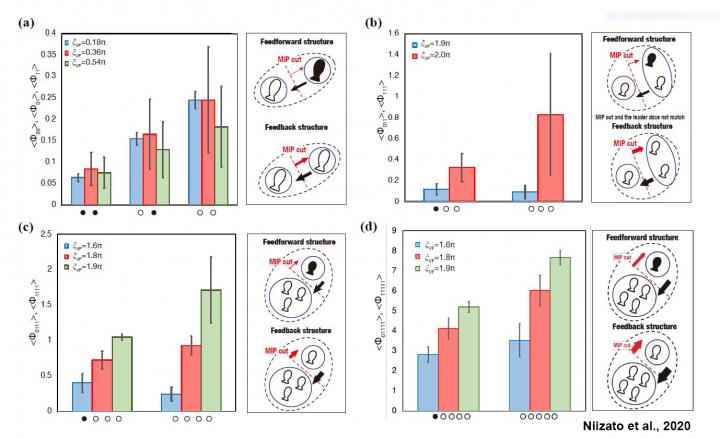
Tsukuba, Japan – Researchers at the University of Tsukuba used advanced metrics from information theory to describe the collective behavior of small schools of ayu fish. They found that the overall dynamics were noticeably different for groups of three or more, compared with smaller groups, even over very short timescales. This work may help shed light on fundamental problems in complexity theory and assist in the development of cooperative biomimetic swarming robots.

Some of the most difficult questions in science today deal with the same fundamental question: How can complex dynamics arise from simple, local interactions? For example, schools of fish and flocks of birds can move and turn in near perfect synchrony without any top-down control from a leader. To try to make progress on this question, integrated information theory (IIT) has been used to provide a mathematical framework for measuring how information passes back and forth from individuals to the group as a whole.

A team including Professor Takayuki Niizato at the University of Tsukuba studied the swimming of Ayu, which are small fish related to smelts. Ayu were randomly chosen and placed in a tank in groups of 2, 3, 4, or 5 fish.

Explains Professor Niizato, “The trajectory of each fish was tracked, and a computer calculated three binary parameters for every fish at each time step. These parameters were as follows: if the subject fish was close to another fish, if the fish was turning, and if another fish was in its field of view. We found that, over times ranging from 40 milliseconds to one second, a grouping of three fish acted very differently than a pair.”

In this study, “integrated information” quantified the extent to which the cause and effect in a system can be explained by the repertoires of its components. And “integrated conceptual information” was used as an expression of the fish school’s group collective action, roughly how much the behavior of individual members is dependent on the behavior of the group.

“The aim of IIT is to try to shift the paradigm from ‘what a system does’ to ‘what a system is.’ The former tries to analyze the system on the basis of observable behavior, while the latter tries to determine its intrinsic causal structure,” says Professor Niizato.

This work may help make inroads in some truly difficult questions surrounding group dynamics that emerge naturally when simple components join to form a complex group. This may also aid in the development of “swarming” robots that, like schools of fish or ant colonies, make use of this principle to achieve complicated goals.

###

Media Contact
Naoko Yamashina
[email protected]

Related Journal Article

http://dx.doi.org/10.3390/e22070726

Tags: Biomechanics/BiophysicsChemistry/Physics/Materials SciencesNanotechnology/MicromachinesNeurochemistry
Share12Tweet8Share2ShareShareShare2

Related Posts

Cutting Electrolyte Reduction Boosts High-Energy Battery Performance

Cutting Electrolyte Reduction Boosts High-Energy Battery Performance

December 19, 2025
Microenvironment Shapes Gold-Catalysed CO2 Electroreduction

Microenvironment Shapes Gold-Catalysed CO2 Electroreduction

December 11, 2025

Photoswitchable Olefins Enable Controlled Polymerization

December 11, 2025

Cation Hydration Entropy Controls Chloride Ion Diffusion

December 10, 2025
Please login to join discussion

POPULAR NEWS

  • Nurses’ Views on Online Learning: Effects on Performance

    Nurses’ Views on Online Learning: Effects on Performance

    70 shares
    Share 28 Tweet 18
  • NSF funds machine-learning research at UNO and UNL to study energy requirements of walking in older adults

    71 shares
    Share 28 Tweet 18
  • Unraveling Levofloxacin’s Impact on Brain Function

    54 shares
    Share 22 Tweet 14
  • Exploring Audiology Accessibility in Johannesburg, South Africa

    51 shares
    Share 20 Tweet 13

About

We bring you the latest biotechnology news from best research centers and universities around the world. Check our website.

Follow us

Recent News

Active Teaching Boosts Nursing Students’ Prescription Skills

Loneliness and Its Impact on Older Pneumonia Patients

Vitamin D Boosts Muscle Function in Intestinal Failure Patients

Subscribe to Blog via Email

Enter your email address to subscribe to this blog and receive notifications of new posts by email.

Join 70 other subscribers
  • Contact Us

Bioengineer.org © Copyright 2023 All Rights Reserved.

Welcome Back!

Login to your account below

Forgotten Password?

Retrieve your password

Please enter your username or email address to reset your password.

Log In
No Result
View All Result
  • Homepages
    • Home Page 1
    • Home Page 2
  • News
  • National
  • Business
  • Health
  • Lifestyle
  • Science

Bioengineer.org © Copyright 2023 All Rights Reserved.