MIAMI —The first global analysis of larval orientation studies found that millimeter-size fish babies consistently use external cues to find their way in the open ocean. There are many external cues available to marine fish including the Sun, Earth’s magnetic field, and sounds. The new study, led by scientists at the University of Miami Rosenstiel School of Marine, Atmospheric, and Earth Science offers important insight into understanding this perilous phase of marine fish.
Credit: Lyle Vail
MIAMI —The first global analysis of larval orientation studies found that millimeter-size fish babies consistently use external cues to find their way in the open ocean. There are many external cues available to marine fish including the Sun, Earth’s magnetic field, and sounds. The new study, led by scientists at the University of Miami Rosenstiel School of Marine, Atmospheric, and Earth Science offers important insight into understanding this perilous phase of marine fish.
Understanding the mechanisms that fish larvae use during their pelagic journey is critical for scientists to better predict their dispersal, the connectivity of marine protected areas, and the structure of marine fish populations.
“This study highlights the importance of a deeper understanding of larval orientation mechanisms and suggests the concept of vector-navigation in the early life history of fish,” said the study’s senior author Claire Paris, a professor of ocean sciences at the Rosenstiel School.
Once considered passive drifters relying on ocean currents to get them to their nursery grounds, the Rosenstiel School researchers, together with multiple collaborators, showed that for many species around the world from tropical to temperate regions, fish larvae are able to control their destination and migrate by keeping a bearing.
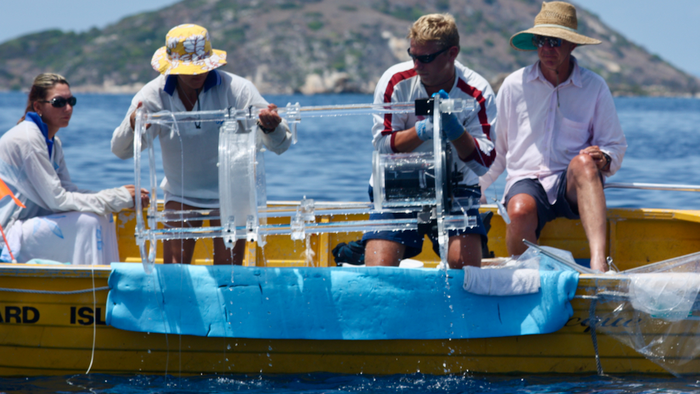
The researchers analyzed nearly two decades of studies using two methods to collect data on an unprecedented number of larvae of multiple species and locations. One method used a Drifting In Situ Chamber instrument invented by Paris that consists of an underwater chamber with an imaging system to record larval fish swimming behavior in their natural settings. The second method used is the Following method developed by Jeff Leis, an ichthyologist at the University of Tasmania, in which two scuba divers follow late-stage larvae while recording the bearing and swimming speed. Movement patterns obtained by these two experimental methods were compared to theoretical movement patterns expected under strict use of internal cues. The results from this combined approach strongly supported oriented movement by fish larvae.
“Our study is the first to show that this is achieved using external directional cues, providing a systematic and global indication for a robust use of external cues by fish larvae for orientation. This is important since a better understanding of the larval stages can facilitate the management and conservation of marine populations” said the study’s lead author Igal Berenshtein, a postdoctoral researcher in the Department of Ocean Sciences at the Rosenstiel School.
“It’s extraordinary that these tiny fish larvae find their way in a vast ocean” said Paris. “We can learn from them to fundamentally advance fisheries models and the science of underwater navigation.”
The study, titled “Evidence for a consistent use of external cues by marine fish larvae for orientation,” was published December 2, 2022, in the journal Communications Biology. The study’s authors include: Claire Paris, Igal Berenshtein, Robin Faillettaz from the University of Miami Rosenstiel School, Jean-Oliver Irisson from the Laboratory of Oceanology of Villefranche-sur-Mer and the CNRS; Moshe Kiflawi from Ben-Gurion University of the Negev; Ulrike Siebeck from University of Queensland; and Jeffery Leis from University of Tasmania.
The study was supported by a National Science Foundation grant (NSF-OCE 1459156).
About the University of Miami
The University of Miami is a private research university and academic health system with a distinct geographic capacity to connect institutions, individuals, and ideas across the hemisphere and around the world. The University’s vibrant and diverse academic community comprises 12 schools and colleges serving more than 17,000 undergraduate and graduate students in more than 180 majors and programs. Located within one of the most dynamic and multicultural cities in the world, the University is building new bridges across geographic, cultural, and intellectual borders, bringing a passion for scholarly excellence, a spirit of innovation, a respect for including and elevating diverse voices, and a commitment to tackling the challenges facing our world. Founded in the 1940’s, the Rosenstiel School of Marine, Atmospheric, and Earth Science is one of the world’s premier marine and atmospheric research institutions. Offering dynamic interdisciplinary academics, the Rosenstiel School is dedicated to helping communities to better understand the planet, participating in the establishment of environmental policies, and aiding in the improvement of society and quality of life. www.earth.miami.edu.
Journal
Communications Biology
DOI
10.1038/s42003-022-04137-7
Method of Research
Observational study
Subject of Research
Animals
Article Title
Evidence for a consistent use of external cues by marine fish larvae for orientation
Article Publication Date
2-Dec-2022
COI Statement
none