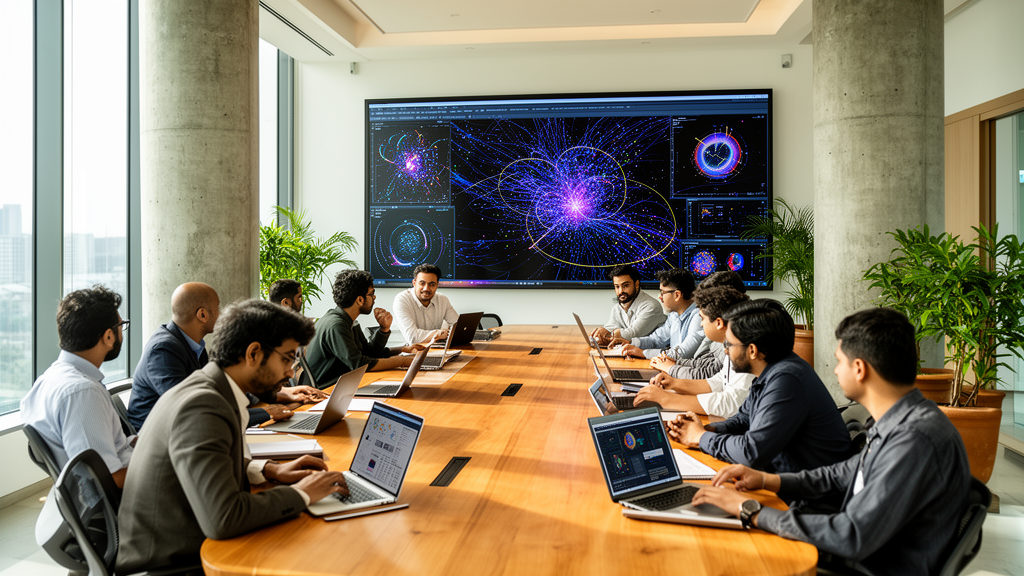
Physicists, computer scientists, and software engineers from around the world gathered at the Indian Institute of Science (IISc) in Bengaluru for the first hands-on workshop dedicated to Phlex, the next-generation software framework currently under development for the Deep Underground Neutrino Experiment (DUNE). The workshop was organized through a partnership involving Rice Global India, HSF-India, and DUNE-TECH, a Department of Energy-funded program focused on DUNE training and workforce development led by Rice University.
DUNE is designed to send an intense beam of neutrinos from Fermilab, located near Chicago, traveling 1,300 kilometers through the Earth to reach giant liquid-argon detectors situated nearly a mile underground in South Dakota. The primary scientific objective of this experiment is to observe how these neutrinos change during their journey, a phenomenon that researchers hope will help explain why the universe is composed of matter rather than antimatter.
Phlex, which stands for Parallel, Hierarchical and Layered EXecution of data-processing algorithms, is the specific software framework developed to address these computational challenges. The framework allows physicists to write their analysis algorithms once and run them efficiently across modern computing resources, streamlining the workflow for researchers involved in high-energy physics. During the workshop, attendees had the unique opportunity to use and explore Phlex as end-users, moving beyond theoretical understanding to practical application.
Kyle Knoepfel, a scientist at Fermi National Accelerator Laboratory and a developer of Phlex, noted that the workshop successfully demonstrated that the conceptual design of the framework is accessible to those who have not previously worked with data-processing systems. The event provided valuable feedback to the development team, enabling them to refine and improve the user experience based on direct input from the scientific community.
In addition to focusing on Phlex, the workshop included sessions on artificial intelligence and machine-learning libraries, which are becoming increasingly central to high-energy physics analysis. Participants also attended lectures on neutrinos and the broader scope of the DUNE experiment, providing a comprehensive educational environment.
Sudhir K. Vempati, a professor at IISc, highlighted the role of Rice Global India in bringing these communities together, creating a platform for engagement between Rice, IISc, and students and researchers across India. He emphasized that such gatherings provide opportunities for individuals to discover shared research interests and initiate conversations that could evolve into meaningful long-term partnerships.
Biswaranjan Behera, a fellow at IISc, stated that the workshop provided an excellent opportunity for the IISc DUNE group to develop expertise in Phlex and scientific computing. The group aims to translate this new knowledge into concrete contributions to the DUNE collaboration by building a sustainable research program at IISc.
Aaron Higuera, an assistant research professor at Rice and the lead organizer of the event, noted that the gathering brought together people from 15 different institutions across India. He described Rice University as the incubator that helped bring this research community together to engage with leading projects. The success of the workshop was also attributed to the close collaboration with the HSF-India project, which is a National Science Foundation initiative connecting collaborative networks in India with those in the U.S. and Europe to build the international partnerships necessary for next-generation particle, nuclear, and astroparticle physics experiments.
As DUNE moves toward its data-taking phase, the workshop played a vital role in building a community of scientists in India and beyond who are prepared to contribute to the experiment and its next-generation framework. Higuera added that the event also strengthened the research-software ties between India and the U.S., fostering a more integrated global scientific network.
Subject of Research: First hands-on workshop for the Phlex software framework used in the Deep Underground Neutrino Experiment
Article Title: Scientists gather in Bengaluru for first hands-on session with DUNE’s next-generation software framework Phlex
Article References: Scientists gather in Bengaluru for first hands-on session with DUNE’s next-generation software framework Phlex. Original publication (Bibliographic details unavailable.)
Image Credits: AI Generated
DOI: Not provided
Keywords: DUNE, Phlex, Neutrino Physics, Scientific Computing, IISc, Rice University, Data Processing, Particle Physics, International Collaboration, Scientists, gather, Bengaluru
News Source: Katie Riggs. (November 10, 2026). First Phlex workshop held in Bengaluru for DUNE scientists. Scienmag.