Scientists and natural resource managers from Canadian First Nations, governments, academic institutions, and conservation organizations published the first results of a unique salmon population monitoring tool in Frontiers in Marine Science. This groundbreaking new technology, dubbed “Salmon Vision,” combines artificial intelligence with age-old fishing weir technology. Early assessments show it to be remarkably adept at identifying and counting fish species, potentially enabling real-time salmon population monitoring for fisheries managers.
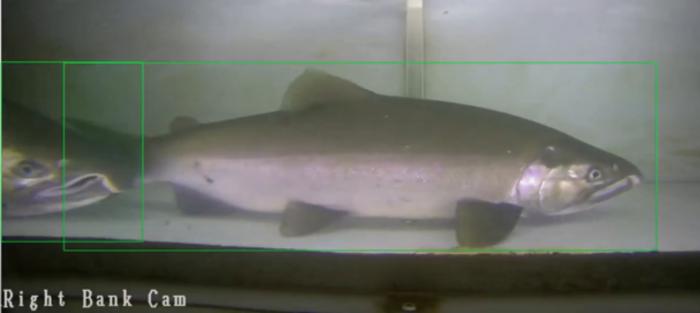
Credit: Wild Salmon Center
Scientists and natural resource managers from Canadian First Nations, governments, academic institutions, and conservation organizations published the first results of a unique salmon population monitoring tool in Frontiers in Marine Science. This groundbreaking new technology, dubbed “Salmon Vision,” combines artificial intelligence with age-old fishing weir technology. Early assessments show it to be remarkably adept at identifying and counting fish species, potentially enabling real-time salmon population monitoring for fisheries managers.
“In recent years, we’ve seen the promise of underwater video technology to help us literally see salmon return to rivers,” says lead author Dr. Will Atlas, Senior Watershed Scientist with the Portland-based Wild Salmon Center. “That dovetails with what many of our First Nations partners are telling us: that we need to automate fish counting to make informed decisions while salmon are still running.”
The Salmon Vision pilot study annotates more than 500,000 individual video frames captured at two Indigenous-run fish counting weirs on the Kitwanga and Bear Rivers of B.C.’s Central Coast.
The first-of-its-kind deep learning computer model, developed in data partnership with the Gitanyow Fisheries Authority and Skeena Fisheries Commission, shows promising accuracy in identifying salmon species. It yielded mean average precision rates of 67.6 percent in tracking 12 different fish species passing through custom fish-counting boxes at the two weirs, with scores surpassing 90 and 80 percent for coho and sockeye salmon: two of the principal fish species targeted by First Nations, commercial, and recreational fishers.
“When we envisioned providing fast grants for projects focused on Indigenous futurism and climate resilience, this is the type of project that we hoped would come our way,” says Dr. Keolu Fox, a professor at the University of California-San Diego, and one of several reviewers in an early crowdfunding round for the development of Salmon Vision.
Collaborators on the model, funded by the British Columbia Salmon Recovery and Innovation Fund, include researchers and fisheries managers with Simon Fraser University and Douglas College computing sciences, the Pacific Salmon Foundation, Gitanyow Fisheries Authority, and the Skeena Fisheries Commission. Following these exciting early results, the next step is to expand the model with partner First Nations into a half-dozen new watersheds on B.C.’s North and Central Coast.
Real-time data on salmon returns is critical on several fronts. According to Dr. Atlas, many fisheries in British Columbia have been data-poor for decades. That leaves fisheries managers to base harvest numbers on early-season catch data, rather than the true number of salmon returning. Meanwhile, changing weather patterns, stream flows, and ocean conditions are creating more variable salmon returns: uncertainty that compounds the ongoing risks of overfishing already-vulnerable populations.
“Without real-time data on salmon returns, it’s extremely difficult to build climate-smart, responsive fisheries,” says Dr. Atlas. “Salmon Vision data collection and analysis can fill that information gap.”
It’s a tool that he says will be invaluable to First Nation fisheries managers and other organizations both at the decision-making table—in providing better information to manage conservation risks and fishing opportunities—and in remote rivers across salmon country, where on-the-ground data collection is challenging and costly.
The Salmon Vision team is implementing automated counting on a trial basis in several rivers around the B.C. North and Central Coasts in 2023. The goal is to provide reliable real-time count data by 2024.
Journal
Frontiers in Marine Science
DOI
10.3389/fmars.2023.1200408
Method of Research
Experimental study
Subject of Research
Animals
Article Title
Wild salmon enumeration and monitoring using deep learning empowered detection and tracking
Article Publication Date
20-Sep-2023
COI Statement
The authors declare that the research was conducted in the absence of any commercial or financial relationships that could be construed as a potential conflict of interest.