


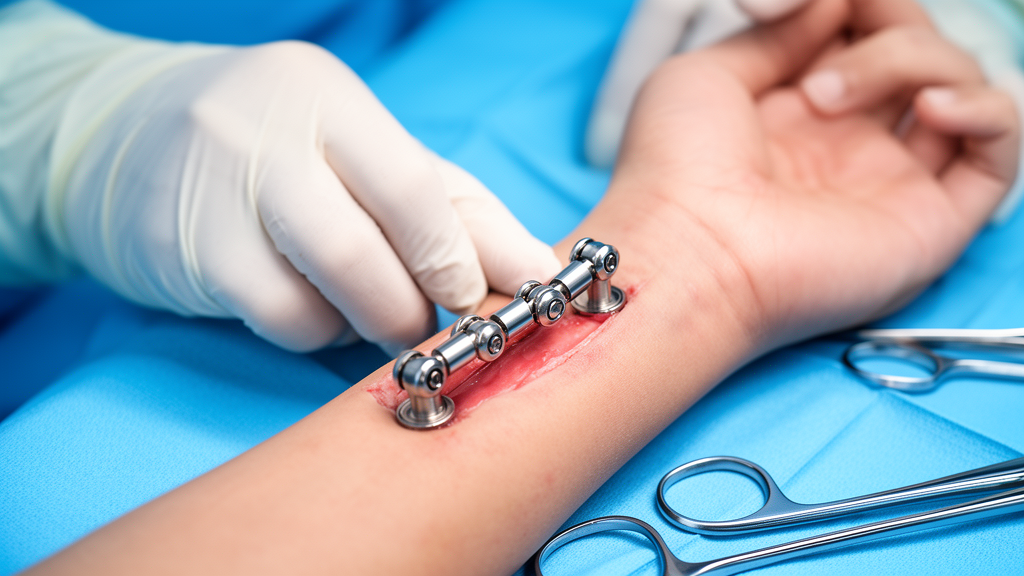
A first-in-human pilot study has reported early results for a novel total wrist arthroplasty implant built around two centers of rotation rather than the single pivot used by most contemporary designs. In five consecutive male patients with end-stage wrist arthritis, the bipolar dual-center device showed no radiographic loosening, migration, dislocation, or mechanical failure over a mean follow-up of 19.2 months, and every patient met the study’s predefined criteria for a meaningful clinical response. The findings, published in Archives of Orthopaedic and Trauma Surgery, mark the first clinical test of the dual-center concept, which its developers designed to preserve both radiocarpal and midcarpal motion while avoiding carpal fusion and extensive bone resection.
The rationale for the new design lies in the biomechanics of the native wrist. Unlike a simple hinge, the wrist is a composite of multiple articulations that work through coordinated radiocarpal and midcarpal motion, distributing load across the carpus during multiplanar movement. Most current total wrist arthroplasty systems rely on a single center of rotation and often require partial carpal fusion or substantial carpal bone removal. Although these designs can deliver acceptable pain relief, they do not fully reproduce native kinematics, and the resulting abnormal load transfer and altered carpal mechanics are thought to contribute to implant loosening and long-term mechanical failure, problems that have historically limited the procedure alongside instability and non-physiological load transfer.
The implant tested, called WristArt and manufactured by Fibioseq Medical in Israel, consists of cobalt-chromium-molybdenum and titanium components with articulation between a highly polished cobalt-chromium surface and a highly cross-linked, vitamin E-stabilized ultra-high molecular weight polyethylene insert. It incorporates two coordinated rotational centers: a midcarpal ball joint within the carpal component and a radiocarpal articulation between an elliptical surface and the radial component. The radial component carries an intramedullary stem and a dorsal fixation plate, the implant is universal for right and left wrists with a one-size-fits-all design, and the neck component comes in four sizes to adjust joint tension. The hypothesis was that this configuration would promote more physiological kinematics, reduce abnormal mechanical stress at the bone-implant interface, and provide early mechanical stability without sacrificing motion.
The study was a prospective single-center case series conducted at one institution between January and September 2024, with institutional review board approval and written informed consent from all participants. The five patients, with a mean age of 67.0 years, all had symptomatic end-stage wrist arthritis refractory to nonoperative treatment. Their diagnoses were post-traumatic osteoarthritis in one case, scapholunate advanced collapse wrist in two, scaphoid nonunion advanced collapse wrist in one, and severe primary wrist osteoarthritis in one. Three right and two left wrists were operated on. Patients with active infection, severe bone loss precluding fixation, inadequate bone stock defined as at least 50 percent capitate destruction or poor-quality radial bone, a history of complex regional pain syndrome or other chronic pain syndromes were excluded, and no patient with SLAC or SNAC wrist had undergone prior wrist surgery.
All procedures were performed by a single senior surgeon through a dorsal approach between the third and fourth extensor compartments. The lunate and proximal scaphoid were excised, a guidewire was passed through the capitate under fluoroscopic guidance, and the capitate and distal radius were prepared with dedicated reamers. Because the device is intended for cemented fixation, a medium-viscosity polymethyl methacrylate cement was vacuum-mixed and approximately 0.5 milliliters was applied to the radial and carpal bone-implant interfaces, filling residual gaps while minimizing extrusion; the thin cement mantle may not be visible on standard postoperative radiographs. Trial implantation assessed alignment and passive motion before final placement. A standardized rehabilitation protocol followed, with two weeks of splint immobilization, range-of-motion exercises from two weeks, a dart-throwing motion from day 21, passive mobilization and progressive strengthening between weeks 7 and 12, and lifting restricted to no more than 4 kilograms in that period and 5 kilograms thereafter.
Outcomes were collected prospectively at roughly 1, 3, 6, 12, and 24 months. Pain was measured with the pain subscale of the Patient-Rated Wrist Evaluation, normalized to a 0 to 10 scale by dividing the summed five-item score by five. Wrist-specific function used the PRWE total score, global upper-extremity disability the DASH questionnaire, and range of motion was measured goniometrically with the forearm in neutral rotation, with grip strength averaged over three trials per hand. Radiographs at each visit were assessed for alignment, fixation, loosening defined as radiolucent lines of at least 2 millimeters, subsidence, migration, dislocation, and component-related mechanical failure. A responder was defined hierarchically as a patient with both an improvement of at least 20 points in PRWE from baseline, exceeding the published minimum clinically important difference of 11.5 and falling within a meta-analytic range of 17 to 24, and the absence of radiographic loosening. Statistical analysis was descriptive, with no formal hypothesis testing given the exploratory design and small sample.
The results showed 100 percent implant survivorship, with no loosening, migration, dislocation, or revision on serial radiographs. One patient experienced a documented traumatic fall onto the operated wrist between the 1- and 3-month visits; his PRWE score transiently returned to baseline at 3 months before partial recovery, yet radiographs confirmed preserved implant alignment and fixation. One intraoperative capitate fracture occurred in a patient judged to have poor capitate bone quality; the defect was filled with cement and the carpal component stabilized without component exchange, with no subsequent migration or revision. Three patients with positive preoperative signs of carpal tunnel syndrome underwent secondary carpal tunnel release 4 to 8 months after arthroplasty, all with symptomatic improvement; the authors attributed this 60 percent rate of soft-tissue secondary procedures to the clinical overlay of median neuropathy in end-stage wrist arthropathy rather than a device-related adverse event. No patient required revision arthroplasty, implant removal, or conversion to wrist fusion.
Patient-reported outcomes improved substantially. The mean PRWE-derived pain score fell from 9.0 at baseline to 3.0 at the latest follow-up, a mean reduction of 6.1 points, with three patients achieving complete pain resolution. The mean PRWE total improved from 84.6 to 23.2, and the mean DASH score improved from 79.0 to 29.5, though with substantial inter-patient variability, with final DASH values ranging from 0 to 91.7. One patient showed a delayed recovery, with a functional plateau between 3 and 12 months followed by marked improvement between 12 and 24 months; the authors noted that possible contributors, including advanced age and variable adherence to occupational therapy, are post-hoc observations. Another patient met the wrist-specific responder threshold despite persistent upper-extremity limitations on DASH, a discordance the authors link to his traumatic fall and persistent symptoms. All five patients exceeded a PRWE improvement of 30 points, surpassing the upper bound of published minimum clinically important difference estimates. Mean flexion improved from 13 to 37 degrees and extension from 11 to 32 degrees, with radial deviation rising from 3.2 to 11 degrees and ulnar deviation from 6.6 to 10 degrees. Mean ipsilateral grip strength increased from 17.9 to 25.2 kilograms, with every patient exceeding baseline.
The authors are explicit that these results cannot be extrapolated to long-term performance. Because the implant does not rely on biological ingrowth, long-term stability depends entirely on the integrity of the cement-bone interface, the implant-cement interface, and the mechanical construct, so early radiographic stability does not reliably predict long-term survival, and the risk of late aseptic loosening under repetitive cyclic loading remains an open question. The study’s limitations are considerable: only five patients, all male, treated at a single center with heterogeneous indications, no control group receiving standard single-center arthroplasty or wrist fusion, variable follow-up with 24-month data for only three patients, and radiographs read by the operating surgeon rather than by an independent blinded adjudicator. The authors call for larger multicenter studies with longer follow-up, independent radiographic evaluation, and investigation of the device in patients with compromised bone quality such as rheumatoid arthritis, an intended indication from which patients with profound bone loss were excluded. Within those constraints, the pilot demonstrates technical feasibility and early mechanical stability of the dual-center concept, with all five patients achieving meaningful wrist-specific pain relief and functional improvement alongside stable implant fixation.
Subject of Research: First-in-human pilot study of a bipolar dual-center total wrist arthroplasty implant
Article Title: First-in-human prospective pilot study of a bipolar dual-center total wrist arthroplasty: early mechanical stability and clinical outcomes
Article References: Israeli, R., Gorelick, L., Gannot, G., & Oron, A. (2026). First-in-human prospective pilot study of a bipolar dual-center total wrist arthroplasty: early mechanical stability and clinical outcomes. Archives of Orthopaedic and Trauma Surgery, 146(1), Article 380. https://doi.org/10.1007/s00402-026-06493-z
Image Credits: AI Generated
DOI: 10.1007/s00402-026-06493-z
Keywords: total wrist arthroplasty, wrist arthritis, dual-center implant, first-in-human study, pilot study, implant loosening, PRWE, DASH, radiocarpal motion, midcarpal motion, orthopedic surgery, cemented fixation
News Source: Ophelia Keating. (October 28, 2026). First-in-human wrist implant with two rotation centers shows early stability in five patients. Scienmag.



