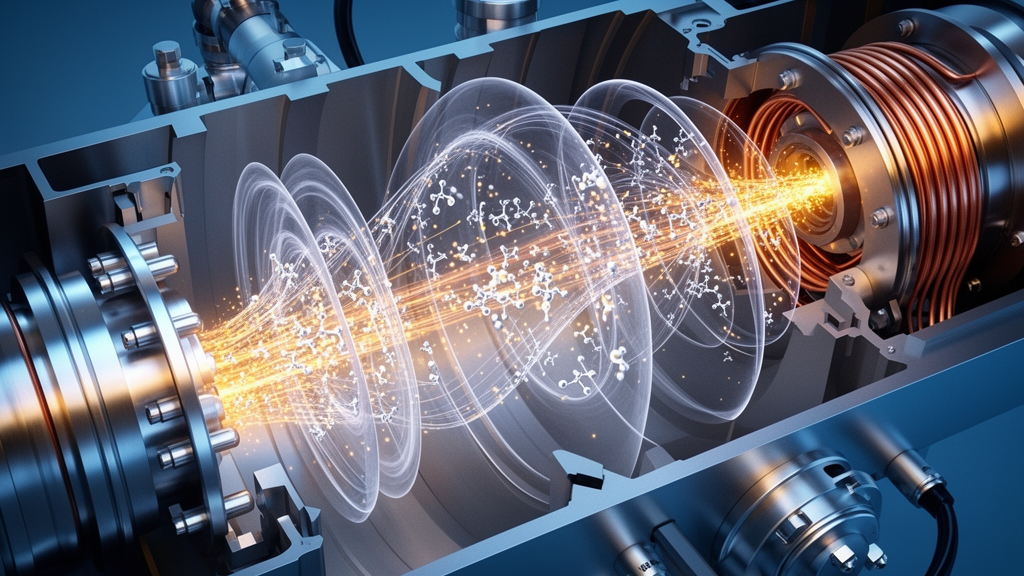
Every day, in pharmaceutical laboratories, food manufacturing plants and biomaterial research facilities around the world, an unassuming instrument called the Evaporative Light Scattering Detector quietly performs millions of chemical measurements. Known as the ELSD, this device is prized as a so-called universal detector because it can spot molecules that are invisible to conventional ultraviolet and infrared methods. Yet despite decades of routine use, no one had ever built a complete physical simulation of what actually happens inside it. That gap has now been closed. A team at the University of Cambridge has published the first comprehensive model of the ELSD, tracing the journey of a solvent spray from the instant it is atomized to the moment its dried particles scatter laser light, and the results have been validated against a purpose-built database of experiments.
The work, published in the journal Aerosol Research by Frederick Bertani, Joshua Hassim and Simone Hochgreb of the Department of Engineering, is the second part of a two-paper study. The companion paper described the experimental measurements; this one delivers the theoretical machinery. Together they provide something the field has never had: a predictive, physics-based tool that connects the knobs an operator turns, such as gas flow, liquid flow, analyte concentration and evaporator temperature, to the electrical signal that emerges at the detector. Until now, the literature contained no quantitative model of aerosol behaviour inside the ELSD that was sensitive to analyte volatility and varying flow rates, a striking omission for a technique so widely deployed.
The detector’s operating principle sounds deceptively simple. A chromatography column hands over a solution of separated analytes dissolved in a solvent. The solution is blasted into a fine mist by a high-speed gas jet, the droplets travel down a heated tube where the solvent evaporates, and the remaining dry particles of analyte are illuminated by a laser. A photodetector positioned at an angle to the beam measures the light scattered by the particle cloud, and that scattered intensity becomes the analytical signal. Because the method relies on scattering rather than absorption, it can detect compounds that do not absorb in the ultraviolet, visible or infrared ranges, which is precisely why industries from drug development to food processing depend on it.
Recreating this chain of events in software required the researchers to stitch together several demanding pieces of physics. The model is described as zero-dimensional, meaning it treats each section of the instrument as a series of connected modules rather than resolving the full three-dimensional geometry at every step. The first module generates the initial droplet distribution using an atomization model based on the geometry of the nebulizer, a twin-fluid coaxial SeaSpray device, together with the gas and liquid flow rates and fluid properties. Droplet sizes follow a log-normal distribution, characterized by a Sauter mean diameter that captures the ratio of droplet volume to surface area. The team anchored this stage in validated scaling laws from previous measurements of similar air-blast nebulizers, and refined the parameters with their own phase Doppler particle analysis and aerodynamic aerosol classification measurements described in the companion study.
Two modules then deal with a phenomenon that has an outsized effect on the final signal: droplet loss. As the high-speed spray leaves the nebulizer, it encounters a Y-shaped junction where large, sluggish droplets with too much inertia slam into the walls and are diverted to waste, while smaller droplets follow the gas streamlines onward. A diffuser cartridge made of rings and counter-rings acts as a second impaction trap. The physics here is governed by the Stokes number, the ratio of a particle’s characteristic stopping time to the flow’s characteristic time. Particles with a Stokes number below unity ride the flow around obstacles; heavier ones deviate and collide. The researchers determined the collection efficiency curves for both obstructions using computational fluid dynamics, fitting the results to an error-function form with a universal fifty-percent cutoff at a Stokes number of 0.49.
The computational fluid dynamics work was substantial in its own right. The team built a mesh of nearly 1.8 million cells from CAD drawings of the complete detector assembly, solved the steady-state gas flow with a realizable k-epsilon turbulence model, and tracked droplet trajectories with a Lagrangian discrete phase model. The simulations revealed gas velocities peaking near the sonic atomizer, where the gas exits at roughly 318 metres per second, and showed how particles become trapped in recirculation zones before reaching the outlet. Because droplets in the discrete phase model are treated as point sources, the team had to balance mesh refinement against the reliability of the method when droplet sizes approach the cell size, a well-known limitation of the approach.
The heart of the model is the evaporation module, which follows each droplet size class down the heated tube using the Abramzon and Sirignano droplet vaporization framework. The liquid is treated as a binary mixture of solvent and analyte, with each component evaporating independently until the droplet mass falls to the mass of the solute alone. The equations couple mass and energy transfer through Spalding transfer numbers, Sherwood and Nusselt correlations corrected for Stefan flow, and a Clausius-Clapeyron-based treatment of surface vapour pressure, including a Kelvin correction for the curvature of very small droplets. The researchers also tested whether thermophoresis, the thermal force that pushes particles away from hot walls, and diffusive deposition mattered; they found both negligible compared with convection and evaporation in this dilute, fast-flowing system.
The final module converts the dried particle distribution into a signal using Mie theory, the classical description of how spherical particles scatter monochromatic light. Because the scattering intensity scales with a high power of particle diameter, roughly the third to fourth power, most of the detected signal comes from the largest particles in the distribution. This has a direct and somewhat counterintuitive consequence for calibration: since higher analyte concentrations leave behind larger residual particles after drying, the signal rises with concentration first slowly and then steeply, a nonlinearity that the model reproduces naturally from first principles rather than through empirical fitting.
Validation against experiments revealed both triumphs and honest limitations. For a one gram per litre aqueous citric acid solution, chosen because its particles dry into known-density spheres, the model captured the dramatic shrinkage from micrometre-scale droplets to dried particles with a mode near 40 nanometres, and the predicted shape and width of the size distribution matched measurements closely once normalized. The predicted peak number concentration ran about thirty percent high, suggesting the model slightly underestimates impingement losses and evaporation rates. More importantly, the model correctly reproduced how the detector signal responds to analyte concentration and volatility across five evaporator temperatures from 25 to 100 degrees Celsius, predicting a negligible signal for the volatile ethylene glycol and rising signals for semi-volatile glycerol and non-volatile citric acid. It also captured how different solvents, including water, acetone, isopropanol and methanol, shift the response through their atomization properties, expressed neatly as a function of the Weber number. The one clear discrepancy appeared for non-volatile analytes at higher temperatures, where experiments showed a temperature dependence the model did not predict, pointing to physics yet to be identified.
The significance of this work extends well beyond a single instrument. The ELSD has been a workhorse since the 1980s, yet its users have relied on empirical calibration curves with no underlying physical picture. A validated model changes that calculus: manufacturers can now optimize detector geometry and operating conditions in silico, analysts can interpret anomalous signals by tracing them to droplet losses or incomplete drying, and the modular framework, built in MATLAB with minimal reliance on experimental constants, offers a template for simulating other spray-based analytical techniques. The authors note that the model has been transferred to their project co-sponsor and can be made available on request. For a device that has quietly underpinned quantitative chemistry for four decades, the arrival of its first complete physical simulation marks the moment an invisible workhorse finally became visible to theory.
Subject of Research: Physics-based simulation of aerosol transport, evaporation and light scattering in the Evaporative Light Scattering Detector
Article Title: Simulation of aerosol transport, evaporation and scattering in the Evaporative Light Scattering Detector – Part 2
Article References: Simulation of aerosol transport, evaporation and scattering in the Evaporative Light Scattering Detector – Part 2. (n.d.). https://doi.org/10.5194/ar-4-325-2026
Image Credits: AI Generated
Keywords: Evaporative Light Scattering Detector, aerosol dynamics, droplet evaporation, computational fluid dynamics, Mie scattering, chromatography detection, atomization, Stokes number, droplet impingement, analytical chemistry, University of Cambridge, Aerosol Research
News Source: Bethany Barker. (October 9, 2026). First-Ever Simulation Reveals the Hidden Physics Inside a Ubiquitous Chemistry Detector. Scienmag.