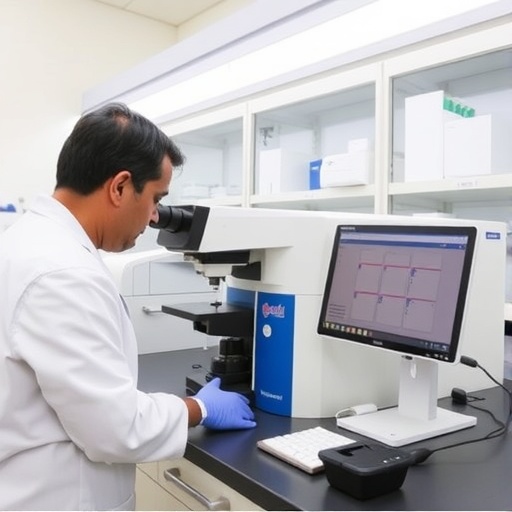
In a groundbreaking advancement that promises to deepen our understanding of fundamental particle interactions, researchers have achieved the first direct observation of the Migdal effect induced by neutron bombardment. This elusive phenomenon, long theorized but hardly ever witnessed, occurs during neutron–nucleus collisions, where the sudden recoil of a nucleus can lead to ionization of its surrounding electrons—a subtle quantum effect with significant implications for particle detection, especially in the search for dark matter.
The team employed a sophisticated gas mixture, primarily comprising carbon, hydrogen, and oxygen atoms, to study the differential cross-section of the Migdal effect in the soft limit of neutron scattering. Their theoretical framework integrates contributions from a range of neutron interaction processes, including elastic scattering, inelastic scattering, fission, and radiative capture. The transition probabilities for electron ionization, calculated from first principles using the Dirac–Hartree–Fock method, enabled precise prediction of the Migdal ionization spectra—remarkably consistent with their experimental findings.
To capture the faint signal associated with the Migdal effect, the researchers designed a highly sensitive detector unit, ingeniously sealed via brazing and laser welding to maintain exceptional gas tightness and mechanical stability. This detector, featuring a gas microchannel plate (GMCP) and a highly refined pixel chip mounted on a ceramic pedestal, operates within a carefully controlled environment. With layers of ceramic and Kovar alloys, the detector minimizes external contamination and optimizes electron detection sensitivity, reinforced by rigorous calibration protocols employing a 5.9-keV ^55Fe source.
Integral to this achievement was the electronic architecture supporting data acquisition. The system divided functionalities across front-end, back-end, and high-voltage boards. The front-end hosted the gas pixel detector and its readout circuitry, while the back-end incorporated an FPGA controller with fault tolerance mechanisms ensuring uninterrupted operation. The high-voltage board not only powered the GMCP but also processed electron arrival pulses to enhance timing and energy resolution, crucial for identifying faint ionization tracks.
The data processing hinged on an ingenious compression algorithm to handle vast data volumes produced by the 2D imaging of microscopic interactions. Utilizing a difference compression technique, the system efficiently flagged and transmitted pixels with meaningful signals for further analysis, thus enabling real-time capture of subtle electron and nuclear recoil events with 262 ns coincidence timing. This precision allowed the discrimination of Migdal events amidst myriad backgrounds.
Detector calibration extended beyond energy resolution to spatial precision, where a deconvolution method quantified the position resolution with an average of 200 μm. This exquisite spatial resolution was vital when reconstructing nuclear recoil (NR) and electron recoil (ER) tracks, permitting distinction between overlapping ionization signals that characterize the Migdal effect. The detector’s response linearity and resolution followed expected physical scaling, confirming the reliability of the experimental setup.
Simulation efforts were equally meticulous. Leveraging the Star-XP software framework built upon GEANT4, the researchers modeled neutron interactions with unparalleled accuracy, incorporating high fidelity neutron collision data and simulating ionization and charged particle propagation in gas media. The simulations extended to the full detector assembly, including structural materials and shielding, to realistically capture background processes and validate experimental signal attribution.
Precise measurement and monitoring of the neuronal flux and energy spectrum from a deuterium–deuterium neutron generator were accomplished using an EJ309 liquid scintillator detector. Through sophisticated calibration and pulse shape discrimination, the team effectively separated neutron signals from gamma backgrounds and successfully unfolded the true neutron spectrum, which peaked sharply at 2.5 MeV as anticipated. This characterization was critical for correlating detected events with neutron impact parameters.
During extensive experimental runs, systematic monitoring ensured environment stability and detector performance consistency. Notably, the count rates between the neutron flux monitor and the Migdal detector remained well correlated, while periodic gain calibrations with the ^55Fe source confirmed energy scale stability. Continuous checks of chamber pressure and temperature verified the detector’s airtightness and gas integrity amid experimentation.
To distinguish the faint Migdal electron signals from the overwhelming array of nuclear recoil tracks, the team adopted machine learning advances, particularly leveraging the YOLOv8 model architecture. Training across thousands of experimental and simulated track images, this deep learning model achieved exceptional accuracy—over 99%—in classifying ER and NR events. This automated track recognition facilitated the identification of candidate Migdal events displaying spatially coincident electron and nuclear recoil signatures.
Building upon this, a novel event selection algorithm refined track reconstruction by iteratively fitting the NR track as a Gaussian-diffused linear trajectory while subtracting its influence to isolate nearby ER signals. Applying spatial proximity criteria and stringent endpoint analyses, the team effectively filtered genuine Migdal events from accidental track overlaps or background contaminants, resulting in a confident detection of several candidate Migdal scatters.
The comprehensive background analysis underpinned the statistical significance of the observation. Accounting for delta electron production, particle-induced X-ray emissions, various bremsstrahlung processes, and accidental coincidences, the researchers employed a combination of data-driven and GEANT4 simulations. These efforts demonstrated background rates orders of magnitude below the detected signal, with neutron activation and trace radioactive contaminants also critically assessed and found negligible.
Taking into account quenching effects—which describe the reduced ionization signal from nuclear recoils compared to electrons—the team incorporated TRIM-derived quenching factors into their simulations and data interpretation, ensuring the accurate estimation of energy depositions and signal efficiencies. This consideration was pivotal, given the different ionization yields among gas components.
Finally, the statistical treatment utilized the profile likelihood method to rigorously evaluate the significance of the detected events. Using a combination of Poisson and Gaussian models for signal and background counts respectively, the analysis achieved a confidence level exceeding five standard deviations. This milestone firmly establishes the presence of the Migdal effect in neutron–nucleus scattering, marking a pivotal experimental validation predicted decades ago.
This historic observation not only opens new avenues in direct dark matter detection—where Migdal-induced electron signals can lower energy thresholds—but also enhances our fundamental grasp of atomic responses to nuclear recoils. With refined detectors and analysis techniques demonstrated here, future experiments will further elucidate the role of the Migdal effect in rare event searches and nuclear physics alike.
Subject of Research: Direct experimental observation and analysis of the Migdal effect induced by neutron–nucleus scattering.
Article Title: Direct observation of the Migdal effect induced by neutron bombardment.
Article References:
Yi, D., Liu, Q., Chen, S. et al. Direct observation of the Migdal effect induced by neutron bombardment.
Nature 649, 580–583 (2026). https://doi.org/10.1038/s41586-025-09918-8
Tags: advanced detector technologydark matter detection methodsdifferential cross-section analysisDirac-Hartree-Fock calculationsexperimental particle physics breakthroughsgas mixture experiments in physicsionization processes in nucleiMigdal effect detectionneutron bombardment effectsneutron-nucleus collision studiesparticle interactions researchquantum effects in particle physics