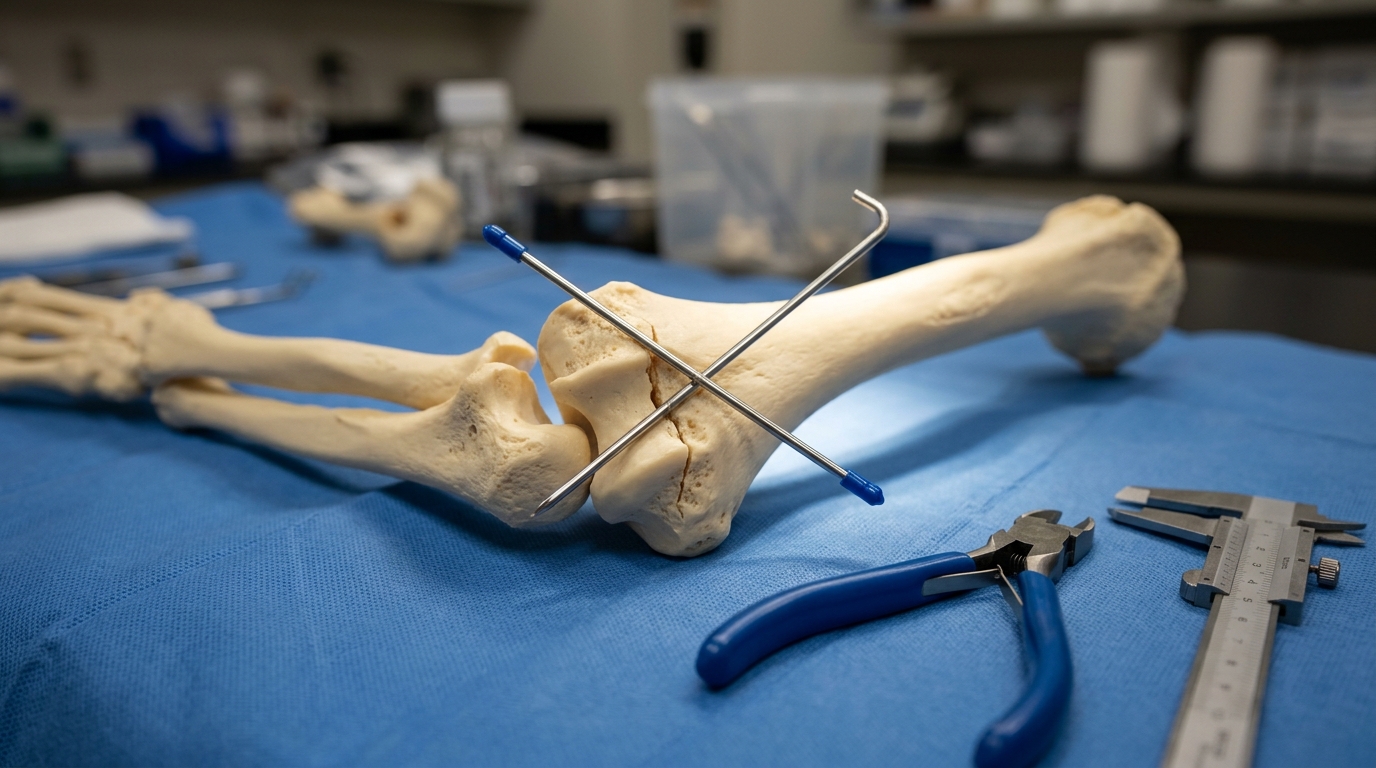
Finite element analysis has demonstrated that the biomechanical stability of crossed Kirschner wire (K-wire) fixation in supracondylar humerus fractures depends directly on the fracture level. In a computational investigation evaluating wire configurations across different fracture heights, researchers identified distinct mechanical stability profiles, establishing a biomechanical basis for personalized surgical planning in pediatric elbow fractures.
To assess stability characteristics, the researchers constructed 27 types of finite element models displaying various insertion angles of crossed K-wires across low, middle, and high fracture levels of supracondylar humerus fractures. Across these simulated configurations, the computational analysis evaluated equivalent (von Mises) stress, equivalent elastic strain, and total construct deformation.
The finite element analysis demonstrated distinct biomechanical characteristics across the different fracture levels. For low fractures, smaller insertion angles for the crossed K-wires provided more favorable biomechanical performance. For middle fractures, a configuration combining a larger lateral insertion angle with a smaller medial insertion angle appeared to offer superior mechanical stability. For high fractures, crossed fixation using large insertion angles on both sides showed more favorable biomechanical characteristics.
The study established a biomechanical relationship between fracture level and the optimal configuration of crossed K-wire fixation in supracondylar humerus fractures. The authors noted that these findings can serve as a reference for optimizing fixation techniques and pin configurations according to fracture height.
Subject of Research: Biomechanical finite element analysis of crossed Kirschner wire fixation for supracondylar humerus fractures
Article Title: Biomechanical comparison of crossed Kirschner wires fixation for supracondylar humerus fractures at different fracture lines: finite element analysis and exploration of the optimal fixed angle
Article References: Deng, Y., Guo, Y., Wang, Y., Bi, Y., Cao, Y., Huang, M., & Guo, Z. (2026). Biomechanical comparison of crossed Kirschner wires fixation for supracondylar humerus fractures at different fracture lines: finite element analysis and exploration of the optimal fixed angle. BMC Musculoskeletal Disorders. https://doi.org/10.1186/s12891-026-10719-x
Image Credits: AI Generated
DOI: 10.1186/s12891-026-10719-x
Keywords: supracondylar humerus fractures, Kirschner wires, finite element analysis, biomechanics, orthopedic surgery, fracture fixation, pediatric fractures, von Mises stress, Biomechanical, comparison, crossed, Kirschner
News Source: Ophelia Keating. (November 6, 2026). Finite Element Study Evaluates Crossed Wire Fixation Angles for Supracondylar Fractures. Scienmag.