• HOME
  • NEWS
  • EXPLORE
    • CAREER
      • Companies
      • Jobs
    • EVENTS
    • iGEM
      • News
      • Team
    • PHOTOS
    • VIDEO
    • WIKI
  • BLOG
  • COMMUNITY
    • FACEBOOK
    • INSTAGRAM
    • TWITTER
Thursday, November 12, 2026
BIOENGINEER.ORG
No Result
View All Result
  • Login
  • HOME
  • NEWS
  • EXPLORE
    • CAREER
      • Companies
      • Jobs
        • Lecturer
        • PhD Studentship
        • Postdoc
        • Research Assistant
    • EVENTS
    • iGEM
      • News
      • Team
    • PHOTOS
    • VIDEO
    • WIKI
  • BLOG
  • COMMUNITY
    • FACEBOOK
    • INSTAGRAM
    • TWITTER
No Result
View All Result
Bioengineer.org
No Result
View All Result
Home NEWS Science News Technology

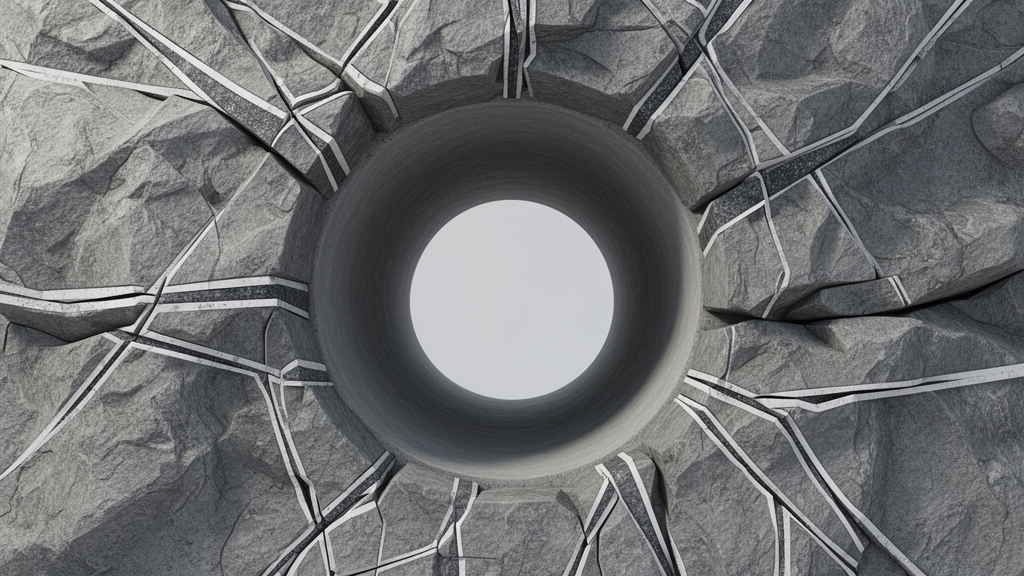
Filled Joint Defects Shape Rock Deformation Around Underground Circular Openings

by
November 8, 2026
in Technology
Reading Time: 2 mins read
0
Filled Joint Defects Shape Rock Deformation Around Underground Circular Openings

Filled Joint Defects Shape Rock Deformation Around Underground Circular Openings

Share on FacebookShare on TwitterShare on LinkedinShare on RedditShare on Telegram

Biaxial compression tests under low lateral confinement reveal that the geometric configuration of through-going filled fissures strongly dictates load-bearing capacity, deformation localization, and failure evolution around circular underground openings. Investigating how surrounding sandstone behaves when an opening coexists with a filled weak discontinuity, researchers tested two single-factor experimental series alongside intact and single-hole reference groups. The first test series evaluated fissure inclinations of 10°, 15°, and 20° at a constant filling thickness of 2 mm, while the second examined filling thicknesses of 2, 5, and 10 mm at a constant inclination of 15°.

The core methodological contribution of the investigation centered on simultaneously characterizing the global mechanical response, local deformation at the roof and floor of the circular hole, acoustic emission (AE) activity, and the evolution of tensile–shear AE sources. By combining these measurement streams, the experimental setup established direct empirical links between defect geometry, overall load-bearing performance, and localized structural instability in the surrounding rock mass.

Mechanical testing demonstrated that fissure geometry heavily influenced peak compressive strength and the timing of localized failure. For specimens tested at a 15° fissure inclination, measured peak strengths reached 43.16 MPa for a 2 mm filling thickness, 48.96 MPa for a 5 mm thickness, and 47.90 MPa for a 10 mm thickness. In comparison, tests conducted at a constant 2 mm filling thickness produced peak strengths of 53.47 MPa at a 10° inclination, 43.16 MPa at 15°, and 55.61 MPa at 20°. The specimen combining a 15° inclination with a 2 mm filling thickness, designated s-15-2, developed the largest local deformation concentration and the earliest local instability around the circular hole. In contrast, the specimen with a 15° inclination and a 5 mm filling thickness (s-15-5) achieved a relatively high peak strength, delayed roof instability, and restricted floor deformation.

Monitoring acoustic emissions demonstrated that joint thickness shifts the underlying damage process toward interfacial sliding. Increasing the filling thickness markedly elevated middle-to-late-stage AE activity, with shear-type AE event proportions reaching 67.5% under the 5 mm condition and 63.9% under the 10 mm condition. These shifts indicate that thicker filled discontinuities increasingly govern rock degradation through shear-related sliding along interfaces. Overall, the findings differentiate the separate influences of hole-induced stress concentration and filled-fissure geometry on load-bearing limits, deformation localization, and AE-source transitions, offering an experimental foundation for identifying unstable zones around openings adjacent to filled weak discontinuities.

Subject of Research: Rock mechanics and deformation around underground openings with filled joints

Article Title: Effects of persistent joints on the strain failure of the roof and floor around a circular opening

Article References: Deng, H., Shen, J., Xu, J., & Liu, Y. (2026). Effects of persistent joints on the strain failure of the roof and floor around a circular opening. Discover Applied Sciences. https://doi.org/10.1007/s42452-026-09854-w

Image Credits: AI Generated

DOI: 10.1007/s42452-026-09854-w

Keywords: rock mechanics, underground openings, persistent joints, sandstone deformation, acoustic emission, biaxial compression, shear failure, structural stability, Effects, persistent, joints, strain

News Source: Denise Maddox. (November 8, 2026). Filled Joint Defects Shape Rock Deformation Around Underground Circular Openings. Scienmag.


Tags: acoustic emissionbiaxial compressioneffectsjointspersistentpersistent jointsrock mechanicssandstone deformationshear failurestrainStructural stabilityunderground openings
Share12Tweet7Share2ShareShareShare1

Related Posts

RGA-MalNet Architecture Detects Malware With High Accuracy Across Benchmark Datasets

RGA-MalNet Architecture Detects Malware With High Accuracy Across Benchmark Datasets

November 12, 2026
Curved Surfaces Reduce Fluid Drag in Williamson Nanofluid Bioconvection Models

Curved Surfaces Reduce Fluid Drag in Williamson Nanofluid Bioconvection Models

November 12, 2026

Two-Stage Framework Predicts Hospital Length of Stay Using Inpatient Records

November 12, 2026

Deep Learning Architecture Shows High Uncertainty on Physical Education Student Dataset

November 12, 2026

POPULAR NEWS

  • Ternary Spinel Nanocomposite Yields High Capacitance but Shows Moderate Cycling Retention

    Ternary Spinel Nanocomposite Yields High Capacitance but Shows Moderate Cycling Retention

    29 shares
    Share 12 Tweet 7
  • Uranium Isotopes Converge in Metamict Uranopolycrase Heated to Extreme Temperatures

    29 shares
    Share 12 Tweet 7
  • Four-Hour Glycation Optimizes Soy Protein and Polysaccharide Conjugate Structure and Function

    29 shares
    Share 12 Tweet 7
  • Multi-Trait Screening Identifies Productive Ganoderma Strains with Lower Resource Intensity

    29 shares
    Share 12 Tweet 7

About

We bring you the latest biotechnology news from best research centers and universities around the world. Check our website.

Follow us

Recent News

Perspective Proposes RUC Revaluation Task Force to Address Primary Care Underpayment

Rural Living Shapes Distinct Health Inequity Factors During Older Age

Lower BDNF in Diabetes Associates With Hearing Loss but Shows Subgroup Limits

Subscribe to Blog via Email

Enter your email address to subscribe to this blog and receive notifications of new posts by email.

Join 86 other subscribers
  • Contact Us

Bioengineer.org © Copyright 2023 All Rights Reserved.

Welcome Back!

Login to your account below

Forgotten Password?

Retrieve your password

Please enter your username or email address to reset your password.

Log In
No Result
View All Result
  • Homepages
    • Home Page 1
    • Home Page 2
  • News
  • National
  • Business
  • Health
  • Lifestyle
  • Science

Bioengineer.org © Copyright 2023 All Rights Reserved.