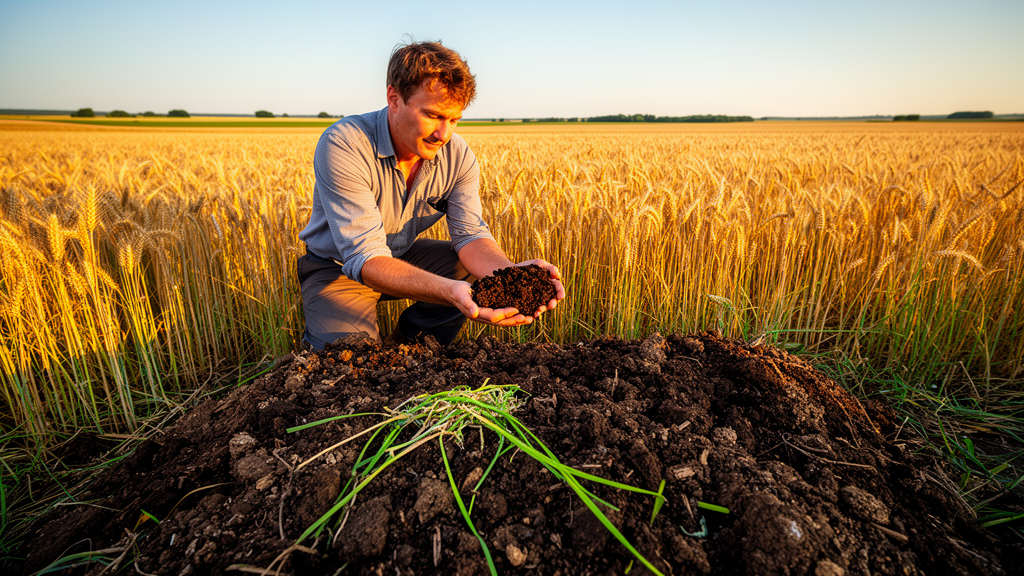
A four-year agronomic field trial evaluating spring wheat production on degraded agricultural land in Norway demonstrates that amending soil with high-quality compost significantly increases crop yields while actively rebuilding depleted soil organic matter and revitalizing biological activity. Reporting in the journal Frontiers in Sustainable Food Systems, researchers compared the performance of three spring wheat genotypes managed with either farm-made organic compost amendments or standard commercial pelleted chicken manure. The empirical investigation revealed that integrating biological soil measurements and carbon accounting into farm economic performance assessments provides a viable mechanism to eliminate the traditional trade-off between short-term farm profitability and long-term soil ecosystem health, offering an empirical pathway for operationalizing the principles of ecological economics in crop management.
The study addresses a pervasive global and continental challenge documented by the European Commission, which estimates that 60 to 70 percent of agricultural soils across the European Union are currently degraded, with projections suggesting that 90 percent could reach degraded status by 2050 if current management models persist. Globally, approximately 33 percent of all agricultural soils are categorized as moderately to highly degraded. From the perspective of ecological economics, conventional farm accounting concentrates strictly on immediate contribution margins defined by yearly crop revenues minus direct variable costs, neglecting the depletion of underlying soil natural capital. Over historical agriculture, an estimated 150 to 170 gigatonnes of soil organic carbon have been consumed without economic accounting, including an ongoing loss rate of approximately 1.6 gigatonnes per year over the past 160 years. When management focuses exclusively on maximizing annual crop harvest, soil degradation becomes an unaccounted latent cost carried across generations, ultimately pushing agricultural ecosystems toward critical collapse thresholds.
To investigate practical mechanisms for reversing this decline, the research team established a replicated block field experiment starting in 2021 within the pedo-climatic zone BOREAL 8 in Norway, characterized by a cool temperate continental climate influenced by the Gulf Stream with an average growing season of 177 days above 5 degrees Celsius. The experimental site featured degraded silty sand and sandy silt soils with very low baseline nutrient reserves, a starting volume weight of 1.4 kilograms per liter, an initial loss-on-ignition value of 2.7 percent total solids, and historical grain yields averaging below 700 kilograms per hectare. Across three replicated experimental blocks of 14-square-meter plots, the researchers cultivated three distinct spring wheat genotypes: an ancient emmer wheat variety named Gotland hvit, a historical common wheat landrace known as Dala, and a modern common wheat variety designated Mirakel. All genotypes were subjected to two distinct soil management strategies across cropping seasons in 2021, 2022, and 2024, separated by a resting restorative year in 2023 when a multi-species green manure cover crop was established across all plots.
The experimental treatments were carefully designed to provide comparable levels of total applied nitrogen across management regimes while contrasting the physical and biological nature of the nutrient sources. Plots receiving commercial organic management were supplied strictly with pelleted chicken manure at rates delivering 80 kilograms of total nitrogen per hectare in 2021 and 120 kilograms per hectare in 2022, 2023, and 2024. The compost treatment received 40 tons per hectare of windrow compost prepared from cattle and sheep bedding with straw in 2021, followed in 2022 and 2023 by 30 tons per hectare of compost supplemented with 500 kilograms per hectare of pelleted chicken manure to reach equivalent target nitrogen levels. In 2024, the compost plots were treated with a specialized formulated soil amendment termed Symbiotika alongside 1,000 kilograms per hectare of pelleted manure. Over the cumulative 2021 to 2024 experimental cycle, commercial control plots received 440 kilograms of total nitrogen, 165 kilograms of phosphorus, and 275 kilograms of potassium per hectare, while compost plots received 430 kilograms of total nitrogen, 141 kilograms of phosphorus, and 229 kilograms of potassium per hectare.
Agronomic harvest assessments revealed substantial and statistically significant yield gains across the compost-amended plots. Statistical evaluation utilizing two-sample t-tests and general linear analysis of variance demonstrated that wheat cultivated with compost produced a mean yield of 1,137 kilograms per hectare with a standard deviation of 392 across 27 plot harvests, compared to a mean of 665 kilograms per hectare with a standard deviation of 405 in the commercial fertilizer group. This difference represents a statistically significant mean yield increase of 472 kilograms per hectare, supported by a 95 percent confidence interval spanning 254 to 690 kilograms per hectare and a large standardized effect size reflected by a Cohen’s d of 1.18 and Hedges’ g of 1.16. Factorial analysis of variance indicated significant main effects for experimental year, wheat genotype, and compost treatment, with the statistical model accounting for 79.94 percent of the total variation in crop yield. Although yield levels varied across cultivation years, compost application consistently delivered yield advantages across ancient, landrace, and modern genotypes.
Beyond volumetric grain yield, laboratory evaluations at the Norwegian University of Life Sciences revealed pronounced enhancements in grain mineral composition and total nutritional yields. Analysis of whole-meal flour samples using near-infrared spectroscopy and inductively coupled plasma mass spectrometry showed significant differences in protein, iron, zinc, and molybdenum concentrations. While the initial compost application in 2021 yielded micronutrient concentrations comparable to commercial control plots, repeated annual compost amendments in 2022 and 2024 generated marked increases in zinc and iron yields per hectare, which are essential dietary elements across Nordic populations. Molybdenum concentrations exhibited an immediate three- to four-fold elevation in compost-treated grains across all trial years without a year-by-treatment interaction. Because molybdenum serves as an indispensable enzymatic cofactor for plant nitrogen assimilation, the correction of baseline soil molybdenum deficiency from sub-optimal concentrations up into the healthy physiological range between 0.1 and 0.5 parts per million in soil contributed directly to enhanced plant vigor and nitrogen-use efficiency.
Soil organic matter dynamics, evaluated through repeated standardized loss-on-ignition testing to a 20-centimeter topsoil depth, showed divergent trajectories between the experimental treatments over the trial period. Plots receiving routine commercial pelleted chicken manure experienced a slight contraction in soil organic matter, declining from the initial baseline of 2.7 percent down to a mean of 2.619 percent total solids by 2024. In contrast, plots managed with organic compost amendments achieved a statistically significant increase in soil organic matter, reaching an average of 2.881 percent total solids. A two-sample t-test confirmed a significant mean difference of 0.263 percent total solids between treatments with a 95 percent confidence interval from 0.136 to 0.390 percent. General linear modeling affirmed that the positive effect of compost on loss on ignition was statistically robust across crop genotypes, indicating that regular compost application successfully reversed structural carbon depletion within degraded topsoil.
To capture biological dynamics that remain undetected by standard chemical soil testing, the researchers tracked subterranean microbial ecology using the Biological Soil Health Index developed by Smartsoil Biotech AS. The index analyzes composite root zone samples through amplicon sequencing targeting the 16S ribosomal RNA gene for bacteria and the 18S ribosomal RNA gene for eukaryotic organisms, synthesizing data across nine distinct indicators into an unweighted arithmetic composite score scaled from 1 to 10 against a database of approximately 1,000 reference soils. In two-sample comparisons between management regimes across 2022 and 2024, the composite index score averaged 5.797 in compost plots compared to 5.147 in control plots. A general linear model confirmed that biological health scores in compost plots exhibited a statistically significant upward trajectory between 2022 and 2024. Taxonomic profiling demonstrated that compost enrichment elevated the relative abundance of resilient Firmicutes capable of producing endospores and chitin-degrading enzymes, enhanced lignin-degrading Actinobacteria, and substantially suppressed the relative abundance of plant-parasitic and pathogenic eukaryotes in the wheat root zone.
Translating these physical and biological measurements into economic outcomes, the authors applied a holistic accounting model that integrated commodity crop revenue, variable input expenditures, carbon balance valuation, and public ecosystem stewardship payments over the crop rotation cycle. Assuming baseline wheat prices of 10.5 Norwegian kroner per kilogram for emmer, 6.5 for Dala landrace, and 5.5 for Mirakel modern wheat, average gross grain revenue across genotypes totaled 25,266 kroner per hectare with compost versus 15,450 kroner with commercial manure. Applying an anticipated 2030 Norwegian carbon tax benchmark of 2,000 kroner per ton of carbon dioxide equivalent, net soil carbon accumulation under compost management was valued at a positive stewardship return of 18,482 kroner per hectare, whereas soil carbon losses under commercial pelleted fertilizer represented an economic liability of 8,214 kroner per hectare. Factoring in Norway’s regional environmental program benefit of 3,500 kroner per hectare annually for spreading farm-made compost and deducting input costs, the holistic contribution margin for compost management yielded a net surplus of 22,498 kroner per hectare, compared to a net deficit of 12,014 kroner per hectare under conventional organic pelleted fertilization.
The study authors emphasize that these findings represent an illustrative pilot trial conducted on degraded boreal soil, requiring verification across diverse soil classifications, differing initial organic matter baselines, and broader geographic settings. Furthermore, while the Biological Soil Health Index provides a responsive early-warning metric for tracking biological transitions, its long-term technical reproducibility across independent external datasets continues to undergo active validation. The researchers also caution that organic compost represents a finite biomass resource at regional scales, underscoring that broader implementation of regenerative management relies heavily on advanced societal recycling of organic waste streams and policy frameworks that reward farmers for ecosystem restoration rather than treating soil degradation as an unpriced external cost.
Subject of Research: Holistic economic assessment and soil regeneration in wheat production using compost amendments
Article Title: Toward a holistic assessment of economic performance in agricultural plant production
Article References: Næss, A., Jakobsen, O. D., Hjerde, E., Haugerud, Ø., & Shalchian-Tabrizi, K. (2026). Toward a holistic assessment of economic performance in agricultural plant production. Frontiers in Sustainable Food Systems, 10, Article 1933893. https://doi.org/10.3389/fsufs.2026.1933893
Image Credits: AI Generated
DOI: 10.3389/fsufs.2026.1933893
Keywords: soil health, ecological economics, compost application, wheat cultivation, carbon sequestration, microbiome analysis, regenerative agriculture, soil organic matter, Toward, holistic, assessment, economic
News Source: Alan Morgan. (November 9, 2026). Field Trial Shows Compost Application Boosts Grain Yields and Soil Regeneration. Scienmag.