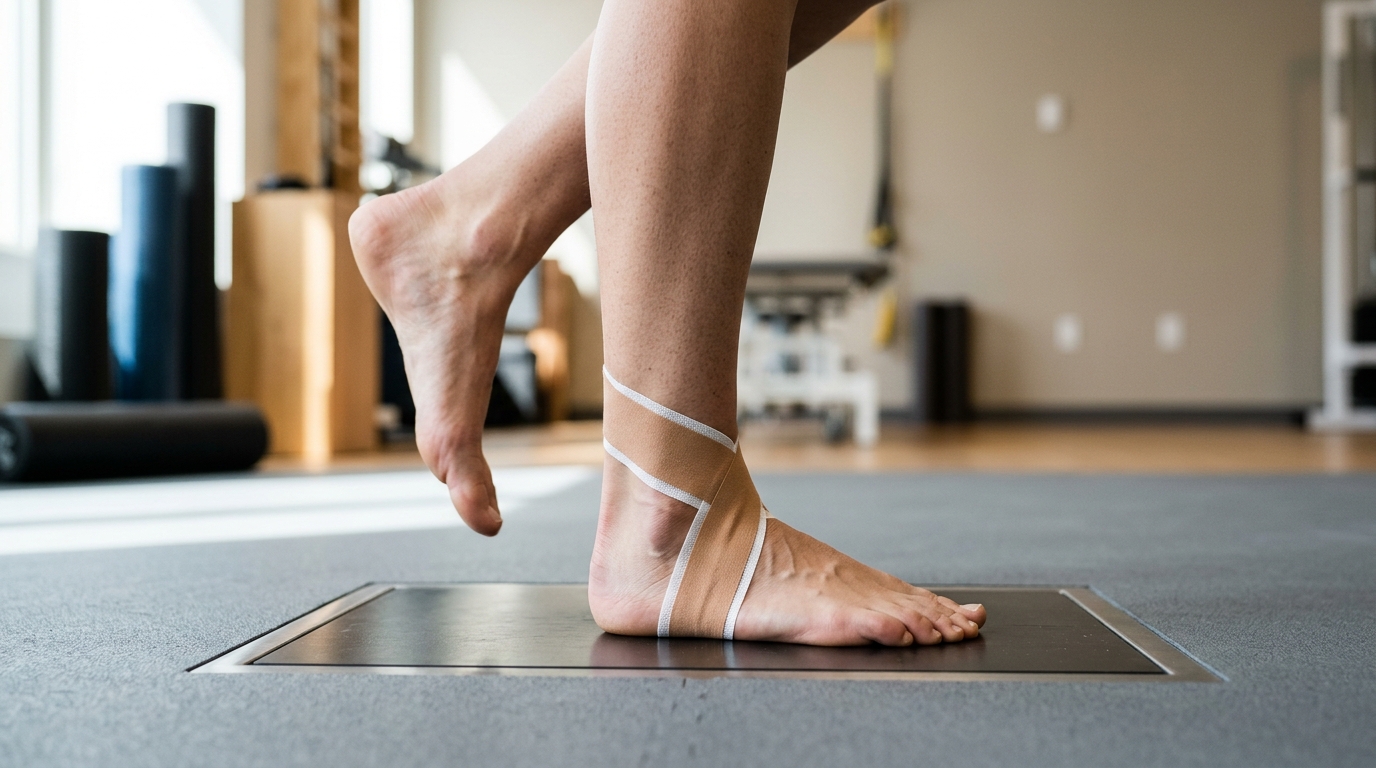
A recent randomized controlled trial published in BMC Sports Science, Medicine and Rehabilitation investigated the acute physical performance effects of fibular repositioning taping (FRT) in healthy young adults. Fibular repositioning taping is intended to enhance ankle stability and proprioceptive input, but its immediate effects on task-specific physical performance in healthy individuals remain unclear.
Researchers recruited 90 healthy participants, aged 18 to 30 years, and randomly allocated them into three distinct groups: those receiving the FRT intervention, those receiving a sham taping procedure, and a control group that received no intervention. Investigators conducted assessments at baseline and 30 minutes post-intervention to measure dynamic balance through the Y-Balance composite score, as well as athletic performance metrics including single-leg hop distance, single-leg countermovement jump height, and 10-meter sprint speed.
Regarding the primary outcome of dynamic balance, the study identified no statistically significant difference between the FRT group and the sham taping group. Although initial change-score analysis indicated that the FRT group experienced greater improvements compared to the control group, these findings were not substantiated when the researchers conducted a more rigorous baseline-adjusted analysis of covariance (ANCOVA) to account for initial scores.
In contrast, the secondary measures yielded more distinct results regarding athletic performance indicators. The trial reported significant group-by-time interactions for both single-leg countermovement jump performance and 10-meter sprint times. Specifically, participants in the FRT group exhibited greater short-term improvements in both jumping and sprinting performance compared to participants in both the sham and control groups under the standardized testing conditions of the trial.
The investigation also evaluated single-leg hop performance, where no statistically significant interaction was observed. The researchers noted that these secondary findings were exploratory in nature and served primarily to generate hypotheses for future research. They emphasized that while the improvements in jump and sprint performance were statistically significant within the scope of this study, these results require further validation through subsequent investigations.
The randomized trial maintained an equal allocation ratio across three parallel arms, assigning sixty women and thirty men. Statistical evaluations relied on repeated measures analysis of variance to test group by time interactions across testing intervals, supplemented by Bonferroni adjusted pairwise comparisons when appropriate. Primary outcome metrics showed a mean difference in change of 2.80 between taping and sham application, with a 95 percent confidence interval from minus 0.88 to 6.48 and a p-value of .199. When comparing the taping group to controls, the mean difference in change reached 4.49, spanning a 95 percent confidence interval of 0.82 to 8.17 with a p-value of .011. Overall interaction testing for dynamic balance yielded an F ratio of 4.542, a p-value of .013, and a partial eta squared of .095, though baseline adjusted analysis of covariance demonstrated non-significant values of .155 against sham and .251 against control.
Analysis of secondary jumping and sprinting metrics demonstrated distinct interaction patterns across the experimental cohorts. The single-leg countermovement jump produced an F ratio of 9.446, a p-value below .001, and an effect size of .178. The ten-meter sprint assessment yielded an F ratio of 13.873, a p-value below .001, and an effect size of .242. Single-leg hop performance showed no significant interaction, recording an F ratio of 2.210, a p-value of .116, and an effect size of .048. Trial registration was completed retrospectively on ClinicalTrials.gov under identifier NCT07604090.
Subject of Research: Acute physical performance effects of fibular repositioning taping in healthy young adults.
Article Title: Acute effects of fibular repositioning taping on balance, jumping, and sprint performance in healthy individuals: a randomized controlled trial
Article References: Günay, S. M., Şahi̇n, B., Sayaca, Ç., & Özkal Değirmenci, Ö. (2026). Acute effects of fibular repositioning taping on balance, jumping, and sprint performance in healthy individuals: a randomized controlled trial. BMC Sports Science, Medicine and Rehabilitation. https://doi.org/10.1186/s13102-026-02265-9
Image Credits: AI Generated
DOI: 10.1186/s13102-026-02265-9
Keywords: fibular repositioning taping, athletic performance, randomized controlled trial, healthy adults, jump performance, sprint performance, Y-Balance, ankle stability, proprioception, physical therapy, sports science, human performance, kinesiology, exercise physiology, motor control, tape intervention, countermovement jump
News Source: Ophelia Keating. (November 18, 2026). Fibular Repositioning Taping Shows No Significant Dynamic Balance Benefit. Scienmag.