Researchers have built a fiber-based optoelectronic system that learns to stabilize a simulated temperature against periodic heat pulses, using a neuro-inspired rule borrowed from biology rather than the fixed gains of a conventional controller. In a study published in Frontiers of Optoelectronics, Silvia Ortín, Moritz Pflüger and Apostolos Argyris describe an optical dendritic unit (ODU) constructed from single-mode fiber, semiconductor optical amplifiers and fast photodetection, which applies the input correlation (ICO) learning rule—a form of Hebbian learning—in a closed-loop control task. The work is a proof of concept for a virtual temperature stabilization problem, not yet a demonstration on a physical thermal system, but it shows how photonic hardware could eventually handle control challenges that outpace traditional electronics.
The motivation comes from a gap in control engineering. Everyday temperature control relies on PID (proportional-integral-derivative) controllers, whose operational bandwidth of up to a few kilohertz is adequate for slow-changing temperatures in ordinary environments. But some processes, including laser ablation, laser annealing of thin films, semiconductor manufacturing, superconducting quantum systems, fusion reactors, high-speed electronics and nanotechnology, can induce localized heating and cooling on microsecond timescales or faster, in the kilohertz to megahertz range, where conventional PID controllers become inadequate. Digital ASIC-based and FPGA-based controllers are increasingly explored as solutions, and optoelectronic systems, which can operate at gigahertz frequencies with low latency, high bandwidth and immunity to electromagnetic interference, offer another route.
The team’s approach embeds learning directly into the control architecture. The ICO rule is a Hebbian algorithm tailored for control systems: instead of relying on feedback from the system’s output, it adjusts the weights of its inputs based solely on correlations among the input signals themselves. In the formalism used by the authors, the change of the weight for a given input is driven by the correlation between that input and the derivative of a reference, or tutor, signal. The tutor input carries the temperature error—the difference between the measured and desired temperature—while other inputs are filtered versions of a predictive disturbance signal detected before it affects the temperature. By correlating the error with the disturbance, the system learns to begin cooling as soon as a heat pulse is detected, rather than waiting for the temperature to rise. This anticipatory behavior contrasts with a standard PID controller, whose gains remain constant during operation and which reacts only after an error has appeared.
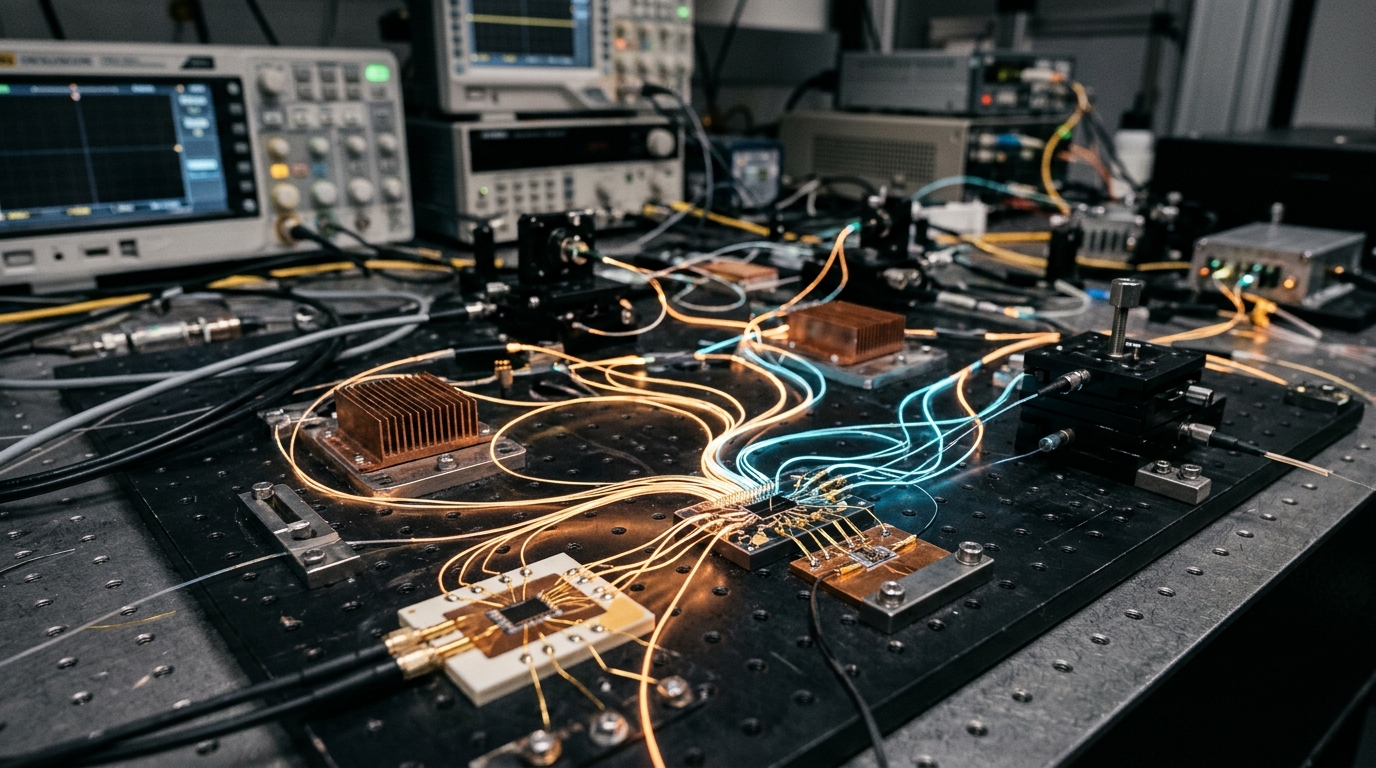
The physical substrate of the controller is a single-mode fiber optical dendritic unit with four dendritic branches, an architecture inspired by the branching input structure of biological neurons. An incoherent optical carrier at 1550 nm, generated by a 40 mW superluminescent diode and filtered to a 1.5 nm bandwidth to suppress chromatic dispersion, is modulated by a 10 GHz Mach–Zehnder modulator and split into four optical paths. Each path contains a semiconductor optical amplifier (SOA); in the three plastic branches, the SOAs are operated as modulators whose bias currents are driven by weight signals, so that the optical multiplication of input by weight happens physically in the hardware. Fiber spools of increasing length—1, 1.5, 2 and 2.5 kilometers—time-align the multiplexed signals at a 4×1 optical coupler, where the branch outputs are summed incoherently and detected by a 20 GHz photoreceiver.
The system runs at 1 GHz signaling and sampling rates, with input encoding performed by an arbitrary waveform generator sampling at 10 GSa/s and output recording on a real-time oscilloscope with 16 GHz analog bandwidth. The learning itself, however, is not yet fully in hardware: the ICO rule is computed digitally on a conventional computer from the experimental output of the optoelectronic system, and the resulting weights are sent back to the waveform generator over Ethernet. That processing step typically takes a few seconds, far slower than the optical dynamics. Even so, because the computed output is fed back into the plastic properties of the ODU’s physical substrate, the authors characterize the operation as autonomous learning. They note that future hardware implementations of the rule, using FPGAs or ASICs and optical conversion of the error and alarm signals, could eliminate the communication delay and enable continuous real-time stabilization at up to 1 GHz.
Before building the hardware, the team ran numerical simulations of a hypothetical temperature control task. A system with a desired temperature of 44 °C is periodically disturbed by heat pulses lasting 12 time steps and repeating every 120 time steps, with a predictive sensor detecting each pulse 6 time steps before it affects the temperature. In the simulation, the disturbance raises the temperature by 0.8 °C per unit, while the control output reduces it by 0.2 °C per unit. After the first disturbance pulse, the temperature oscillates within about 5 °C of the desired value; after a few pulses, as the ICO rule adapts the weights, the oscillation shrinks to a range of about 1.5 °C. The simulations also showed that, at the optimal control gain for each case, the ICO learning configuration produced a maximum temperature deviation 1.4 times lower than a system without ICO learning, along with smoother and less intensive heating and cooling cycles.
The experimental closed-loop run then put the fiber system to work on the same task. Over 1000 iteration steps, the photodetected output of the ODU was recorded, preprocessed to remove background noise, rescale the amplitude and compensate for a non-zero optical bias introduced by the incoherent summation, and then used to update the plastic weights for the next epoch. The processed experimental output closely matched the numerical prediction, with fitting parameters of 448 per volt for the scaling factor and 1.79 for the bias term, though slight deviations remained due to measurement noise and the incoherent nature of the optical summation. Both the numerical model and the physical system converged after a few learning cycles, and both eventually held the temperature near the 44 °C target: the experiment kept the temperature between 42.4 °C and 44.6 °C, while the model predicted a slightly narrower range of 42.5 °C to 44.5 °C.
The experiment also demonstrated robustness to variations in the physical system’s parameters. When the researchers biased the encoding modulator at a different operating point, producing a significantly larger output amplitude, the system still achieved a similar evolution of the plastic weights and of the stabilized temperature, once the preprocessing parameters were adjusted accordingly—with a scaling factor of 287 per volt and a bias term of 1.05 in that configuration. Only three plastic dendritic branches with exclusively positive weights were used, a constraint imposed by the electrical modulation that introduces the plasticity rules, and the first branch served as the fixed-weight reference for the learning rule. The authors also note that the numerical model suggests stabilization could still be achieved for larger disturbance strengths if the weights are adjusted proportionally, though the stabilized temperature range would widen.
Beyond temperature, the researchers point out that the ICO rule and the ODU architecture could be adapted to other dynamic control tasks where correlating an error signal with a predictive alarm signal is useful. Prior applications of ICO learning include mobile robot obstacle avoidance, where a proximity sensor’s alarm signal is correlated with a collision sensor’s error signal, and active noise cancellation, where the rule contributes to generating an anti-noise signal. The flexibility of correlating error and alarm inputs makes the approach a candidate for various real-time adaptive control applications, provided the signals are defined appropriately and the parameters are tuned.
For now, the achievement is a learning-and-control demonstration in a virtual task executed by real photonic hardware, with the temperature dynamics simulated numerically and the weight updates computed off-line on a PC. The authors frame the result as a step toward an all-hardware solution: optimizing the feedback loop speed and embedding the ICO rule directly in hardware would be the final steps toward a real-time platform operating at up to 1 GHz bandwidth, capable of continuous stabilization for the ultrafast thermal fluctuations that conventional electronic controllers cannot track.
Subject of Research: Autonomous optoelectronic temperature control using Hebbian ICO learning in a fiber-based optical dendritic unit
Article Title: Temperature stabilization with Hebbian learning using an autonomous optoelectronic dendritic unit
Article References: Ortín, S., Pflüger, M., & Argyris, A. (2025). Temperature stabilization with Hebbian learning using an autonomous optoelectronic dendritic unit. Frontiers of Optoelectronics, 18(1), Article 7. https://doi.org/10.1007/s12200-025-00151-9
Image Credits: AI Generated
DOI: 10.1007/s12200-025-00151-9
Keywords: optoelectronics, Hebbian learning, ICO learning rule, temperature stabilization, optical dendritic unit, semiconductor optical amplifiers, closed-loop control, neuromorphic computing, fiber optics, photonic signal processing, adaptive control, PID controller alternative
News Source: Denise Maddox. (November 5, 2026). Fiber-Based Optical Dendritic Unit Learns to Stabilize Temperature with Hebbian Rules. Scienmag.