• HOME
  • NEWS
  • EXPLORE
    • CAREER
      • Companies
      • Jobs
    • EVENTS
    • iGEM
      • News
      • Team
    • PHOTOS
    • VIDEO
    • WIKI
  • BLOG
  • COMMUNITY
    • FACEBOOK
    • INSTAGRAM
    • TWITTER
Saturday, February 7, 2026
BIOENGINEER.ORG
No Result
View All Result
  • Login
  • HOME
  • NEWS
  • EXPLORE
    • CAREER
      • Companies
      • Jobs
        • Lecturer
        • PhD Studentship
        • Postdoc
        • Research Assistant
    • EVENTS
    • iGEM
      • News
      • Team
    • PHOTOS
    • VIDEO
    • WIKI
  • BLOG
  • COMMUNITY
    • FACEBOOK
    • INSTAGRAM
    • TWITTER
  • HOME
  • NEWS
  • EXPLORE
    • CAREER
      • Companies
      • Jobs
        • Lecturer
        • PhD Studentship
        • Postdoc
        • Research Assistant
    • EVENTS
    • iGEM
      • News
      • Team
    • PHOTOS
    • VIDEO
    • WIKI
  • BLOG
  • COMMUNITY
    • FACEBOOK
    • INSTAGRAM
    • TWITTER
No Result
View All Result
Bioengineer.org
No Result
View All Result
Home NEWS Science News Chemistry

Ferroelectric material is now fatigue-free

Bioengineer by Bioengineer
June 6, 2024
in Chemistry
Reading Time: 2 mins read
0
The sliding ferroelectricity endows ferroelectric materials with fatigue-free features
Share on FacebookShare on TwitterShare on LinkedinShare on RedditShare on Telegram

Researchers at the Ningbo Institute of Materials Technology and Engineering (NIMTE) of the Chinese Academy of Sciences, in collaboration with research groups from the University of Electronic Science and Technology of China and Fudan University, have developed a fatigue-free ferroelectric material based on sliding ferroelectricity.
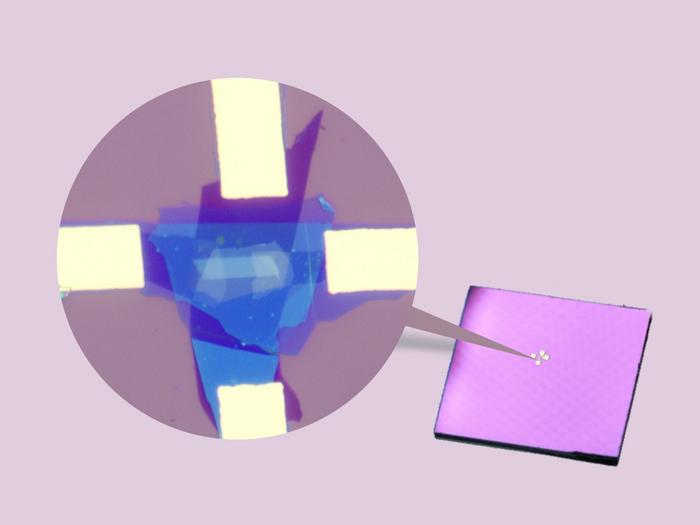
The sliding ferroelectricity endows ferroelectric materials with fatigue-free features

Credit: NIMTE

Researchers at the Ningbo Institute of Materials Technology and Engineering (NIMTE) of the Chinese Academy of Sciences, in collaboration with research groups from the University of Electronic Science and Technology of China and Fudan University, have developed a fatigue-free ferroelectric material based on sliding ferroelectricity.

The study was published in Science.

Ferroelectric materials have switchable spontaneous polarization that can be reversed by an external electric field, which have been widely applied to non-volatile memory, sensing, and energy conversion devices.

Due to the inherited ionic motion of ferroelectric switching, ferroelectric polarization fatigue inevitably occurs in conventional ferroelectric materials as the number of polarization reversal cycles increases. This can lead to performance degradation and device failure, thus limiting the practical applications of ferroelectric materials.

To solve this fatigue problem, the researchers developed a fatigue-free ferroelectric system based on sliding ferroelectricity. A bilayer 3R-MoS2 dual-gate device was fabricated using the chemical vapor transport method.

After 106 switching cycles with different pulse widths ranging from 1 ms to 100 ms, the ferroelectric polarization dipoles showed no loss, indicating that the device still retained its memory performance.

Compared with commercial ferroelectric devices, this device exhibits a superior total stress time of 105 s in an electric field, demonstrating its excellent endurance.

By means of a novel machine-learning potential model, theoretical calculations revealed that the fatigue-free property of sliding ferroelectricity can be attributed to its immobile charged defects.

This work provides an innovative solution to the problematic performance degradation of conventional ferroelectrics.

The study was supported by the National Natural Science Foundation of China and the Zhejiang Provincial Natural Science Foundation of China, among others.


Journal

Science

DOI

10.1126/science.ado1744

Method of Research

Experimental study

Subject of Research

Not applicable

Article Title

Developing fatigue-resistant ferroelectrics using interlayer sliding switching

Article Publication Date

6-Jun-2024

Share12Tweet8Share2ShareShareShare2

Related Posts

blank

Breakthrough in Environmental Cleanup: Scientists Develop Solar-Activated Biochar for Faster Remediation

February 7, 2026
blank

Cutting Costs: Making Hydrogen Fuel Cells More Affordable

February 6, 2026

Scientists Develop Hand-Held “Levitating” Time Crystals

February 6, 2026

Observing a Key Green-Energy Catalyst Dissolve Atom by Atom

February 6, 2026

POPULAR NEWS

  • Robotic Ureteral Reconstruction: A Novel Approach

    Robotic Ureteral Reconstruction: A Novel Approach

    82 shares
    Share 33 Tweet 21
  • Digital Privacy: Health Data Control in Incarceration

    63 shares
    Share 25 Tweet 16
  • Study Reveals Lipid Accumulation in ME/CFS Cells

    57 shares
    Share 23 Tweet 14
  • Breakthrough in RNA Research Accelerates Medical Innovations Timeline

    53 shares
    Share 21 Tweet 13

About

We bring you the latest biotechnology news from best research centers and universities around the world. Check our website.

Follow us

Recent News

Succinate Receptor 1 Limits Blood Cell Formation, Leukemia

Palmitoylation of Tfr1 Drives Platelet Ferroptosis and Exacerbates Liver Damage in Heat Stroke

Oxygen-Enhanced Dual-Section Microneedle Patch Improves Drug Delivery and Boosts Photodynamic and Anti-Inflammatory Treatment for Psoriasis

Subscribe to Blog via Email

Enter your email address to subscribe to this blog and receive notifications of new posts by email.

Join 73 other subscribers
  • Contact Us

Bioengineer.org © Copyright 2023 All Rights Reserved.

Welcome Back!

Login to your account below

Forgotten Password?

Retrieve your password

Please enter your username or email address to reset your password.

Log In
No Result
View All Result
  • Homepages
    • Home Page 1
    • Home Page 2
  • News
  • National
  • Business
  • Health
  • Lifestyle
  • Science

Bioengineer.org © Copyright 2023 All Rights Reserved.