Experiment on beta-decay sheds light on fate of intermediate-mass stars
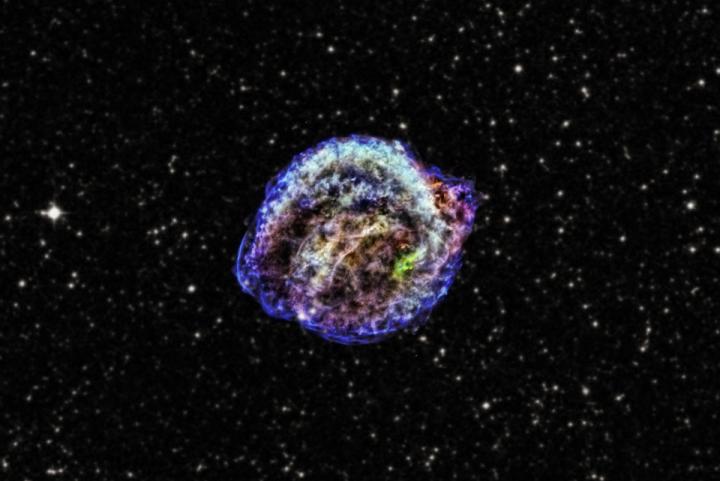
Credit: Picture: X-ray: NASA/CXC/NCSU/M. Burkey et al.; Optical: DSS
A group of scientists, among them several from GSI Helmholtzzentrum für Schwerionenforschung and from Technical University of Darmstadt, succeeded to experimentally determine characteristics of nuclear processes in matter ten million times denser and 25 times hotter than the centre of our Sun. A result of the measurement is that intermediate-mass stars are very likely to explode, and not, as assumed until now, collapse. The findings are now published in the scientific magazine Physical Review Letters. They stress the fascinating opportunities offered by future accelerator facilities like FAIR in understanding the processes defining the evolution of the Universe.
Stars have different evolutionary paths depending on their mass. Low-mass stars such as the Sun will eventually become white dwarfs. Massive stars, on the other hand, finish with a spectacular explosion known as a supernova, leaving either a neutron star or a black hole behind. The fate of both low- and high-mass stars is well understood but the situation for intermediate-mass stars, which weigh between seven and eleven times as much as the Sun, has remained unclear. This is surprising since intermediate-mass stars are prevalent in our Galaxy.
“The final fate of intermediate-mass stars depends on a tiny detail, namely, how readily the isotope neon-20 captures electrons in the stellar core. Depending on this electron capture rate, the star will be either disrupted in a thermonuclear explosion or it will collapse to form a neutron star,” explains Professor Gabriel Martínez-Pinedo of GSI’s research department Theory and the Institut für Kernphysik, TU Darmstadt. Professor Karlheinz Langanke, Research Director of GSI and FAIR, adds: “This work started when we realized that a strongly suppressed, and hence previously ignored and experimentally unknown, transition between the ground states of neon-20 and fluorine-20 was a key piece of information needed to determine the electron capture rate in intermediate mass stars.” By a combination of precise measurements of the beta-decay of fluorine-20 and theoretical calculations, an international collaboration of physicists with participation from GSI and TU Darmstadt, has now succeeded in determining this important rate. The experiment took place under conditions far more peaceful than those found in stars, namely at the Accelerator Laboratory of the University of Jyväskylä. The measurements showed a surprisingly strong transition between the ground states of neon-20 and fluorine-20 that leads to electron capture in neon-20 occurring at lower density than previously believed. For the star, this implies that, in contrast to previous assumptions, it is more likely to be disrupted by a thermonuclear explosion than to collapse into a neutron star. “It is amazing to find out that a single transition can have such a strong impact on the evolution of a big object like a star,” says Dag Fahlin Strömberg, who, as a PhD student at TU Darmstadt, was responsible for large parts of project’s simulations.
Since thermonuclear explosions eject much more material than those triggered by gravitational collapse, the results have implications for galactic chemical evolution. The ejected material is rich in titanium-50, chromium-54, and iron-60. Therefore, the unusual titanium and chromium isotopic ratios found in some meteorites, and the discovery of iron-60 in deep-sea sediments could be produced by intermediate-mass stars and indicate that these have exploded in our galactic neighbourhood in the distant (billions of years) and not so distant (millions of years) past.
In the light of these new findings the most probable fate of intermediate-mass stars seems to be a thermonuclear explosion, producing a subluminous type Ia supernova and a special type of white dwarf star known as an oxygen-neon-iron white dwarf. The (non-)detection of such white dwarfs in the future would provide important insights into the explosion mechanism. Another open question is the role played by convection — the bulk movement of material in the interior of the star — in the explosion.
At existing and future accelerator centres like the international FAIR project (Facility for Antiproton and Ion Research) currently under construction at GSI, new not yet investigated isotopes and their properties can be investigated. Thus, scientists continue to bring the universe into the laboratory to answer the unsolved questions about our cosmos.
###
Media Contact
Dr. Ingo Peter
[email protected]
49-615-971-1500
Original Source
https:/
Related Journal Article
http://dx.