• HOME
  • NEWS
  • EXPLORE
    • CAREER
      • Companies
      • Jobs
    • EVENTS
    • iGEM
      • News
      • Team
    • PHOTOS
    • VIDEO
    • WIKI
  • BLOG
  • COMMUNITY
    • FACEBOOK
    • INSTAGRAM
    • TWITTER
Friday, April 10, 2026
BIOENGINEER.ORG
No Result
View All Result
  • Login
  • HOME
  • NEWS
  • EXPLORE
    • CAREER
      • Companies
      • Jobs
        • Lecturer
        • PhD Studentship
        • Postdoc
        • Research Assistant
    • EVENTS
    • iGEM
      • News
      • Team
    • PHOTOS
    • VIDEO
    • WIKI
  • BLOG
  • COMMUNITY
    • FACEBOOK
    • INSTAGRAM
    • TWITTER
  • HOME
  • NEWS
  • EXPLORE
    • CAREER
      • Companies
      • Jobs
        • Lecturer
        • PhD Studentship
        • Postdoc
        • Research Assistant
    • EVENTS
    • iGEM
      • News
      • Team
    • PHOTOS
    • VIDEO
    • WIKI
  • BLOG
  • COMMUNITY
    • FACEBOOK
    • INSTAGRAM
    • TWITTER
No Result
View All Result
Bioengineer.org
No Result
View All Result
Home NEWS Science News Chemistry

Exploring the origins of life

Bioengineer by Bioengineer
August 4, 2023
in Chemistry
Reading Time: 3 mins read
0
New model for self-organizing catalytic molecules
Share on FacebookShare on TwitterShare on LinkedinShare on RedditShare on Telegram

One possible scenario for the origin of life is the spontaneous organization of interacting molecules into cell-like droplets. These molecular species would form the first self-replicating metabolic cycles, which are ubiquitous in biology and common throughout all organisms. According to this paradigm, the first biomolecules would need to cluster together through slow and overall inefficient processes. Such slow cluster formation seems incompatible with how quickly life has appeared. Scientists from the department of Living Matter Physics from MPI-DS have now proposed an alternative model that explains such cluster formation and thus the fast onset of the chemical reactions required to form life.
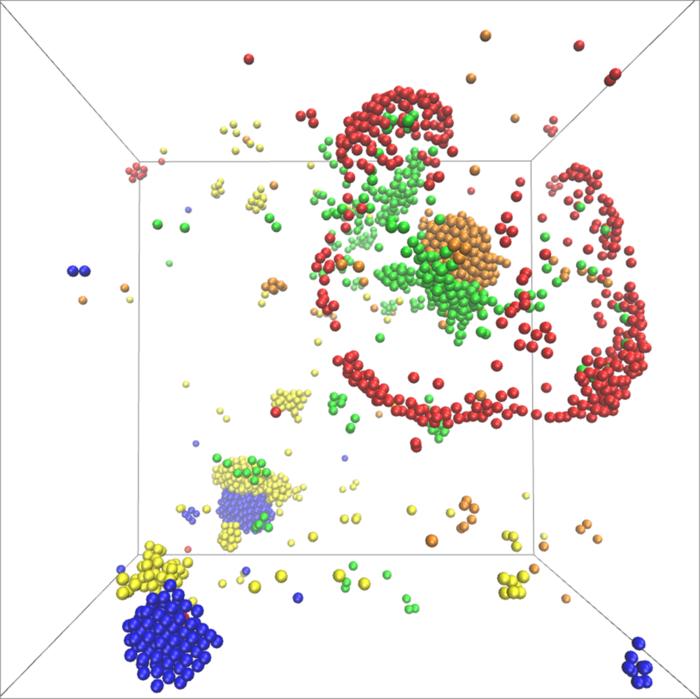
New model for self-organizing catalytic molecules

Credit: MPI-DS / LMP

One possible scenario for the origin of life is the spontaneous organization of interacting molecules into cell-like droplets. These molecular species would form the first self-replicating metabolic cycles, which are ubiquitous in biology and common throughout all organisms. According to this paradigm, the first biomolecules would need to cluster together through slow and overall inefficient processes. Such slow cluster formation seems incompatible with how quickly life has appeared. Scientists from the department of Living Matter Physics from MPI-DS have now proposed an alternative model that explains such cluster formation and thus the fast onset of the chemical reactions required to form life.

“For this, we considered different molecules, in a simple metabolic cycle, where each species produces a chemical used by the next one,” says Vincent Ouazan-Reboul, the first author of the study. “The only elements in the model are the catalytic activity of the molecules, their ability to follow concentration gradients of the chemicals they produce and consume, as well as the information on the order of molecules in the cycle,” he continues. Consequently, the model showed the formation of catalytic clusters including various molecular species. Furthermore, the growth of clusters happens exponentially fast. Molecules hence can assemble very quickly and in large numbers into dynamic structures.

“In addition, the number of molecule species which participate in the metabolic cycle plays a key role in the structure of the formed clusters,” Ramin Golestanian, director at MPI-DS, summarizes: “Our model leads to a plethora of complex scenarios for self-organization and makes specific predictions about functional advantages that arise for odd or even number of participating species. It is remarkable that non-reciprocal interactions as required for our newly proposed scenario are generically present in all metabolic cycles.”

In another study, the authors found that self-attraction is not required for clustering in a small metabolic network. Instead, network effects can cause even self-repelling catalysts to aggregate. With this, the researchers demonstrate new conditions in which complex interactions can create self-organized structures.

Overall, the new insights of both studies add another mechanism to the theory of how complex life once emerged from simple molecules, and more generally uncover how catalysts involved in metabolic networks can form structures.


Journal

Nature Communications

DOI

10.1038/s41467-023-40241-w

Method of Research

Computational simulation/modeling

Subject of Research

Cells

Article Publication Date

26-Jul-2023

Share12Tweet8Share2ShareShareShare2

Related Posts

Rice scientists uncover novel metal-oxygen binding mechanism, opening a ‘new chapter’ in chemistry

Rice scientists uncover novel metal-oxygen binding mechanism, opening a ‘new chapter’ in chemistry

April 10, 2026
“’Poor Man’s Majoranas’ as Quantum Spin Probes: A New Frontier in Quantum Science”

“’Poor Man’s Majoranas’ as Quantum Spin Probes: A New Frontier in Quantum Science”

April 9, 2026

Revealing Unexpected Discoveries on Hydroxyl Radical Chemistry at BESSY II

April 9, 2026

Crystalline/Amorphous Bi-BiNiOx Electrocatalyst Drives Efficient Simultaneous Formate Production from CO2 and Methanol

April 9, 2026

POPULAR NEWS

  • Boosting Breast Cancer Risk Prediction with Genetics

    46 shares
    Share 18 Tweet 12
  • Popular Anti-Aging Compound Linked to Damage in Corpus Callosum, Study Finds

    44 shares
    Share 18 Tweet 11
  • Imagine a Social Media Feed That Challenges Your Views Instead of Reinforcing Them

    1012 shares
    Share 400 Tweet 250
  • Revolutionary Theory Transforms Quantum Perspective on the Big Bang

    40 shares
    Share 16 Tweet 10

About

We bring you the latest biotechnology news from best research centers and universities around the world. Check our website.

Follow us

Recent News

CFD Study of Aircraft Emergency Vertical Tail Aerodynamics

NAT10 Drives Cisplatin Resistance, Immune Escape in Gastric Cancer

Short Survey Enables Tracking of Health Literacy Variations Among Finnish Adults

Subscribe to Blog via Email

Enter your email address to subscribe to this blog and receive notifications of new posts by email.

Join 78 other subscribers
  • Contact Us

Bioengineer.org © Copyright 2023 All Rights Reserved.

Welcome Back!

Login to your account below

Forgotten Password?

Retrieve your password

Please enter your username or email address to reset your password.

Log In
No Result
View All Result
  • Homepages
    • Home Page 1
    • Home Page 2
  • News
  • National
  • Business
  • Health
  • Lifestyle
  • Science

Bioengineer.org © Copyright 2023 All Rights Reserved.