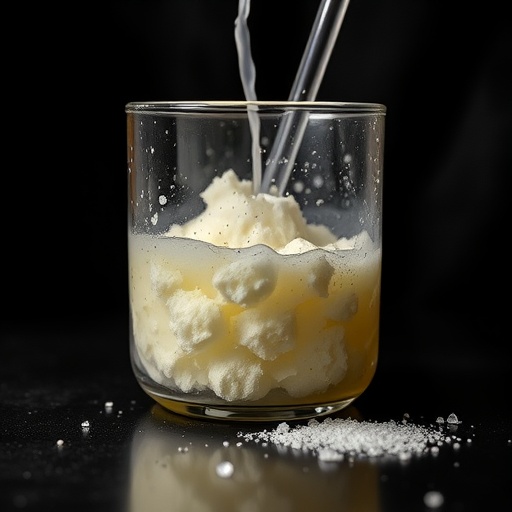
Recent advancements in chemical research have spotlighted the fascinating domain of starch dissolution using hydroxyl-based ionic liquids. The study conducted by Zhao and colleagues not only sheds light on the intricate interactions between starch and these ionic solvents but also delves deeply into how varying the number of hydroxyl groups and the length of alkyl chains affects the dissolution process. This work carries significant implications for industries reliant on starch, such as food, pharmaceuticals, and biofuels.
Ionic liquids, often described as “green” solvents due to their low volatility and high thermal stability, are progressively gaining recognition for their unique ability to dissolve a myriad of compounds, including polysaccharides like starch. Polysaccharides are polymers composed of carbohydrate monomers, and their solubility poses challenges due to complex intermolecular interactions and hydrogen bonding. To tackle this, the research team, led by Zhao, systematically investigates the impact of hydrophilic hydroxyl groups and the hydrophobic characteristics conferred by alkyl chains in ionic liquids.
The experimental phase of the study employed both quantitative and qualitative analyses to understand how nuances in the molecular architecture of ionic liquids play a pivotal role in solvation. High-performance liquid chromatography (HPLC) and nuclear magnetic resonance (NMR) spectroscopy were utilized to measure the extent of starch dissolution and to evaluate the structure of the dissolved products. The collected data underscored a clear correlation between the number of hydroxyl groups in ionic liquids and the efficiency of starch dissolution. Essentially, more hydroxyl groups facilitated stronger interactions with starch, promoting higher solubility.
Interestingly, the results also revealed that varying the length of alkyl chains in these ionic liquids could lead to divergent outcomes in starch dissolution. While longer alkyl chains contributed to increased hydrophobic character, they also created steric hindrance, which could obstruct interaction with the starch molecules. This interplay between hydrophilicity and hydrophobicity is crucial in fine-tuning the properties of the ionic liquids to maximize starch solubility.
To complement the experimental findings, the researchers employed computational models to simulate molecular interactions. Using density functional theory (DFT), they could predict how various ionic liquid structures interact with starch at the molecular level. The theoretical predictions resonated well with their experimental observations, confirming the relationship between ionic liquid structure and starch solubility. This dual approach of combining experimental data with computational insights proved invaluable in substantiating the results.
Moreover, the implications of this research extend beyond just laboratory curiosity; they hint at broader applications in various fields. For instance, the enhancement of starch solubility may streamline enzymatic processes in bioethanol production, thereby increasing efficiency and yield. Such advancements can also lead to more sustainable practices in the food industry, improving the functionality of starch in food matrices and enhancing the sensory properties of products.
Another vital aspect of this study is its contribution to understanding the fundamental chemistry of ionic liquids. Previous studies have often highlighted the general properties of ionic liquids, but Zhao and colleagues provide a comprehensive analysis that specifically addresses how structural modifications affect solvation patterns. This insight opens doors for the design of tailored ionic liquids that can be optimized for specific applications, establishing a framework for future research in ionic liquid chemistry.
The varied performance of these ionic liquids in dissolving starch also raises intriguing questions about the underlying mechanisms at play. For instance, how do the individual properties of starch, such as molecular weight and branching, influence its interaction with ionic liquids? Addressing this could lead to more nuanced approaches in modifying starch for targeted functionalities in various applications.
Additionally, the thorough investigation into the relationship between alkyl chain length and starch dissolution characteristics invites further exploration. As researchers aim to identify the optimal balance of hydrophobic and hydrophilic components, it may pave the way for innovations not just in starch processing but also in the development of new materials based on these ionic liquids.
The study by Zhao et al. encapsulates a critical intersection of chemistry, material science, and application-driven research. By elucidating the complex nature of starch dissolution facilitated by hydroxyl-based ionic liquids, the authors have equipped the scientific community with valuable insights that may inspire upcoming research endeavors. Their work exemplifies how controlled molecular engineering can address long-standing challenges in polysaccharide solubility, enabling advancements across a wide spectrum of industries.
One of the highlights of this research is its sustainable angle. The push towards more environmentally friendly solvents in the chemical industry cannot be overstated. Ionic liquids, in their potential to dissolve biopolymers, signify a step closer to minimizing waste and employing greener methods in various manufacturing processes.
In conclusion, the exploration of starch dissolution using hydroxyl-based ionic liquids represents a dynamic and promising area of study. Through a blend of experimental rigor and sophisticated theoretical modeling, Zhao and colleagues have opened up a realm of possibilities for the future of ionic liquids in materials science and beyond. As researchers continue to dissect the detailed interactions between these solvents and polysaccharides, we can expect further refinements in how we utilize these compounds in diverse applications, reshaping industries and enhancing product efficacy.
Subject of Research: Starch dissolution using hydroxyl-based ionic liquids
Article Title: Experimental and theoretical studies on starch dissolution with hydroxyl-based ionic liquids: number of hydroxyl group and alkyl chain length.
Article References: Zhao, H., Song, S., Zhang, Y. et al. Experimental and theoretical studies on starch dissolution with hydroxyl-based ionic liquids: number of hydroxyl group and alkyl chain length. Ionics (2025). https://doi.org/10.1007/s11581-025-06910-0
Image Credits: AI Generated
DOI: 10.1007/s11581-025-06910-0
Keywords: Starch dissolution, ionic liquids, hydroxyl groups, alkyl chains, sustainability, chemical engineering, polysaccharides
Tags: alkyl chains impact on dissolutionbiofuels and starch dissolutionchemical research advancementsfood and pharmaceuticals starch usegreen solvents in industrial applicationshigh-performance liquid chromatography applicationshydroxyl-based ionic solventsinteractions between starch and ionic liquidsnuclear magnetic resonance spectroscopy in researchpolysaccharides solubility challengesquantitative and qualitative analysis in chemistrystarch dissolution ionic liquids