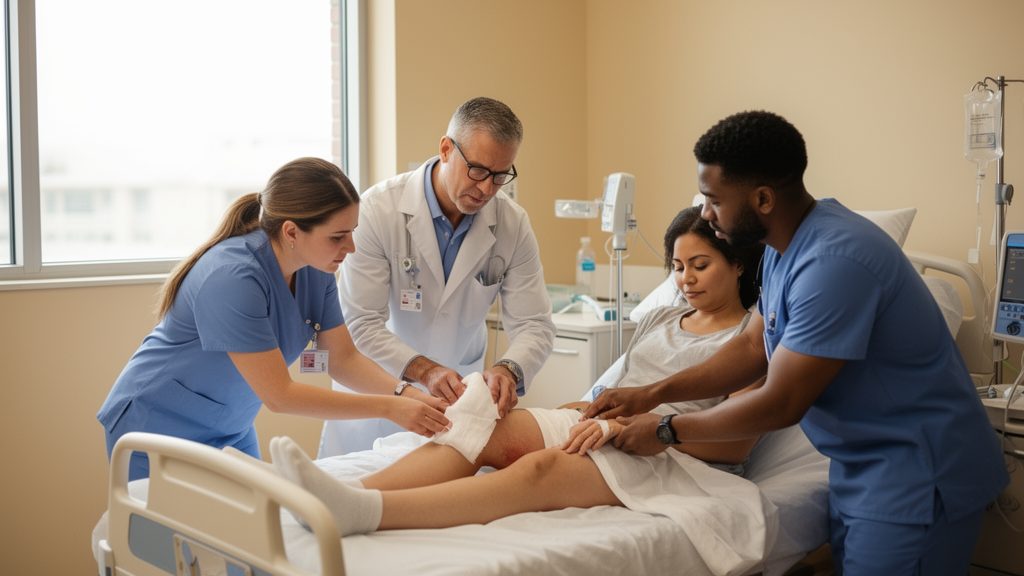
Interprofessional collaboration is often praised in abstract terms, but a new qualitative study breaks it down into concrete, observable moments. Researchers at LMU Munich University Hospital, together with colleagues from Katholische Stiftungsfachhochschule München and Technische Hochschule Rosenheim, used simulated wound care scenarios to identify exactly where collaboration becomes critical in patient care—and what kinds of reasoning activities unfold at those moments. Their work, published in Frontiers in Medicine, offers a structured foundation for designing interprofessional education in the health professions.
From the analysis, the team identified eight critical collaboration points across the arc of wound care. These included pre-briefing before a procedure, wound assessment itself, and follow-up care. The points span the whole trajectory of a patient case, suggesting that collaboration is not confined to dramatic handover moments but is distributed across planning, examination, treatment, and long-term management.
What makes the study technically distinctive is its decomposition of each collaboration point into three activity types. Diagnostic activities involve gathering and evaluating evidence about the patient’s condition. Intervention activities cover planning and adjusting treatment. Collaborative activities include information sharing, negotiation, and coordination among professionals. By separating these strands, the framework makes visible what usually remains implicit in team practice: that reasoning about a diagnosis, reasoning about an intervention, and reasoning about how to work together are distinct but intertwined processes.
The researchers found that these activity types did not occur in a neat linear sequence. Instead, they appeared in dynamic, iterative patterns, with experts cycling back and forth between gathering evidence, adjusting plans, and coordinating with colleagues. Notably, the activity clusters were often situated at moments the experts themselves described as requiring interprofessional coordination. The authors connect this to the concept of “noticing”—the capacity to recognize, in the flow of practice, that a given situation is precisely one where cross-professional collaboration matters.
This connection to noticing has practical significance for education. If learners can be trained to recognize critical collaboration points the way experts do, interprofessional education can move beyond generic teamwork exercises toward scenario-based training that targets specific, identifiable moments.
The authors argue that structuring collaboration points into collaborative, diagnostic, and intervention activities provides a functional lens for describing and supporting collaborative reasoning in practice. Beyond teaching, they see applications in structuring feedback for learners and in specifying interprofessional contributions within assessment frameworks such as Entrustable Professional Activities, which describe the units of professional work that trainees must be trusted to perform.
The authors therefore position the work as a foundation rather than a finished solution: further research is needed to test whether the eight collaboration points and the three-activity structure transfer to other clinical settings, and how the framework can be integrated into teaching, supervision, and assessment. Even so, by making the where and how of collaboration explicit, the study gives educators and researchers a concrete vocabulary for one of healthcare’s most persistently diffuse challenges.
Subject of Research: Identifying critical collaboration points and reasoning activities in interprofessional wound care to inform interprofessional education
Article Title: Making collaboration explicit through collaborative, diagnostic, and intervention activities: foundations for interprofessional education
Article References: Witti, M. J., Weiß, A., Bauer, M., Baumann, E., Schunk, M., Stadler, M., & Richters, C. (2026). Making collaboration explicit through collaborative, diagnostic, and intervention activities: foundations for interprofessional education. Frontiers in Medicine, 13, Article 1907531. https://doi.org/10.3389/fmed.2026.1907531
Image Credits: AI Generated
DOI: 10.3389/fmed.2026.1907531
Keywords: interprofessional education, wound care, diagnostic reasoning, collaborative practice, qualitative study, simulation, health professions education, expert elicitation, Entrustable Professional Activities, teamwork, Making, collaboration
News Source: Ophelia Keating. (October 29, 2026). Experts Map Where Wound Care Teams Must Collaborate—and How They Reason Together. Scienmag.