A standardized investigation into human motor control has demonstrated that motorized upper-limb exoskeleton assistance modulates specific muscular contributions during reaching tasks while leaving the central nervous system’s foundational synergy architecture intact. In a cohort study involving 40 healthy right-handed participants, investigators examined how the Float robotic exoskeleton altered coordinated muscle patterns, termed muscle synergies, which the central nervous system uses to simplify complex motor execution. The experimental recordings revealed that mechanical gravity and friction compensation at the shoulder markedly reduced the activation demand placed on the anterior deltoid. Simultaneously, the physical coupling between the user and the device increased mechanical stabilization requirements across the trapezius muscle groups without disrupting core reaching modules.
Understanding the physiological interaction between human neuromuscular systems and assistive robotic hardware represents a fundamental requirement for refining robotic neurorehabilitation. Motor modules or muscle synergies represent coordinated patterns of muscle recruitment that allow the brain to control high-degree-of-freedom limbs through low-dimensional control commands. When robotic systems assist movement, they inevitably alter external limb dynamics and joint loading. Pilot assessments using healthy individuals establish essential normative reference baselines necessary to detect pathological deviations and evaluate functional recovery in clinical populations, such as post-stroke patients who often display abnormal muscle couplings. However, developing reliable normative baselines has historically been challenged by substantial inter-subject variability, prompting researchers to examine whether demographic factors such as chronological age systematically influence synergy modularity.
To rigorously evaluate these interactions, researchers tested 40 healthy volunteers, comprising 20 males and 20 females with a mean age of 44.6 years and a standard deviation of 13.2 years, under ethical protocols approved by the regional ethical committee. The experimental setup utilized a standardized anterior reaching protocol instrumented with a sensorized vertical touch panel. Participants were seated comfortably with their trunk secured in an adjustable chair, executing reaching movements with their right arm toward three centrally aligned vertical targets equipped with light-emitting diodes. Movements were initiated from a relaxed resting posture on the thigh and completed with full elbow extension at comfortable, self-paced speeds across three distinct operational modes: unassisted natural movement, robotic movement with low assistance, and robotic movement with high assistance.
During each reaching trial, surface electromyography signals were continuously captured at 1 kHz from ten distinct muscle sites across the right shoulder and arm, including the long head of the biceps brachii, anterior deltoid, middle deltoid, posterior deltoid, long head of the triceps brachii, upper trapezius, medial trapezius, lower trapezius, pectoralis major, and brachioradialis. The electromyographic data were segmented into reaching epochs based on target trigger contacts, band-pass filtered between 20 and 350 Hz, rectified, treated with a median filter to eliminate signal artifacts exceeding 600 microvolts, and low-pass filtered at 5 Hz to extract linear envelopes. Non-negative matrix factorization was iteratively computed for each individual up to 100 times per step to identify the minimum number of synergies required to achieve a variance accounted for threshold of at least 90 percent.
The extraction pipeline generated four distinct operational synergy sets: free synergies capturing unassisted movements, low synergies reflecting low robotic assistance, high synergies capturing high assistance, and whole synergies extracted by pooling trials across all assisted and unassisted conditions. Across the unassisted free condition, four primary modules emerged: a primary shoulder flexion module dominated by the deltoids with strong anterior deltoid involvement, a scapular elevation module governed predominantly by the upper trapezius, a humeral flexion module dominated by the pectoralis major, and an elbow flexion module driven by the biceps brachii and brachioradialis. This modular configuration aligned with physiological anterior reaching mechanics, reflecting stabilized elevation of the extended arm.
When participants executed movements assisted by the Float exoskeleton under low or high assistance, the dimensionality of motor control compressed from four modules down to three, showing near-identical synergy structures across both assistance levels with cosine similarities exceeding 0.98. Crucially, the primary anterior deltoid module observed in unassisted reaching disappeared as a standalone driver during assisted trials, reflecting how feedforward shoulder flexion support from the robotic actuator effectively substituted for biological deltoid effort. Conversely, the upper trapezius synergy observed in unassisted reaching split into two distinct modules within the assisted conditions, demonstrating an increased recruitment of the middle and lower trapezius to maintain scapular and thoracic stabilization against the rigid corset interface and residual device inertia.
Despite these task-specific redistributions, the overall synergistic architecture showed notable consistency, as the pectoralis major module and scapular elevation patterns remained highly preserved. Across the entire cohort of 39 analyzed participants, the average cosine similarity between individual synergies and the derived group references reached 0.74 in unassisted reaching, 0.83 under low assistance, and 0.82 under high assistance, while falling to 0.69 when pooling all conditions into whole synergies. Correspondingly, the percentage of individual synergy patterns excluded due to insufficient similarity was lowest under assisted reaching, with only 3.21 percent excluded under low assistance and 6.41 percent under high assistance, compared to 13.45 percent in unassisted reaching and 21.03 percent in whole reaching.
To determine whether demographic characteristics accounted for persistent inter-subject variability, researchers stratified the 39 participants into age-defined groups and subgroups, evaluating cohorts aged 25 to 49 years and 50 to 79 years, as well as finer intervals spanning 25 to 29, 30 to 49, 50 to 59, and 60 to 79 years. Stratification demonstrated that unassisted free synergies remained highly uniform across age cohorts, showing consistent one-to-one correspondence with the whole-group reference across similarity values exceeding 0.92, except for minor structural variations in the 30 to 50 and 60 to 79 cohorts. In contrast, whole synergies pooled across unassisted and assisted movements exhibited substantial age-dependent divergence, with extracted module counts fluctuating between 3 and 6 across age brackets and failing to show complete correspondence with general population references.
Linear mixed-effects modeling evaluating cosine similarity across reference conditions confirmed that while categorical reference matching did not produce statistically significant differences on its own, age exhibited a statistically significant negative association with synergy similarity in the pooled whole condition, decreasing by 0.0027 per year of age with a 95 percent confidence interval from minus 0.0045 to minus 0.0009. Deriving reference baselines within age-homogeneous groups significantly reduced individual exclusion rates in younger groups, dropping whole synergy exclusion from 21.03 percent to statistically lower thresholds in the 25 to 50 cohort. Furthermore, similarity scores between individual subject modules and reference baselines increased significantly across multiple age subgroups when age-matched references were applied.
These observations indicate that older individuals adopt more individualized motor adaptation strategies when accommodating external robotic dynamics, reflecting cumulative sensorimotor divergence and altered musculoskeletal biomechanics over time. The researchers noted that while the study benefited from a standardized reaching paradigm, limitations included a restricted vertical reaching workspace consisting of three planar targets, relatively small participant numbers within specific age subdivisions, and the execution of self-paced movements without external speed pacing to avoid electroencephalographic interference. Overall, the findings confirm that the Float exoskeleton successfully unloads primary shoulder musculature while preserving core motor modules, underscoring that future clinical assessments must incorporate age-stratified reference baselines to reliably evaluate neuromuscular recovery in patient populations.
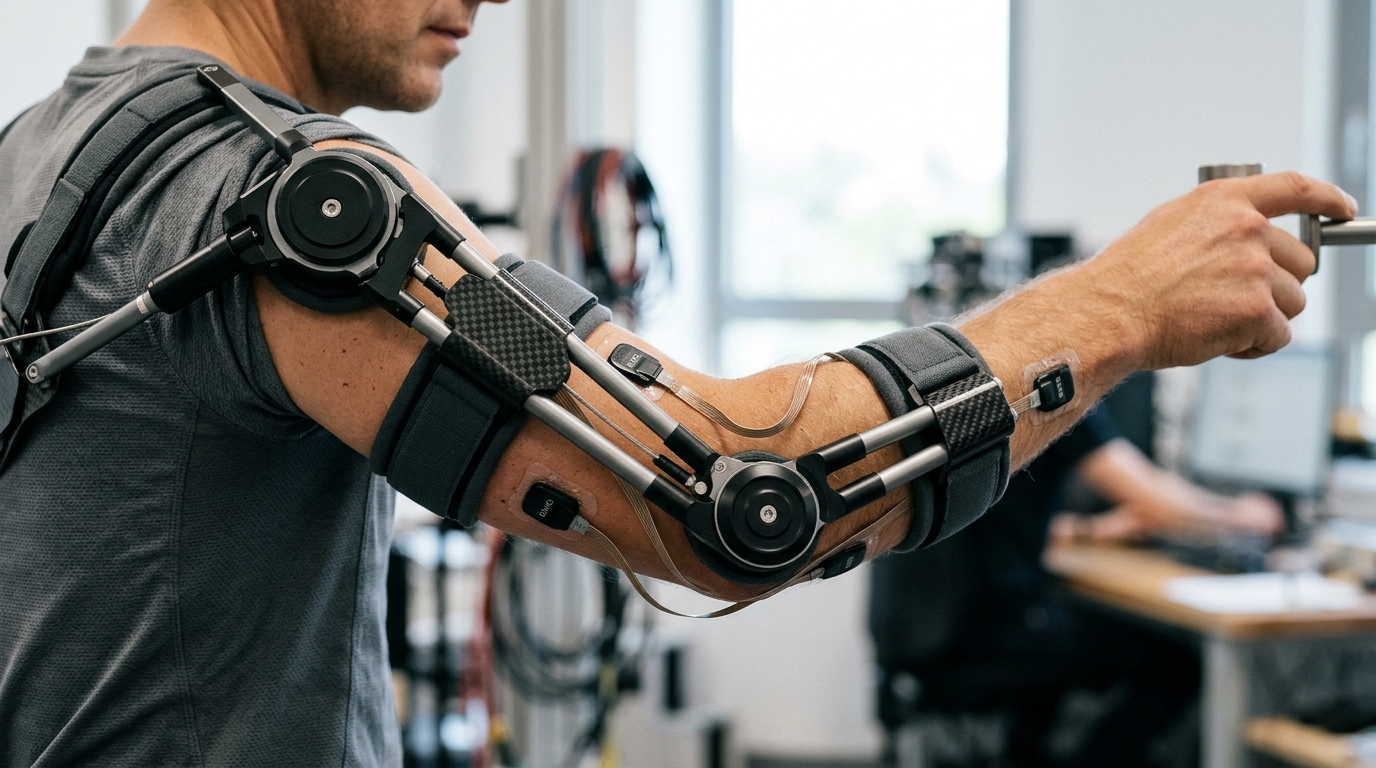
Beyond general assistance effects, the mechanical operation of the Float exoskeleton, engineered by the Rehab Technologies Lab at the Italian Institute of Technology, explains the neuromuscular shifts observed during reaching. Featuring five rotational joints that reproduce the degrees of freedom of the human shoulder complex, the robotic system integrates a corset and upper-limb orthosis to apply model-based gravity and friction compensation alongside active feedforward assistance during shoulder flexion. Because the gravity compensation algorithm does not directly measure system weight, residual physical loading is partially transferred to the user. This mechanical loading, combined with the rigid trunk posture enforced by the corset, necessitates heightened scapulothoracic stabilization through middle and lower trapezius recruitment. Furthermore, initiating the reaching movement with the hand resting on the thigh explains why unassisted coordination emphasized an elbow flexion module involving the biceps brachii and brachioradialis, diverging from previous reaching studies initiated at ninety degrees of elbow flexion that isolated triceps-driven extension.
Granular comparisons also revealed distinct age-specific synergy compositions within the pooled whole-movement condition that broader group averages obscured. Participants younger than 50 years consistently retained a whole synergy dominated by deltoid activation, whereas participants aged 50 and older exhibited an age-specific whole synergy characterized primarily by triceps recruitment. These structural differences coincided with marked shifts in synergy consistency across cohorts. In the undivided population, coefficients of variation across muscle weights were substantial, measuring between 0.93 and 1.10 for unassisted synergies and between 0.98 and 1.18 across whole synergies. Age-based stratification reduced this dispersion, resulting in only 14 of 48 subgroup synergy weights exhibiting a coefficient of variation exceeding 1.0.
Methodologically, the reference synergy extraction pipeline clustered single-subject modules based on the muscle exhibiting the highest weight, retaining only clusters populated by at least half the subgroup and excluding modules with a cosine similarity below 0.5. To address the inherent limitations of these fixed heuristic thresholds, future research will explore alternative clustering methods and dimension-insensitive metrics, such as Euclidean distance or chance-level normalized cosine similarity. Integrating upper-limb kinematics will further clarify movement speed effects, refining reference benchmarks for rehabilitative robotics.
Subject of Research: Neuromuscular coordination and age-related muscle synergy modulation during exoskeleton-assisted reaching
Article Title: Age-related effects on muscle synergies during a standardized exoskeleton-assisted reaching task
Article References: Ceroni, I., Garro, F., & Semprini, M. (2026). Age-related effects on muscle synergies during a standardized exoskeleton-assisted reaching task. Discover Neuroscience, 21(1), Article 80. https://doi.org/10.1186/s13064-026-00281-6
Image Credits: AI Generated
DOI: 10.1186/s13064-026-00281-6
Keywords: muscle synergies, upper limb exoskeleton, Float exoskeleton, electromyography, motor control, rehabilitation robotics, anterior deltoid, trapezius muscle, aging, non-negative matrix factorization, biomechanics, reaching movements, inter-subject variability, motor modules, cosine similarity, neurorehabilitation
News Source: Ophelia Keating. (November 17, 2026). Exoskeleton Assistance Modulates Arm Muscle Synergies While Preserving Core Coordination Patterns. Scienmag.