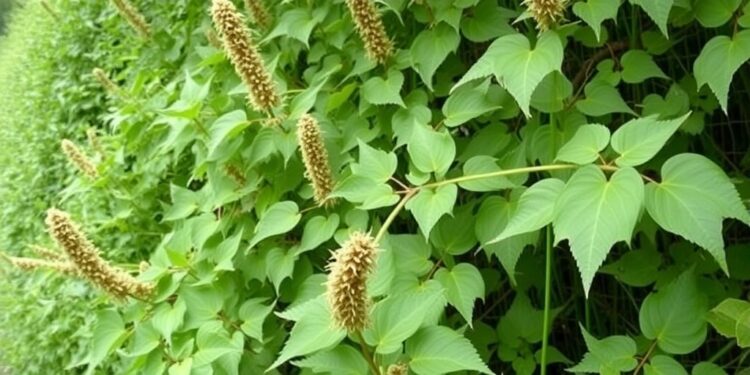

Japanese knotweed, scientifically known as Reynoutria japonica, has rapidly become a bane for ecosystems in Europe and North America after being introduced from its native regions in eastern Asia. This invasive plant is notorious for its aggressive growth patterns, resilience, and the ability to outcompete native flora. Recent research published in the esteemed journal New Phytologist delves into the factors that contribute to the organism’s formidable success in non-native environments, aiming to unveil the genetic and evolutionary mechanisms at play. The study is primarily focused on understanding how these invasive plants manage to thrive while stifling the growth of indigenous species.
The essence of Japanese knotweed’s invasive success lies in its reproductive adaptation. Unlike many of its native counterparts, which typically rely on sexual reproduction for propagation, Japanese knotweed utilizes a strategy known as clonal propagation. This asexual method allows the plant to produce genetically identical offshoots rapidly, enabling it to proliferate over vast areas at an astonishing rate. The study highlights this ability as a pivotal feature in its evolution and dominance, which could be useful for devising more effective control measures against this plant.
Research teams, including international scientists from regions both native and introduced to Japanese knotweed, conducted extensive comparisons of growth and reproductive traits between introduced populations in Germany and the USA and native populations in China and Japan. This broad geographical focus allowed researchers to evaluate significant evolutionary changes that might not emerge in more localized studies. The comparative approach is vital for elucidating how invasive species adapt to novel ecosystems, challenging long-held beliefs about plant competitiveness and resilience.
One of the critical findings of the study is that Japanese knotweed exhibits “general-purpose genotypes,” which enhance its adaptability across varying environments. These genotypes not only increase the plant’s plasticity but also contribute to its vigorous clonal growth and reproduction. Such traits are particularly advantageous for survival in disturbed habitats, often characteristic of urban environments where it typically flourishes. The researchers believe that understanding the genetics behind such adaptabilities can inform ecological management strategies.
Further analytical data presented in the research suggests that the evolutionary pathways of Japanese knotweed involve mechanisms similar to those observed in other successful invaders. The convergence of traits such as enhanced plasticity, rapid reproduction, and the ability to thrive in diverse environments might indicate a broader evolutionary trend among invasive species. This insight underscores the importance of identifying and understanding these traits to develop robust strategies combatting plant invasiveness.
A daunting aspect of Japanese knotweed’s biology is its remarkable resilience. The plant can thrive in a range of environmental conditions, including exposure to harsh weather and varying soil types. Its capacity to regenerate from small fragments means that traditional eradication methods often fall short. The findings of this study emphasize the need for innovative approaches to manage invasive populations effectively.
The collaboration between researchers from different geographical contexts not only enriches the study but also underscores the urgency of addressing the issue of invasive species on a global scale. By pooling knowledge and methodologies from areas where the plant is native and areas where it has become problematic, the team could gain a multifaceted understanding of the plant’s biology and adaptation. Such international collaboration is pivotal in tackling the complex challenges posed by invasive species.
Another aspect worth noting is the ecological ramifications of Japanese knotweed’s unchecked growth. Native species, many of which possess specific ecological roles and values, are often outcompeted and displaced by this robust invader. This displacement can lead to significant shifts in local biodiversity, affecting everything from soil health to habitat structure. Conservationists and ecologists must grapple with these long-term changes when formulating invasive species management policies.
The study also posits that the insights garnered can extend to understanding other invasive species in similar circumstances. By employing evolutionary and genetic frameworks, researchers can better interpret the dynamics of invasiveness and resilience in plants. This knowledge is instrumental for developing strategies pursuing both prevention and management of invasive species.
Additionally, the implications of this research may reach beyond ecological management to agriculture and land use. Farmers and landowners grappling with the adverse effects of invasive plants such as Japanese knotweed may benefit from understanding the specific adaptations that confer success. Knowledge of the reproductive strategies and growth patterns associated with invasive species is crucial for designing targeted interventions.
In conclusion, the newly published research sheds light on the complex interplay between evolutionary biology and ecology concerning Japanese knotweed’s invasiveness. The plant’s reproductive adaptations, coupled with its resilience to a range of environmental stresses, create a formidable challenge for natural ecosystems. The extra insights gained through this international collaborative research may serve as a critical resource in developing sustainable and effective management models for invasive plant species worldwide. As invasive flora continue to affect global biodiversity and ecosystem functionality, studies like these are invaluable in guiding conservationists and policymakers alike.
Subject of Research: The invasive mechanisms and reproductive traits of Japanese knotweed.
Article Title: General-purpose genotypes and evolution of higher plasticity in clonality underlie knotweed invasion.
News Publication Date: 19-Feb-2025.
Web References: New Phytologist.
References: DOI: 10.1111/nph.20452.
Image Credits: N/A.
Keywords: Japanese knotweed, invasive species, clonal propagation, evolutionary biology, ecological management, biodiversity, genetics, resilience, environmental adaptation.
Tags: adaptive strategies of invasive plantsasexual reproduction in plantsclonal propagation in plantscontrolling invasive speciesecological impact of Japanese knotweedenvironmental challenges of knotweedgenetic mechanisms of invasioninternational research on knotweedinvasive plant species researchJapanese knotweed invasivenessnative flora competitionReynoutria japonica growth patterns