


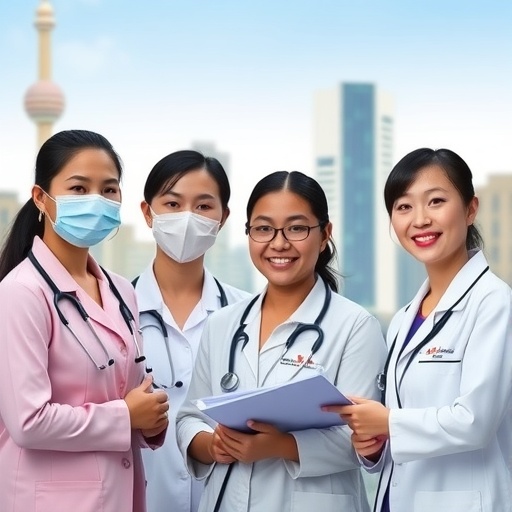
In recent years, the world of nursing education has seen a transformative shift influenced by globalization. This transformation is evident in the increasingly diverse pool of nursing students who travel across borders for clinical learning experiences. A fascinating study conducted by Xu et al. has delved into the dynamics of workplace social capital among international nursing students while they are engaged in clinical education in China. This study provides invaluable insights into how cultural, social, and professional interactions shape the experiences of these students, ultimately influencing their educational journey and professional development.
The research underscores that social capital is crucial in clinical settings, where collaboration and interpersonal relationships are foundational. In an unfamiliar environment, international students often find themselves relying on social networks, which encompass relationships with peers, educators, and healthcare professionals in their host communities. These connections serve as a vital resource for support, knowledge sharing, and professional growth, demonstrating that social interactions can significantly impact student learning outcomes.
Furthermore, the study points out the intricacies of navigating these social networks within a new cultural context. International students may encounter barriers that inhibit their ability to connect with others, such as language differences and cultural misunderstandings. Yet, the positive outcomes from establishing robust social networks can lead to enhanced confidence and increased efficacy in clinical practices, enabling these students to thrive despite challenges.
Xu et al. highlight that social capital is not merely individualistic; its effects ripple through the entire learning environment. When international nursing students build relationships, they contribute to a more inclusive and collaborative educational setting that benefits not just themselves but also their classmates and mentors. This synergy promotes a richer clinical learning atmosphere, where knowledge and experiences are exchanged freely, thereby enriching the educational landscape.
The clinical learning experiences of international nursing students also provide them with a unique lens through which they can observe and engage with different healthcare systems. This exposure is vital in today’s interconnected world, where healthcare providers must be culturally competent and sensitive to diverse patient populations. As these students immerse themselves in varied clinical practices, they develop critical skills that are essential for delivering quality care in globalized contexts.
The findings of this qualitative study are particularly significant in highlighting the importance of mentorship and guidance. Experienced healthcare professionals who act as mentors can play a pivotal role in facilitating the integration of international students into clinical environments. These mentors not only provide professional advice but also assist in bridging cultural gaps, which helps to nurture an environment conducive to learning and development.
Moreover, the study sheds light on the emotional experiences of international nursing students. The challenges they face in adapting to new clinical environments often bring forth feelings of anxiety and isolation. However, having a support system through social capital can significantly alleviate these feelings, as students are more likely to seek help and share their experiences with peers and mentors. Emphasizing mental health and emotional well-being in addition to academic performance is crucial for fostering resilience and adaptability.
As healthcare systems worldwide strive to improve patient care quality, the implications of this study extend beyond nursing education. Stakeholders in nursing programs must recognize the value of fostering social capital as a core component of the curriculum. Developing strong networks among students, faculty, and healthcare professionals can lead to a more engaged cohort of nursing students who are better prepared to enter the workforce upon graduation.
The study reinforces the notion that educational institutions play an integral role in shaping students’ experiences and professional trajectories. By creating programs and initiatives aimed at enhancing social capital—such as peer mentorship programs and networking events—schools can empower their international nursing students. These measures enable students to navigate challenges more effectively while optimizing their clinical learning experiences.
Furthermore, the active participation of local healthcare facilities in assisting international students can enhance their integration into the clinical setting. Such collaboration can manifest through orientation programs, language support, and inclusion in social activities. These initial gestures foster a sense of belonging among students, thus enhancing their emotional well-being and academic resilience.
In conclusion, the qualitative study by Xu and colleagues presents an enlightening perspective on the interplay of social capital and international nursing students’ experiences during clinical learning in China. By exploring the ways in which social networks and cultural interactions shape students’ lives, the research emphasizes the need for strategic investments in social capital cultivation within nursing education. As the landscape of healthcare continues to evolve, understanding these dynamics will be pivotal in shaping the future workforce of nursing professionals, who will be tasked with providing compassionate and culturally competent care in an increasingly multicultural world.
The findings of this study hold implications for educational policies and program development within nursing institutions. As nursing education adapts to meet the challenges of globalization, fostering an environment that values social capital will be essential for nurturing the next generation of healthcare leaders. Engaging in collaborative practices, promoting peer relationships, and leveraging mentorship can provide a transformative experience for international students, equipping them with the tools they need to succeed in diverse clinical settings. By prioritizing these elements, the nursing profession can ensure a richer, more inclusive future that benefits both educators and learners alike.
In summary, this study serves as a clarion call for educational institutions to acknowledge and cultivate the social dimensions of learning. As the profiles of nursing students evolve, so too must the strategies that support their professional development. The path forward in nursing education lies not only in cultivating clinical competencies but also in fostering an enriching community of support that transcends cultural boundaries.
Subject of Research: International nursing students’ workplace social capital during clinical learning in China
Article Title: A qualitative study on the composition of international nursing students’ workplace social capital during clinical learning in China.
Article References:
Xu, JM., Chen, MH., Liu, XC. et al. A qualitative study on the composition of international nursing students’ workplace social capital during clinical learning in China. BMC Nurs 25, 4 (2026). https://doi.org/10.1186/s12912-025-04176-5
Image Credits: AI Generated
DOI: https://doi.org/10.1186/s12912-025-04176-5
Keywords: International nursing students, social capital, clinical learning, mentorship, cultural competence, nursing education, emotional well-being, healthcare systems.
Tags: challenges faced by international studentsclinical education in Chinacultural interactions in nursingglobalization in nursing educationintercultural communication in healthcareinternational nursing educationinternational student experienceslanguage barriers in nursing educationnetworking for nursing studentsprofessional development in nursingsocial capital in healthcaresupport systems for nursing students



