


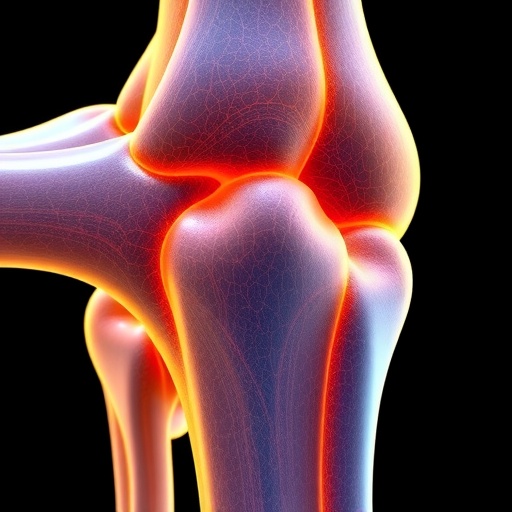
Recent advancements in biomedical engineering have unlocked new avenues for understanding the mechanical properties of articular cartilage, particularly under the influence of glycation. Recently published research offers profound insights into how glycated articular cartilage behaves when subjected to uniaxial and cyclic tensile loading. This study, helmed by experts in the field, sheds light on the implications that these mechanical properties may have on joint health and overall mobility.
Articular cartilage, the smooth tissue that caps the ends of bones at joints, is crucial for reducing friction and acting as a shock absorber during movement. However, its mechanical properties can be compromised due to various factors, including age, disease, and metabolic changes. Glycation, a biochemical process where sugar molecules bond with protein or fat molecules, is one significant factor that alters cartilage’s biophysical characteristics, potentially leading to degenerative joint diseases such as osteoarthritis.
In the study, researchers employed sophisticated methodologies to analyze the mechanical performance of glycated cracked articular cartilage. Utilizing both uniaxial and cyclic tensile loading techniques, the team unveiled a comprehensive view of the stress-strain relationship in compromised cartilage. Through meticulous experiments, researchers assessed the tensile strength and elasticity of the tissue, highlighting a distinct correlation between glycation levels and the diminished mechanical integrity of the cartilage.
The results from the uniaxial tensile tests indicated a considerable decline in the cartilage’s tensile strength as glycation increased. This decline raises concerns regarding the cartilage’s ability to withstand physical stresses, which can lead to increased tissue suscepibility to damage and inflammation. The implications are profound, particularly for individuals active in sports or those with physically demanding occupations, as the risk for joint injuries escalates with weakened cartilage.
Cyclic loading tests provided additional insights, demonstrating how cartilage responds to repeated mechanical strain. Such loading conditions are akin to those frequently experienced in daily activities, providing a contextual understanding of how glycated cartilage endures real-world challenges. The data revealed that glycated cartilage exhibits significantly reduced fatigue resistance compared to its healthy counterparts, suggesting a heightened risk for progressively deteriorating conditions over time.
The study’s findings not only elevate the understanding of mechanical properties in glycated cartilage but also mark a pivotal moment for potential clinical applications. Addressing the mechanical dysfunction associated with glycated cartilage could open new therapeutic pathways for managing joint health, particularly for osteoarthritis patients. By targeting the biochemical pathways of glycation, researchers may develop strategies to restore mechanical properties and improve outcomes for those afflicted by joint degeneration.
Additionally, the implications of glycation extend beyond just mechanical properties; they resonate through various biological responses and systemic health concerns. The modulation of collagen fibers and proteoglycans within cartilage significantly influences how this tissue behaves under stress, and understanding this relationship fuels further inquiry into interventions that could mitigate adverse effects.
As the demand for greater insight into joint biomechanics surges, this research signals a critical step towards enhancing our knowledge of cartilage functionality. The integration of mechanical testing and biochemical analysis fosters a multidimensional approach to cartilage research, paving the way for innovative treatments and preventive measures.
In considering future studies, applying a broader scope of experimental conditions, such as investigating different temperatures and loading rates, could provide a more nuanced understanding of the cartilage’s mechanical characteristics. Expansion of the current research could lead to a more comprehensive repertoire of data that draws clearer links between mechanical properties and clinical outcomes in joint health.
The study also raises awareness about the non-linear behavior of cartilage in healthy versus compromised states, emphasizing that standard assessments conducted in laboratories often overlook real-world biomechanical scenarios. This gap in research may lead to inadequate evaluations of joint health, suggesting that future methodologies must align more closely with actual physiological conditions.
Ultimately, the work spearheaded by Gao and colleagues not only contributes fundamental knowledge to the field of biomechanics but also catalyzes a wider discourse on cartilage preservation strategies. As scientists and clinicians strive for joint health optimization, integrating mechanical understanding with biochemical interactions is crucial. This synergy could facilitate breakthroughs that not only improve the quality of life for individuals suffering from joint ailments but also enhance the longevity of joint function in aging populations.
In conclusion, the research highlights crucial revelations about how glycolation alters the mechanical landscape of articular cartilage under loading conditions. The ability to discern the intricate balance between biomechanical stress and the state of cartilage health renders this study a significant contribution to biomedical engineering. As knowledge expands and methodologies evolve, the promise of better interventions for cartilage repair and regeneration looms on the horizon.
Subject of Research: Mechanical Properties of Glycated Cracked Articular Cartilage Under Uniaxial and Cyclic Tensile Loading
Article Title: Mechanical Properties of Glycated Cracked Articular Cartilage Under Uniaxial and Cyclic Tensile Loading
Article References: Gao, LL., Fang, Y., Lin, XL. et al. Mechanical Properties of Glycated Cracked Articular Cartilage Under Uniaxial and Cyclic Tensile Loading. Ann Biomed Eng (2026). https://doi.org/10.1007/s10439-025-03964-z
Image Credits: AI Generated
DOI: https://doi.org/10.1007/s10439-025-03964-z
Keywords: articular cartilage, glycation, mechanical properties, tensile loading, osteoarthritis, biomechanical testing, joint health, cartilage repair.
Tags: advanced methodologies in cartilage researchbiomedical engineering and cartilage mechanicscartilage biophysics and mobilitydegenerative joint diseases and glycationeffects of aging on cartilage propertiesglycated articular cartilage mechanicsimpact of glycation on joint healthimplications of glycation in osteoarthritismechanical properties of articular cartilagestress-strain relationship in cartilagetensile strength and elasticity of cartilageuniaxial and cyclic tensile loading



