A simulation investigation published in Frontiers in Robotics and AI demonstrates that modeling cable-driven continuum robots using exact trigonometric evaluations rather than truncated Taylor polynomials can significantly improve dynamic trajectory tracking when paired with advanced nonlinear control. Continuum manipulators replace rigid joints with continuously flexible structures, offering notable dexterity for navigating confined environments in inspection, maintenance, and minimally invasive surgery. However, predicting and controlling their spatial dynamics remains challenging because continuous deformation couples with configuration-dependent tendon tension. Researchers Selman Djeffal, Abdelhamid Ghoul, Mohamed Razi Morakchi, and Ameur Latreche developed a control-oriented dynamic model of a two-section spatial continuum robot that retains full sine and cosine expressions within piecewise-constant-curvature kinematics. The team coupled this formulation with an adaptive super-twisting sliding-mode controller tuned via particle swarm optimization. Across simulated tracking benchmarks, the proposed framework achieved substantial tracking improvements over classical and modern control baselines while operating at comparable control effort.
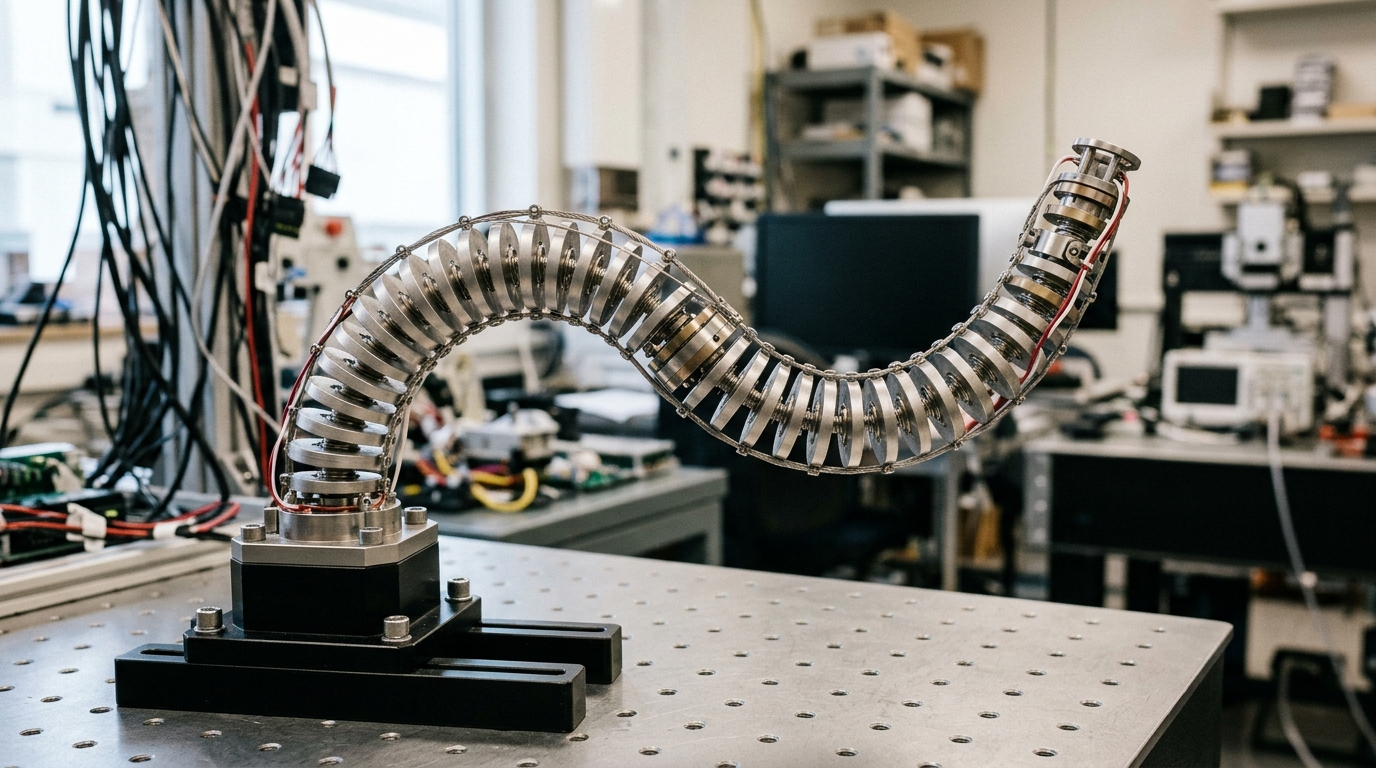
To establish a balance between mechanical fidelity and computational feasibility, the researchers formulated their two-section manipulator under the piecewise-constant-curvature assumption. In this architecture, each independent section measures 0.30 meters in nominal arc length and is driven by three longitudinal cables spaced symmetrically at a 21-millimeter routing radius. Rather than restricting bending to fixed geometric planes, the model assigns each section two generalized coordinates representing bending curvature and bending-plane orientation. This yields a four-dimensional coordinate vector that allows fully three-dimensional reorientations over time. Previous reduced-order models frequently relied on low-order Taylor series approximations to simplify kinematics and avoid symbolic singularity challenges near zero bending. In contrast, the current study preserves the complete trigonometric functions by employing an exact half-angle transformation. Kinematic Jacobians and inertia derivatives are subsequently derived through centered finite differences, maintaining numerical differentiation errors below one part in one billion when benchmarked against complex-step derivative calculations.
The physical dynamics of the two-section robot were assembled using the classical Euler–Lagrange formulation, incorporating full rotational and translational disk inertia, gravitational forces, elastic bending moments, and structural damping. The backbone incorporates spring-steel mechanical properties with an elastic modulus of 210 gigapascals, yielding a bending stiffness of 2.779 newton meters per radian per section. Actuation is applied through explicit cable-space kinematics mapped into generalized torques using virtual work. Because physical cables can pull but cannot push, the researchers implemented a positive-tension differential mapping with a minimum tension threshold of 1 newton and a nominal pretension of 4 newtons. Equations of motion were numerically propagated using an explicit fourth-order Runge–Kutta scheme with a 15-millisecond integration step during nominal tracking simulations. This structured formulation preserves cross-coupling between adjacent sections and bending-plane rotations without relying on artificial numerical decoupling.
To steer the flexible structure along intricate trajectories, the investigators designed an adaptive super-twisting sliding-mode controller optimized through particle swarm optimization, designated as PSO-ASTSMC. Sliding-mode techniques provide robust trajectory tracking for nonlinear systems by driving error states toward an engineered sliding manifold. The proposed scheme introduces a continuous reaching term alongside an adaptive gain schedule that dynamically expands the first twisting gain during large tracking deviations and contracts as the system approaches the target surface. A rigorous stability proof using a strict Lyapunov function confirmed finite-time convergence of the sliding variables under bounded perturbation rates verified through linear matrix inequalities. Particle swarm optimization configured six scaling multipliers against a multi-objective cost function that penalized joint errors, velocity errors, total input magnitude, input variation, and actuator saturation across two distinct spatial reference paths.
The primary tracking evaluation benchmarked the proposed controller against five standard control algorithms: model-compensated proportional-integral-derivative control, computed-torque proportional-derivative control, conventional sliding-mode control, fast terminal sliding-mode control, and fixed-gain super-twisting sliding-mode control. The first reference path examined a smooth multi-frequency sinusoidal trajectory, while the second tested a spatial figure-eight motion exciting simultaneous bending and rapid out-of-plane reorientations. Across both tuning trajectories, the adaptive super-twisting algorithm secured the lowest tracking discrepancies. On the figure-eight path, the proposed method achieved a mean joint root-mean-square error of 1.918 degrees and a Cartesian tip error of 13.631 millimeters. These figures correspond to tip tracking error reductions between 35.76 percent and 48.72 percent compared to the alternative baseline controllers. Notably, these gains were realized without inflating control effort, as the root-mean-square generalized torque of 1.644 newton meters remained within 1.6 percent of baseline requirements.
To verify that the optimization had not merely overfitted the controller to the two tuning trajectories, the authors evaluated all six algorithms on two additional reference motions without modifying controller parameters. The first unseen path followed a spatial spiral characterized by amplitude-modulated bending and wide plane excursions, while the second comprised four rest-to-rest quintic point-to-point segments dominated by acceleration, holding, and deceleration phases. The proposed controller maintained its leading performance across both validation tests, reducing tip root-mean-square errors by 27.4 percent to 50.8 percent compared to the baselines. Twenty independent stochastic optimization runs further demonstrated reproducibility, exhibiting a fitness coefficient of variation of 0.13 percent and consistent tracking performance with a tip error variation under 1.5 percent. Cable tensions remained strictly positive across all tests, confirming that tension constraints were systematically satisfied throughout complex spatial maneuvers.
The study also assessed the exact trigonometric kinematics against second-order and fourth-order Taylor-expanded approximations. Under second-order expansions representative of earlier simplified literature models, kinematic tip positioning errors reached 28.5 millimeters at moderate 45-degree section bending and climbed to 67.0 millimeters at 90 degrees. Replaying exact closed-loop torques through the second-order model produced roughly 20 to 22 millimeters of open-loop tip trajectory drift. While a fourth-order expansion performed acceptably at moderate bending, exact trigonometric evaluation eliminated angle-dependent truncation error entirely without requiring arbitrary truncation thresholds. Computationally, numerical differentiation of the exact expressions required 63.8 microseconds per evaluation, representing only a minor difference compared to 51.2 microseconds for the second-order series. Comparison against a planar elastica formulation revealed that piecewise-constant-curvature modeling introduced tip discrepancy between 0.43 and 1.04 millimeters under nominal disturbance loads, confirming the geometric model’s validity for moderate transverse loading.
Disturbance rejection was investigated using three complementary simulation protocols: section-wise transverse Cartesian forces, configuration-dependent tendon follower forces, and sequential three-axis force pulses. In the follower-force release protocol, an external lateral load was applied along the instantaneous tendon tangent and suddenly released, preserving continuous dynamic state propagation without artificial velocity resets. The robot exhibited three equilibrium crossings and four alternating extrema before settling within 2.48 millimeters of the unloaded origin, confirming natural damped oscillation governed by stored elastic and kinetic energy. Under persistent held loading, the manipulator converged within 0.45 millimeters of its displaced equilibrium position. The repeated-pulse tests, comprising three sequential forces of 0.22, 0.20, and 0.18 newtons across different Cartesian axes, showed that the controller rapidly restored tip position within 5 millimeters, although complete damping of internal joint oscillations required extended recovery intervals exceeding 3.5 seconds.
A critical contribution of the research lies in its thorough robustness analysis, which exposed significant structural sensitivities inherent to nominal-model tuning. When controllers were tuned exclusively on the nominal robot model, all six algorithms failed—either diverging or exceeding 50 millimeters of post-transient tip error—when the plant’s actual stiffness or damping deviated by approximately 10 percent. The authors traced this fragility to physical dynamics: because the robot’s generalized inertia is exceptionally small (around 10^-4 to 10^-5 kilogram square meters) relative to its elastic restoring stiffness, slight parameter mismatches generate severe acceleration-level disturbances exceeding 80 radians per second squared. To overcome this vulnerability, the authors executed an uncertainty-aware retuning over multi-plant parameter bounds using a 500-hertz control loop. Following retuning, the proposed controller sustained zero failures across 40 randomized plants with plus-or-minus 15 percent parametric variations, achieving a median post-transient tip error of 0.59 millimeters.
Despite these encouraging numerical findings, the authors emphasize several key physical limitations that demand experimental validation on physical prototypes. High control gains in the retuned system heightened sensitivity to sensor measurement noise, increasing total control signal variation from 9.1 to 3431 units, which produces severe actuation chattering that would require dedicated state observers or filtering in practice. Furthermore, the simulations revealed peak cable tensions approaching 88 to 108 newtons, producing up to 278 newtons of cumulative axial compression on the proximal backbone section. While design modifications such as adopting superelastic nickel-titanium backbones and increasing routing radii can reduce tension demands to 22 to 27 newtons, unmodeled physical phenomena including guide-hole friction, cable stretch, backlash, and non-constant curvature under heavy loads cannot be resolved by simulation alone. The researchers have released their complete numerical algorithms in MATLAB, Python, and C to provide an open benchmark for subsequent hardware validation.
Subject of Research: Dynamic modeling and adaptive robust control of two-section cable-driven continuum robots
Article Title: Taylor-free exact-trigonometric dynamic modeling and PSO-tuned adaptive super-twisting control of a two-section spatial continuum robot: a simulation study
Article References: Djeffal, S., Ghoul, A., Morakchi, M. R., & Latreche, A. (2026). Taylor-free exact-trigonometric dynamic modeling and PSO-tuned adaptive super-twisting control of a two-section spatial continuum robot: a simulation study. Frontiers in Robotics and AI, 13, Article 1962199. https://doi.org/10.3389/frobt.2026.1962199
Image Credits: AI Generated
DOI: 10.3389/frobt.2026.1962199
Keywords: continuum robots, cable-driven manipulators, piecewise constant curvature, exact trigonometric modeling, adaptive super-twisting control, sliding-mode control, particle swarm optimization, Euler-Lagrange dynamics, finite-time stability, Lyapunov methods, trajectory tracking, follower force disturbances, parametric uncertainty, actuator saturation, tendon tension allocation, soft robotics dynamics
News Source: Denise Maddox. (November 13, 2026). Exact Trigonometric Model Improves Simulated Control of Two-Section Continuum Robots. Scienmag.