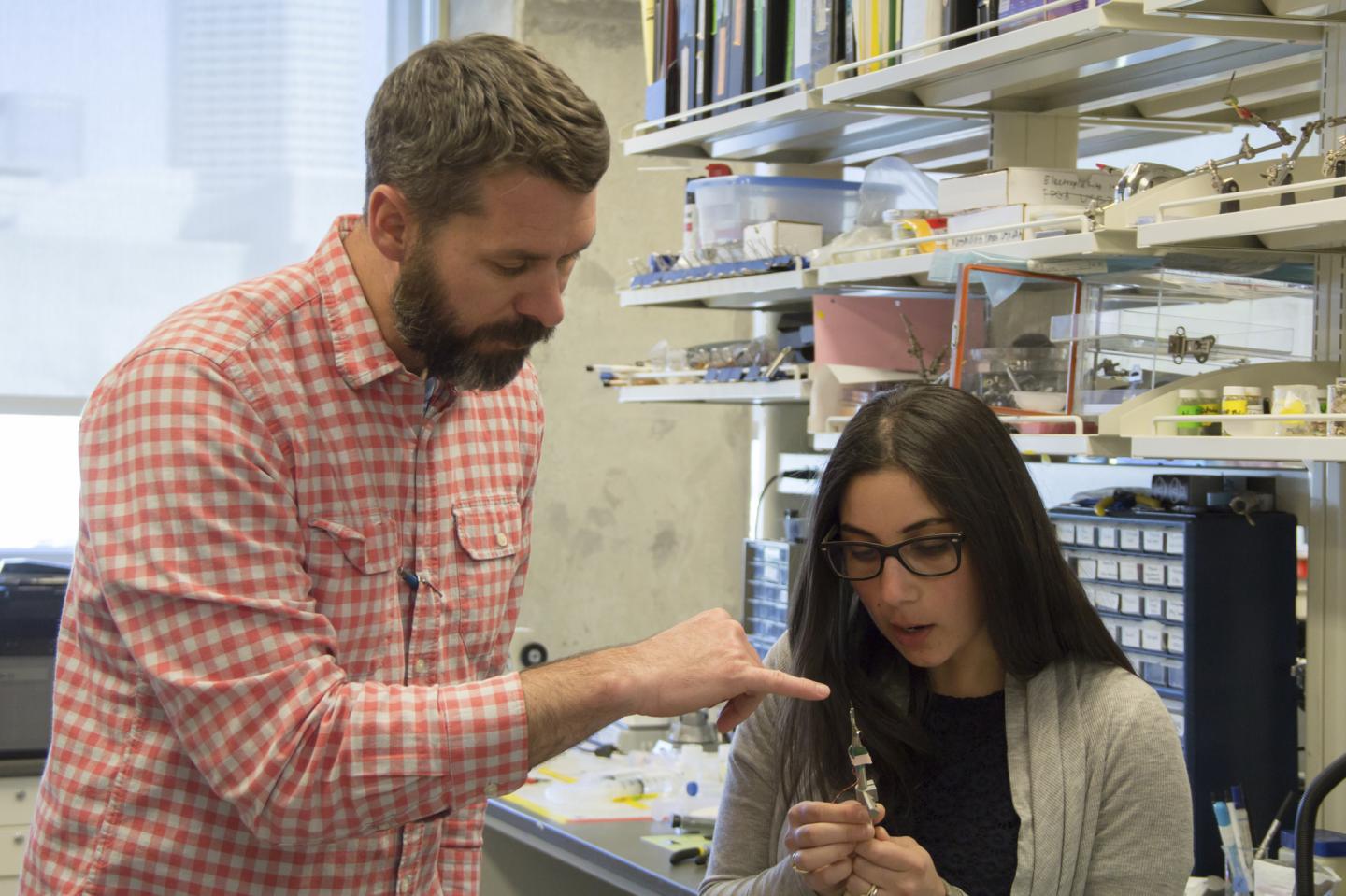
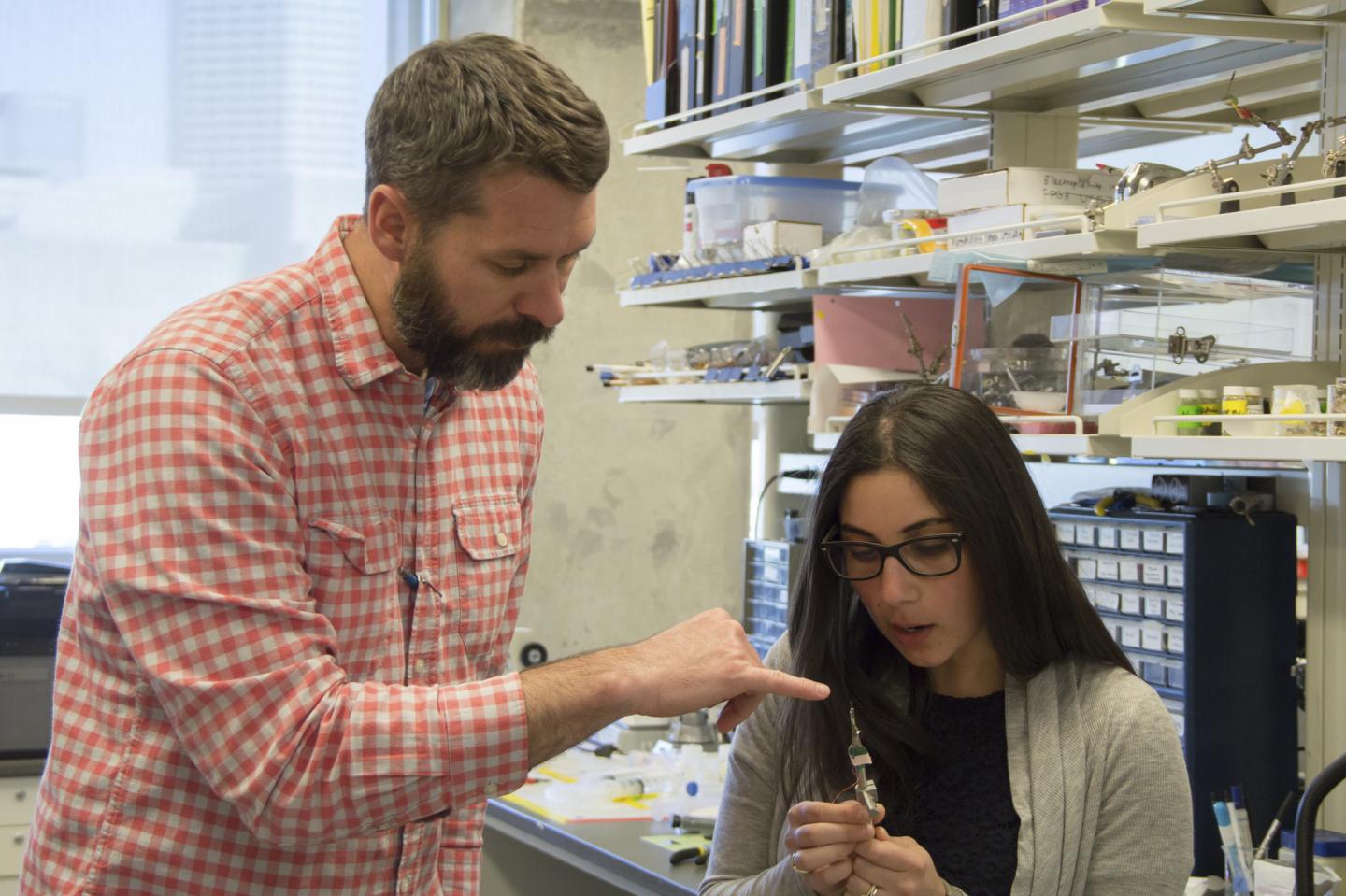
Credit: School of Science at IUPUI
INDIANAPOLIS — When a baby is taken from its mother for even a brief period early in life, this traumatic event significantly alters the future, adult function of the brain, according to a new animal model study from the School of Science at IUPUI. These changes in the brain are similar to disturbances in brain structure and function that are found in people at risk for neuropsychiatric disorders, such as schizophrenia.
The study was conducted in the laboratory of associate professor of psychology Christopher Lapish. In the study, young rats were removed from their mothers for 24 hours when they were nine days old, which is a critical period of brain development. The resulting scans revealed that, unlike animals that were not separated from their mother during this crucial period, the separated rats exhibited significant behavioral, as well as biological and physiological, brain abnormalities in adulthood.
"Rat and human brains have similar structure and connectivity," Lapish said. "Understanding what happens in the brain of a young rat that's removed from its mother gives us important insight into how this type of early trauma — perhaps comparable to the incarceration of a human mother — affects the young human brain.
"The more we understand how the brain responds, the closer we come to being able to address and hopefully develop novel treatment strategies to reverse these neurological changes."
"In this study, we found memory impairment, as well as less communication between brain regions, in the animals that had been removed from their mothers, among other neurological changes," said study corresponding author Sarine Janetsian-Fritz, formerly a graduate student in the Lapish lab and now a postdoctoral fellow in neuropsychology at the Indiana University School of Medicine. "These are all clues to how a traumatic event early in life could increase a person's risk of receiving a schizophrenia diagnosis in the future."
The causes of schizophrenia and the delay in the appearance of symptoms of this lifelong disease remain a mystery.
"Children exposed to early-life stress or deprivation are at higher risk for mental illness and addictions later in life, including schizophrenia," said study co-author Brian F. O'Donnell, professor of psychological and brain sciences at IU Bloomington. "We have identified enduring changes in the brain and behavior that result from one type of stress in a rodent. These types of brain changes might mediate the effects of adverse events on children. Thus, policies or interventions that mitigate stress to children could reduce vulnerability to emotional disorders in adulthood."
"Maternal deprivation induces alterations in cognitive and cortical function in adulthood" appears in Translational Psychiatry, a Nature Publishing Group journal. Authors, in addition to Lapish, Janetsian-Fritz and O'Donnell are Nicholas M. Timme, Maureen M. Timm, Aqilah M. McCane and Anthony J. Baucum II, all of the School of Science at IUPUI.
###
The study was funded by an Indiana University Collaborative Research Grant awarded jointly to Lapish, who studies the neurophysiological basis of cognition; O'Donnell, who studies schizophrenia in humans; and Baucum, who conducts brain chemical analyses.
The School of Science at IUPUI is committed to excellence in teaching, research and service in the biological, physical, computational, behavioral and mathematical sciences. The school is dedicated to being a leading resource for interdisciplinary research and science education in support of Indiana's effort to expand and diversify its economy.
Media Contact
Cindy Fox Aisen
[email protected]
317-843-2275
http://science.iupui.edu/