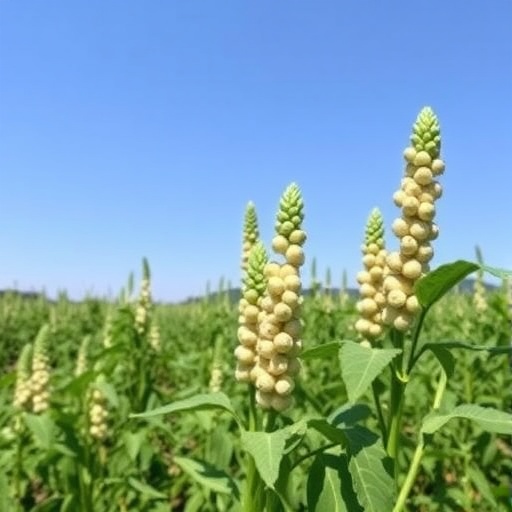
Evapotranspiration plays a critical role in agricultural productivity, particularly in semi-arid regions where water resources are scarce. In a recent comprehensive study published in Discover Agriculture, researchers Mahmoud, Husein, and Omar meticulously examined the evapotranspiration rates of Faba beans and Chickpeas using the soil water balance method. This investigation was conducted under field conditions in the Gezira Scheme, Sudan, a region characterized by its unique climatic and hydrological conditions.
Understanding evapotranspiration is essential for efficient water management in agricultural practices. It encompasses the processes of water evaporation from soil and plant surfaces as well as transpiration from plants. The need for precise measurement of this phenomenon is paramount, especially in areas where farmers depend heavily on rain-fed agriculture. In the diverse agricultural landscape of Sudan, accurate calculations of evapotranspiration can significantly impact crop yield and sustainability.
The study leverages the soil water balance method, which provides a robust framework for understanding the interplay between water input and output in the agricultural context. By establishing a detailed hydrological balance, the researchers were able to quantify the water demands of Faba beans and Chickpeas over time. This approach entails careful monitoring of precipitation, soil moisture, and irrigation, thereby providing a holistic view of water dynamics in the soil-plant-atmosphere continuum.
Rate of water loss through evapotranspiration can vary significantly based on several factors, including plant species, soil type, and climatic conditions. Faba beans and Chickpeas, while both legumes, exhibit distinct characteristics that can influence their respective water needs. By focusing on these two crops, the researchers aimed to provide actionable insights for farmers looking to optimize water use efficiency in their fields.
One of the key findings of the research highlights the critical difference in evapotranspiration rates between the two crops under similar environmental conditions. Faba beans, known for their deep rooting systems, exhibited different water uptake patterns compared to Chickpeas, which tend to have more shallow roots. Understanding these nuances helps farmers tailor their irrigation strategies to conserve water while maximizing yield.
Furthermore, the study emphasizes the significance of local environmental factors, including temperature, humidity, and wind speed, which collectively influence evaporation and transpiration rates. The Gezira Scheme’s specific conditions offer a valuable case study for exploring the interactions between these variables and crop water usage, ultimately guiding more effective agricultural practices in similar climates.
The researchers conducted a rigorous field experimentation process, applying advanced techniques to monitor soil moisture content and analyze crop growth parameters. This empirical data not only enhances the understanding of evapotranspiration but also serves as a foundation for further research into crop adaptability and water-efficient farming methods.
The implications of this research extend beyond agricultural productivity; they also touch on sustainability and resource management in an era where climate change poses significant challenges to food security. By promoting water conservation strategies based on scientifically derived data, this study contributes to the broader discourse on sustainable farming practices.
Farmers often grapple with the uncertainty of water availability, particularly in semi-arid regions experiencing variable precipitation patterns. The findings from Mahmoud et al. offer a beacon of hope, providing essential information that can help mitigate the adverse effects of water scarcity on crop production. By making informed decisions based on evapotranspiration data, farmers can improve crop resilience and overall farm sustainability.
In addition to aiding individual farmers, the insights gained from this research can also inform policymakers and agricultural extension services. By understanding the specific water needs of different crops, policymakers can better design irrigation infrastructure and allocate resources effectively, ensuring that farmers have access to the support they need during critical growing periods.
As the agricultural community continues to navigate the complexities of water management, studies like this one illuminate the path forward. By addressing water scarcity issues through scientific research, it is possible to foster a more sustainable approach to agriculture that prioritizes both productivity and environmental stewardship. The delicate balance between crop demands and available water resources remains a pivotal focus area for future research and agricultural planning.
In summary, Mahmoud and colleagues’ study provides invaluable data on the evapotranspiration rates of Faba beans and Chickpeas in Sudan’s Gezira Scheme, showcasing the importance of scientifically informed practices in agriculture. As the world seeks innovative solutions to optimize resource use in farming, understanding the dynamics of evapotranspiration stands out as a crucial aspect of sustainable farming that cannot be overlooked.
By integrating traditional agricultural knowledge with modern research findings, farmers can enrich their practices and ultimately foster a more resilient agricultural landscape. This study serves as a foundation for ongoing exploration into the relationship between crops and their water needs, setting the stage for further advancements in sustainable agriculture.
Subject of Research: Determining evapotranspiration of Faba bean and Chickpea using the soil water balance method under field conditions in the Gezira Scheme, Sudan.
Article Title: Determining evapotranspiration of Faba bean and Chickpea using the soil water balance method under field conditions in in the Gezira Scheme, Sudan.
Article References: Mahmoud, M.K.A.J., Husein, M.A. & Omar , M.E.D.M. Determining evapotranspiration of Faba bean and Chickpea using the soil water balance method under field conditions in in the Gezira Scheme, Sudan.
Discov Agric 3, 276 (2025). https://doi.org/10.1007/s44279-025-00458-3
Image Credits: AI Generated
DOI: https://doi.org/10.1007/s44279-025-00458-3
Keywords: Evapotranspiration, Faba bean, Chickpea, Soil Water Balance, Gezira Scheme, Sudan, Agriculture, Water Management, Sustainability.
Tags: agricultural water resource managementChickpea irrigation needscrop yield sustainabilityevapotranspiration analysisevapotranspiration measurement techniquesFaba bean water requirementshydrological balance in agriculturerain-fed agriculture challengessemi-arid agriculture practicessoil water balance methodSudan agricultural productivitywater management in farming