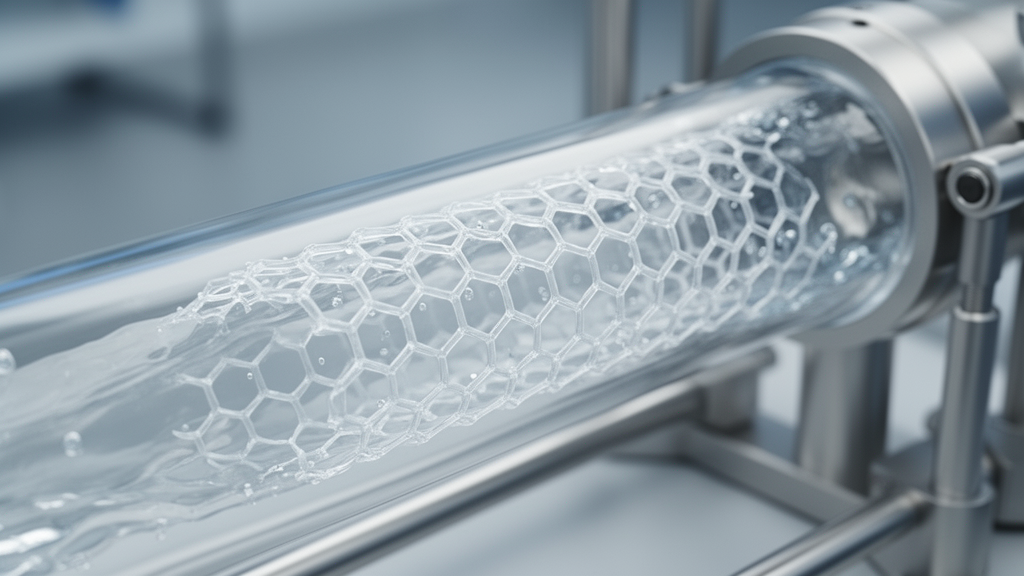
EV2 Technologies, a startup spun out of the University of Pittsburgh, has been awarded a two-year, $2.1 million Small Business Innovation Research Direct-to-Phase II grant from the National Institutes of Health National Heart, Lung, and Blood Institute. The non-dilutive award directly supports the ongoing development and testing of Biocarpet, an endovascular device designed as a fully biodegradable sheet that unfurls inside diseased blood vessels to treat peripheral artery disease. The condition currently affects more than 12 million people across the United States and approximately 200 million individuals worldwide, driving demand for interventions capable of relieving severe arterial blockages.
While stents are commonly used to treat the disease, these devices are not compatible with small or winding arteries and often fail after they are implanted, particularly in vessels that cross joints. According to Jonathan Vande Geest, an EV2 co-founder and professor of bioengineering at Pitt’s Swanson School of Engineering, blood vessels are not just straight tubes and can become a very complex biomechanical environment as people age. Biocarpet was invented to provide a solution that conforms to this complicated vascular anatomy and reduces the likelihood of restenosis.
The underlying biomedical technology represents the culmination of multiple years of collaborative academic research conducted at the University of Pittsburgh. Alongside Vande Geest, the founding team includes chief executive officer and principal investigator Ali Behrangzade, who completed his bioengineering doctorate at Pitt in 2022, bioengineering distinguished professor William R. Wagner, and John Pacella, an associate professor at Pitt’s School of Medicine who also practices as an interventional cardiologist at the University of Pittsburgh Medical Center.
Over the upcoming two-year grant period, EV2 Technologies will deploy the federal funding across several interrelated preclinical development tracks. The team will refine its manufacturing process to lay the foundation for scalability. In tandem, engineering teams will redesign the specialized thermal balloon catheter required to deliver and deploy the unfurling sheet within targeted vessels. The team also plans to develop an accompanying control console engineered for broad compatibility across standardized clinical catheterization laboratories.
Alongside those engineering updates, the company will run a wide range of benchtop testing on the improved prototypes. The benchtop testing will be followed by a six-month study to assess the device's safety and efficacy in an animal model.
The trajectory leading to the Direct-to-Phase II award was established through sequential translational support mechanisms across regional and federal innovation ecosystems. Initial proof-of-concept work began in 2019 when Pitt’s Center for Medical Innovation provided early funding for benchtop feasibility demonstrations. That foundational research positioned the concept to secure awards in institutional venture programs, including the Wells Student HealthTech Challenge, the Randall Family Big Idea Center Pitch Competition, and the Pitt Innovation Challenge, which collectively provided the momentum necessary for continued translational execution.
Translational acceleration continued when Behrangzade joined the university faculty full-time in 2022, enabling dedicated experimental campaigns that generated critical quantitative datasets. In 2023, Vande Geest secured an NIH Catalyze grant with Behrangzade serving as co-investigator and project lead. The Catalyze funding allowed the team to bypass the traditional Phase I SBIR process, and the data it produced ultimately led to the successful application for the Direct-to-Phase II SBIR award now funding the company’s current work.
The award also marks a turning point for EV2, providing the resources to formally license the underlying technology from the University for the first time. Looking forward, the company plans to maintain a balanced capital strategy combining non-dilutive public research grants with private venture capital investment. Vande Geest noted that without support from programs including the Office for Innovation and Entrepreneurship, CMI, the McGowan Institute for Regenerative Medicine, LifeX, and the NHLBI, the technology would not be where it is today.
Subject of Research: Biodegradable endovascular sheet development for peripheral artery disease treatment
Article Title: A flexible fix for rigid stents
Article References: A flexible fix for rigid stents. Original publication (Bibliographic details unavailable.)
Image Credits: AI Generated
DOI: Not provided
Keywords: EV2 Technologies, Biocarpet, peripheral artery disease, biodegradable sheet, NIH NHLBI, SBIR Direct-to-Phase II, University of Pittsburgh, Swanson School of Engineering, Jonathan Vande Geest, Ali Behrangzade, restenosis, thermal balloon catheter, endovascular device, preclinical animal study, vascular biomechanics, Center for Medical Innovation
News Source: Denise Maddox. (November 20, 2026). EV2 Technologies Secures NIH Award to Advance Biodegradable Stent Alternative. Scienmag.