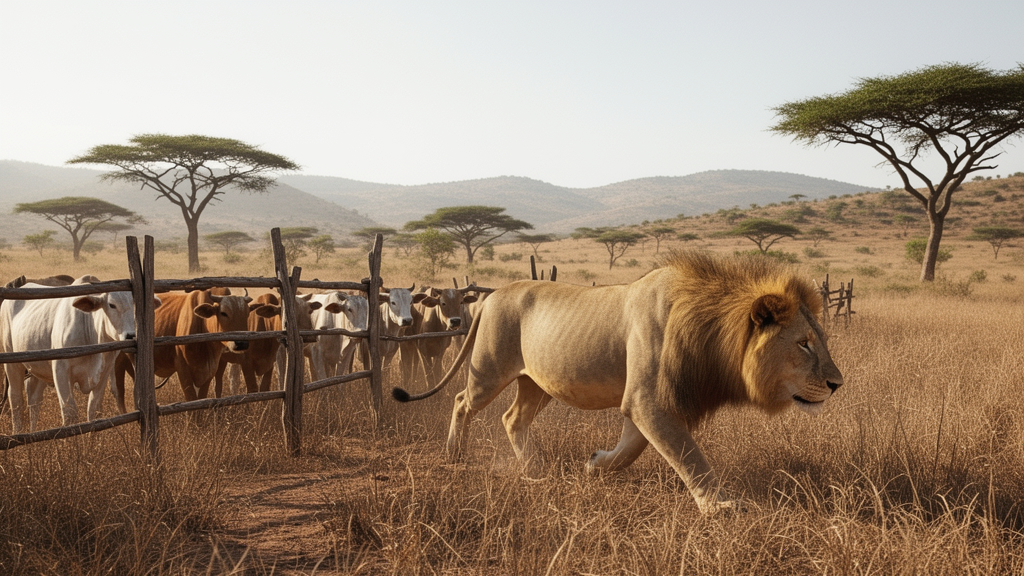
A community-based cross-sectional study conducted in and around Borena Sayint Worehimanu National Park in Ethiopia has documented the scale and drivers of human-carnivore conflict in the South Wollo zone of the Amhara Region. Published in BMC Zoology in March 2026, the research provides a detailed assessment of livestock depredation, farmer responses, and the associated economic burden on rural households. The study highlights that leopards and spotted hyenas are the primary species involved in conflicts, with sheep and goats representing the majority of domestic animals killed. The findings underscore the urgent need for targeted conservation strategies that address the root causes of these interactions, which are largely driven by habitat encroachment and resource competition.
The research team selected four woredas, or districts, bordering the national park for the study: Legambo, Borena, Mekdela, and Sayint. These districts were chosen purposively because they represent the historically core areas of the park and contain the highest density of woodland vegetation, which provides essential habitat for large carnivores. From each district, one village sharing an immediate boundary with the park was included in the sample. This approach allowed the researchers to focus on communities with the most frequent interactions with wildlife. The study period spanned from December 2023 to August 2024, during which data were collected from 573 randomly selected respondents using both open- and close-ended questionnaires.
The study identified six carnivorous species and one opportunistic omnivorous species, the Anubis baboon, as predators of domestic animals in the area. Among the carnivores, the leopard (Panthera pardus) was the most frequently reported predator, accounting for 46.9% of conflict incidents. The spotted hyena (Crocuta crocuta) followed, responsible for 26.5% of the conflicts, while the common jackal ranked third with 17.3%. Together, these three species were responsible for more than 90% of all recorded conflicts. Other species, including the Ethiopian wolf, gelada baboon, African wild dog, and caracal, contributed a smaller percentage of the total conflict, reflecting their specific dietary preferences and hunting behaviors.
Livestock predation patterns revealed that sheep and goats are the most common targets for these predators. Sheep were the most frequent victims, accounting for 48.2% of all attacks, followed by goats at 23.4%. Combined, these two species represent approximately 71.6% of the prey animals. The study found that the majority of predation events occur during the day, specifically when domestic animals are grazing on communal land outside the park. This daytime predation pattern contrasts with some other regions where nocturnal attacks are more common, suggesting that the vulnerability of livestock during grazing hours is a significant factor in the frequency of conflicts in this highland ecosystem.
The economic impact of these conflicts is substantial for the local farming communities. The total economic cost of carnivore depredation over the three-year recall period was estimated at 22,968,500 Ethiopian Birr, which is equivalent to approximately 166,438 US dollars. This translates to an annual loss of about 55,479 US dollars for the community, with a mean annual livestock loss of 96.82 US dollars per household. These figures highlight the significant financial strain that livestock depredation places on rural households, many of which depend on livestock for their primary income. The lack of a compensation system for these losses exacerbates the economic burden and contributes to the negative attitudes held by many community members toward carnivore conservation.
When their livestock are killed by carnivores, farmers in the study area typically respond with retaliatory actions. The most common response is poisoning the remaining parts of the carcass, reported by 43.6% of respondents. Chasing the animals away is the second most frequent action, cited by 28.8% of farmers, followed by direct killing of the predators as revenge, which was reported by 18.8% of respondents. These retaliatory measures are often driven by the immediate financial and emotional losses experienced by the farmers. The study notes that such actions can have detrimental effects on carnivore populations, further complicating conservation efforts in the region.
The study also examined the perceived causes of human-carnivore conflict, with overgrazing identified as the primary driver, cited by 29.3% of respondents. Illegal agricultural expansion was the second most common cause, reported by 17.5% of participants. These factors suggest that the expansion of human activities into wildlife habitats is a significant contributor to the conflict. The study found that conflict severity varies across the different districts, with some communities perceiving the conflict as more severe than others.
Community perceptions of carnivore conservation were largely negative, with 66.1% of respondents opposing the conservation of wild carnivores. This opposition is particularly strong in the Legambo district, where 72.6% of residents expressed negative attitudes. In contrast, the Borena district showed the highest level of support for conservation, although it still remained below 50%. The study suggests that these negative attitudes are directly linked to the economic losses and threats posed by carnivores to livestock and, in some cases, human safety. The lack of tangible benefits from conservation efforts further reinforces these negative perceptions among the local communities.
In terms of mitigation strategies, the majority of respondents suggested that the government should focus on providing alternative livelihoods and establishing a compensation system for lost property. Offering alternative livelihoods was the most popular suggestion, cited by 44.8% of respondents, while setting up a compensation system was suggested by 37.9%. These recommendations reflect the desire for practical solutions that address the root causes of the conflict and provide financial support to affected farmers. The study emphasizes the importance of community-based conservation approaches that engage local residents in the management of wildlife and the protection of their livelihoods.
The study has several limitations that should be considered when interpreting the results. The cross-sectional design limits the ability to establish causal relationships between variables and to track changes over time. Additionally, the study was conducted in only four districts, which may limit the generalizability of the findings to other protected areas in Ethiopia. The use of community recall for economic data may introduce biases, and the reliance on descriptive statistics and chi-square tests limits the analysis of the strength of associations between variables. Despite these limitations, the study provides valuable insights into the dynamics of human-carnivore conflict in the Borena Sayint Worehimanu National Park area and offers a basis for developing more effective conservation and management strategies.
Borena Sayint Worehimanu National Park encompasses 15,262 hectares across an elevational gradient spanning from 1,900 to 4,280 meters at Mount Golate. Established under regional regulation in 2008, the conservation area supports 174 documented plant species, including distinctive endemics such as giant lobelia, Euphorbia dumalis, and Echinops kebericho. In addition to harboring rare flora, the park serves as critical refuge for twenty-three large and medium mammalian species alongside seven small mammal taxa. These include endangered and endemic mammals such as the Ethiopian wolf and gelada baboon, living in close proximity to human settlements where communal grazing lands intersect with wild habitat edges.
Predation dynamics showed pronounced seasonal and species-specific patterns across the surveyed landscape. Depredation incidents occurred somewhat more frequently during the wet season, accounting for 53.2% of events compared to 46.8% in the dry season, a shift attributed to dispersed wildlife movements and denser vegetative cover. Analysis of prey selection revealed significant predator-specific preferences. Leopards focused overwhelmingly on smaller stock, taking sheep in 68.0% and goats in 29.5% of incidents. Meanwhile, common jackals targeted chickens in 87.3% of their recorded attacks, and caracals preyed exclusively on poultry, reflecting how predator body size and hunting methods govern vulnerability among domestic herds.
Local livestock husbandry relied heavily on direct, traditional defensive measures rather than modern deterrents. Herding by adult family members served as the primary protective strategy, used by 36.5% of households, while physical barriers such as fencing sheltered animals for another 27.9%. When attacks occurred, farmer reactions diverged noticeably among administrative areas. In Mekdela, where direct retaliatory killing was reported by 32.9% of farmers, carcass poisoning was the dominant reaction at 52.1%. By contrast, pastoralists in Legambo favored chasing predators away at 43.2%, with direct lethal killing dropping to 5.5%. Correspondingly, underlying drivers differed locally: residents in Sayint cited illegal human settlement as their foremost concern at 39.5%, while respondents in Mekdela identified illegal hunting as the leading factor at 40.0%.
To determine economic loss, researchers gathered commodity valuations from district trade offices, calculating standardized prices by averaging high, medium, and low market values before converting Ethiopian Birr at an exchange rate of 130 Birr per US dollar. Beyond direct financial damages, community members evaluated wider conservation pressures facing regional wildlife. Habitat destruction was considered the predominant threat overall, identified by 41.0% of participants, followed by retaliatory killing at 29.3%. Spatial variations remained marked, with Legambo reporting disturbance-driven wildlife migration as its foremost concern at 48.0%, while Mekdela cited agricultural encroachment at 46.7%. These localized environmental realities highlight how conservation solutions must address specific district pressures to foster sustainable coexistence.
Subject of Research: Human-carnivore conflict dynamics and economic impacts in Borena Sayint Worehimanu National Park, Ethiopia
Article Title: Human carnivore conflict in and around Borena Sayint Worehimanu National Park, South Wollo, Amhara Region, Ethiopia: A community-based cross-sectional study design
Article References: Abdu, I., & Seid Muhie, N. (2026). Human carnivore conflict in and around Borena Sayint Worehimanu National Park, South Wollo, Amhara Region, Ethiopia: A community-based cross-sectional study design. BMC Zoology, 11(1), Article 8. https://doi.org/10.1186/s40850-026-00261-7
Image Credits: AI Generated
DOI: 10.1186/s40850-026-00261-7
Keywords: human-carnivore conflict, livestock depredation, Borena Sayint Worehimanu National Park, Ethiopia, conservation, economic impact, leopard, spotted hyena, community-based study, wildlife management, Human, carnivore
News Source: Margaret Porter. (November 9, 2026). Ethiopian Study Quantifies Carnivore Conflict and Economic Losses. Scienmag.