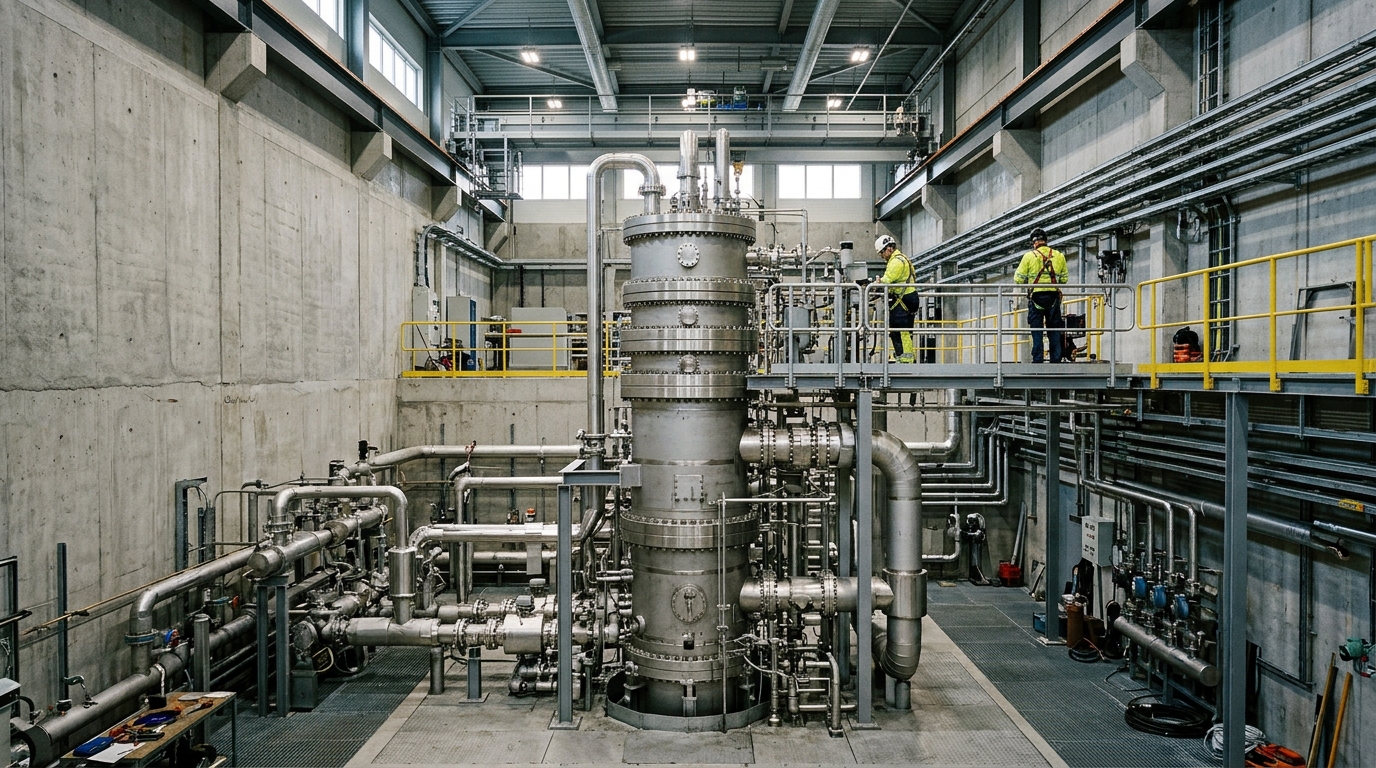
A scholarly analysis published in Science and Engineering Ethics by researchers Johanes Narasetu Widyatmanto and Rafaela Hillerbrand examines how the emergence of small modular reactors challenges established international nuclear governance. While conventional commercial nuclear power plants are built as integrated, large-scale facilities constructed directly on site, small modular reactors introduce factory fabrication, compact layouts, and scalable electricity generation. These evolutionary and innovative designs promise shorter construction timelines and lower initial capital commitments while supplying low-carbon electricity, yet they also generate unprecedented risk scenarios that existing international regulatory architectures were not originally designed to resolve. To address these emerging governance gaps, the authors apply the agent-centred framework of ethical risk assessment developed by Helena Hermansson and Sven Ove Hansson to the International Atomic Energy Agency fundamental safety principles, demonstrating how a systematic mapping of moral responsibilities can modernise nuclear safety protocols for next-generation fission technologies.
Small modular reactors, commonly designated as SMRs, are promoted as flexible technological solutions for national energy security and industrial decarbonisation. Unlike traditional gigawatt-scale facilities, SMRs are designed to possess lower generation capacities and modular assemblies that allow units to be built in factory environments and transported as complete modules by land or sea to final operating sites. This modular architecture allows capacity to expand incrementally as regional demand grows, while multi-module configurations can prevent total facility shutdowns during planned maintenance cycles. Compact dimensions allow these reactors to be deployed in diverse locations, ranging from remote Arctic settlements such as the floating deployment at Pevek in Russia to industrial clusters requiring continuous base-load power for synthetic fuel synthesis, hydrogen electrolysers, and high-demand artificial intelligence data centres. Globally, nuclear engineering organisations have developed ninety-eight distinct SMR designs across various developmental phases, with five units under active construction and two commercial systems operating in China and Russia.
Despite substantial industrial enthusiasm, the structural and commercial novelties of SMRs generate distinct technical and ethical dilemmas that do not occur in conventional large-scale installations. In traditional facilities, on-site construction maintains centralised regulatory oversight throughout assembly, whereas factory manufacturing allows an SMR module to be engineered in one jurisdiction and shipped across international borders to a client state that possesses divergent regulatory standards or no prior commercial nuclear operational history. Transporting fully assembled nuclear reactor modules across open terrestrial and maritime corridors introduces physical security risks, including the potential loss or malicious interception of entire assemblies. Furthermore, the physical compactness of SMRs encourages siting closer to populated municipal centres, expanding the potential civilian demographic directly exposed to radiation hazards in the event of an operational accident. Modularity also creates international knowledge asymmetries, where producing states may retain proprietary technological expertise while recipient nations develop enduring operational and maintenance dependencies.
The foundational regulatory guidance for international civil nuclear energy remains anchored in the ten fundamental safety principles established by the International Atomic Energy Agency in 2006. While the IAEA has maintained that safety remains the paramount priority across all nuclear activities, its overarching principles were drafted to cover a broad spectrum of nuclear applications, encompassing medical facilities, food irradiation, research reactors, and traditional large-scale power stations. Consequently, the authors demonstrate that existing guidelines lack the precise operational specificity required to govern multi-state deployment pipelines, cross-border commercial transactions, and novel engineering configurations characteristic of SMRs. Moreover, earlier philosophical and ethical scholarship in the nuclear domain has concentrated predominantly on back-end fuel-cycle hazards, particularly the intergenerational justice questions surrounding high-level radioactive waste repositories, leaving the managerial, operational, and distributive aspects of reactor safety undertheorised.
To establish a coherent foundation for SMR safety governance, the investigation adopts Hermansson and Hansson’s three-party model of ethical risk assessment. This framework complements standard probabilistic risk assessments and economic cost-benefit analyses, which quantify statistical probabilities and monetary impacts but frequently obscure qualitative questions of justice, ignorance, and unequal exposure. The model organises risk situations around three primary agential categories: the risk-exposed individuals who face potential hazards, the beneficiaries who capture practical or financial utility, and the decision-makers who authorize technical or commercial courses of action. It interrogates risk distributions through seven reflective moral queries regarding the distribution of benefits, procedural fairness, compensatory remedies, agential decision-making power, access to technical data, the representation of unvoiced populations, and the potential personal enrichment of decision-makers. Integrating Amartya Sen’s basic capabilities perspective, the paper argues that fair risk distribution must protect individuals’ essential capabilities for human flourishing rather than merely calculating aggregated economic utility.
The practical necessity of an agent-centred approach becomes particularly acute when evaluating real-world adoption pathways. The study highlights two prominent deployment scenarios: first-of-a-kind implementation in nations lacking established nuclear experience, and the complete privatization of nuclear mini-grids by energy-intensive corporate entities. In embarking countries such as Indonesia, where energy authorities are evaluating novel reactor designs like molten-salt SMR concepts developed by foreign private firms, the absence of commercial operating history amplifies technical uncertainties surrounding regulatory oversight, local workforce training, and long-term waste handling. Similarly, private industrial consumers seeking dedicated power for data processing facilities introduce private-grid configurations that operate outside traditional public utility oversight. Because commercial investments in untested technologies inevitably introduce distributions of risk that are difficult to quantify with historical empirical data, ethical risk assessment provides structured criteria to hold specific corporate and state agents accountable for managing emergent hazards.
Applying this framework directly to international safety standards, the researchers systematically reformulate all ten IAEA fundamental safety principles into agent-centred directives. For Principle 1, governing responsibility for safety, the authors propose that prime accountability must rest specifically with those entities that actively benefit from and decide to initiate radiation-generating operations, thereby distributing legal and operational liability clearly between private corporate vendors and state licensing bodies. For Principle 2, concerning the role of government, the framework mandates that independent regulatory authorities explicitly evaluate risk exposure, economic benefits, and their societal distribution. Principle 3, which addresses leadership and safety management, is expanded to mandate institutional transparency, requiring facility leadership to ensure the comprehensive accessibility and proactive distribution of technical risk data to facility engineers, operating staff, and adjacent communities.
The mid-tier IAEA principles undergo comparable agent-centred restructuring to govern socioeconomic and engineering choices. Principle 4, requiring overall justification for radiation-generating activities, is redefined to mandate that net benefits must be directly realized, either through monetary mechanisms or in-kind public goods, by the specific communities residing near the reactor installation. Principle 5, which directs the optimisation of protection to achieve the highest reasonable standard of safety, is revised so that reasonability cannot be constrained to mere corporate economic viability, requiring nuclear companies and governments to structure safeguards around equitable risk distribution. Principle 6, addressing individual risk limitation, is reformulated to mandate comprehensive institutional mechanisms across engineering containment, seismic resilience, public policy, and professional education to prevent any single population group from bearing disproportionate harm.
The remaining safety directives are adapted to tackle extended temporal, emergency, and mitigation challenges. Under reformulated Principle 7, policymakers and industrial actors bear an explicit duty to minimise radiation risks for both contemporary and unborn generations by maintaining exhaustive transparency regarding fuel types, coolant chemistries, and decommissioning protocols. Principle 8 distributes the primary practical burden of accident prevention and engineering mitigation directly onto commercial business entities working in close coordination with state bodies. For Principle 9, covering emergency preparedness, primary operational and preventive responsibilities are placed upon operating firms, while acknowledging that catastrophic liabilities often necessitate state fiscal backstops, as demonstrated historically during the Fukushima cleanup involving Tokyo Electric Power Company. Finally, Principle 10 mandates that protective interventions for unregulated or legacy risks must be optimized without shifting secondary radiological or economic burdens onto marginalized communities.
Notwithstanding the advantages of this agent-centred model, the authors present a critical appraisal of its internal limitations, observing that focusing exclusively on individual agent categories risks neglecting the profound influence of institutional embedding. Drawing on the institutional governance scholarship of Elinor Ostrom, the paper notes that individual decision-makers and operating organizations do not function within social vacuums; rather, they are embedded within legal conventions, political structures, regulatory traditions, and cultural contexts that differ markedly across jurisdictions. The authors contrast the centralized, state-dominated civil nuclear landscape of France—where Électricité de France and Framatome operate under pervasive governmental ownership—with the highly decentralized commercial landscape of the United States, where dozens of private utilities operate nuclear assets under federal regulatory boundaries across multiple states. This structural divergence demonstrates that formal rules and informal norms fundamentally condition how risk, transparency, and corporate responsibility are enacted.
The study concludes that while an agent-centred methodology successfully rectifies the abstract generality of existing international nuclear regulations, establishing durable governance for next-generation nuclear technology requires synthesizing agential accountability with comprehensive institutional analysis. As small modular reactors progress from theoretical prototypes toward commercial licensing and international cross-border deployment, international policy bodies must ensure that safety guidelines articulate which entities decide, who profits, and who bears the physical hazards of operation. By coupling explicit agent-based duties with an awareness of evolving national institutional frameworks, international safety standards can more effectively safeguard surrounding populations and future generations as modular nuclear fission is applied across decentralized energy networks, industrial hydrogen production, and global computing infrastructure.
Subject of Research: Ethical governance and agent-centred safety principles for small modular nuclear reactors
Article Title: Agent-Centred Nuclear Safety Principles for Small Modular Reactors
Article References: Widyatmanto, J. N., & Hillerbrand, R. (2026). Agent-Centred Nuclear Safety Principles for Small Modular Reactors. Science and Engineering Ethics, 32(5), Article 43. https://doi.org/10.1007/s11948-026-00629-5
Image Credits: AI Generated
DOI: 10.1007/s11948-026-00629-5
Keywords: Small Modular Reactors, Nuclear Safety, Ethical Risk Assessment, International Atomic Energy Agency, Nuclear Ethics, Distributive Justice, Energy Policy, Reactor Design, Capabilities Approach, Nuclear Regulation, Emergency Preparedness, Institutional Embedding, Molten Salt Reactors, Nuclear Technology, First of a Kind Deployment, Radioactive Risk Management
News Source: Denise Maddox. (November 24, 2026). Ethical Risk Assessment Enhances Global Nuclear Safety Principles for Small Modular Reactors. Scienmag.