


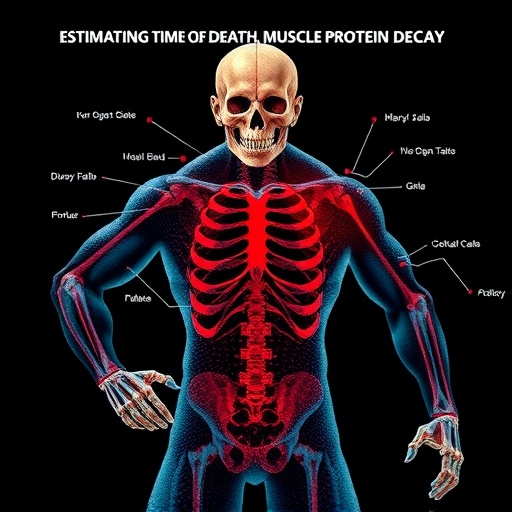
In the realm of forensic science, the accurate determination of the postmortem interval (PMI)—the time elapsed since death—remains a complex and critical challenge. Emerging research has recently shed light on a promising biochemical approach that harnesses the degradation properties of skeletal muscle proteins to refine PMI estimations. A comprehensive review published in the International Journal of Legal Medicine in 2026 by Kori, Chandran, Sangita, and colleagues critically evaluates the current methodologies and advancements in using muscle protein degradation as a forensic tool, potentially revolutionizing how death investigations are approached globally.
Postmortem interval estimation has long relied on morphological and environmental markers, such as body cooling, rigor mortis, insect activity, and decomposition stages. However, these traditional methods often suffer from variability and lack of precision, confounded by factors like ambient temperature and individual physiological conditions prior to death. The degradation patterns of skeletal muscle proteins, which degrade through a predictable cascade of enzymatic and autolytic processes, offer a biochemical timeline that might transcend some of these limitations. The review synthesizes decades of investigative work, providing an integrated perspective that could redefine forensic timelines.
Skeletal muscle, the most abundant tissue in the human body, undergoes regulated degradation after death, driven primarily by endogenous proteases. Proteins like myosin, troponin, and actin degrade sequentially, each at different rates and timelines, influenced by intrinsic and extrinsic factors. Tracking these degradation markers through techniques such as immunoblotting, mass spectrometry, and electrophoresis enables forensic scientists to create protein degradation profiles over time. These profiles correlate to specific PMIs with increasing accuracy, offering insights that morphological clues alone cannot provide.
One of the nuances addressed in the review is the role of environmental variables on protein stability postmortem. Factors such as temperature fluctuations, humidity, and pH levels can accelerate or decelerate protein degradation, introducing a layer of complexity in temporal estimations. The authors emphasize the necessity for standardizing protocols that can account for these variables or applying correctional models incorporating environmental data to bolster reliability. This highlights the dynamic interplay between biological decay and micro-environmental conditions in forensic contexts.
The review also underscores advances in molecular techniques that have transformed protein degradation analysis. High-sensitivity mass spectrometry, coupled with bioinformatic analysis, now enables the identification of specific protein fragments and postmortem modifications with unprecedented precision. Such technological leaps facilitate the development of quantitative models that predict PMIs with narrower confidence intervals. Insights from proteomics have also unveiled previously unknown degradation pathways and temporal markers, opening new investigative frontiers.
Importantly, the focus on skeletal muscle proteins addresses the practical challenges forensic specialists face at crime scenes. Muscle tissues are often well-preserved compared to other organs and can be sampled relatively easily. Moreover, since muscle degradation follows a relatively predictable pattern, it is less susceptible to rapid and erratic changes caused by external factors compared to surface decomposition or insect colonization. This makes skeletal muscle protein analysis a robust and reproducible method in diverse forensic scenarios.
While the biochemical pathway of protein degradation holds promise, the review does not shy away from confronting the limitations. Biological variability such as age, sex, health status before death, and cause of death can influence enzymatic activity postmortem and thus affect degradation rates. The authors advocate for extensive population studies to establish normative degradation baselines across diverse demographics and pathological states. Such comprehensive datasets are crucial to refine predictive algorithms and minimize margin of error in real-world applications.
An intriguing aspect explored is the integration of skeletal muscle protein analysis with other forensic markers to create multiparametric models. By combining protein degradation profiles with microbial succession data, metabolomic shifts, and traditional forensic evidence, forensic scientists could achieve a multidimensional approach to PMI estimation. This fusion of biochemical and ecological insights represents a paradigm shift, moving forensic investigations toward holistic and interdisciplinary frameworks that enhance accuracy and forensic intelligence.
The authors provide an in-depth critique of existing literature, noting discrepancies in methodological approaches, sample sizes, and validation techniques. They call for coordinated international research efforts to standardize muscle protein degradation protocols and encourage data sharing among forensic laboratories worldwide. Such collaborative strategies aim to build globally applicable models, reducing variability arising from laboratory-specific practices and regional environmental factors.
Clinical implications extend beyond forensic science as well. Understanding postmortem protein degradation mechanisms may provide insights into muscle physiology and pathology during life, with potential spillover benefits for medical research. For example, elucidating autolytic pathways can inform muscle-wasting disease studies or enhance tissue preservation techniques. The forensic toolkit thus could double as a resource for biomedical inquiry.
The review highlights several promising candidate proteins beyond traditional markers that warrant further exploration. These include regulatory proteins involved in muscle contraction and structural integrity, whose postmortem degradation kinetics remain largely uncharted. Investigations into non-structural proteins, such as enzymes and signaling molecules associated with muscle metabolism, may yield novel temporal biomarkers. Advances in targeted proteomics empower such endeavors, promising a richer palette of forensic indicators.
Ethical and practical considerations feature prominently in the discussion, especially regarding tissue sampling from deceased individuals. The authors advocate for minimally invasive techniques and respect for cultural norms surrounding postmortem examinations. Moreover, they emphasize the necessity for forensic practitioners to be trained rigorously in biochemical methods, ensuring that cutting-edge technologies translate effectively and ethically into routine forensic workflows.
Looking forward, the review envisions an era where portable, rapid diagnostic devices could analyze skeletal muscle proteins at crime scenes, delivering near real-time PMI estimations. Such technological innovations could dramatically accelerate investigative timelines, assist legal processes, and improve case resolutions. The convergence of biochemistry, data science, and portable instrumentation heralds a new forensic frontier enabled by muscle protein degradation science.
In conclusion, Kori and colleagues have crafted a seminal review that consolidates a wealth of knowledge on postmortem skeletal muscle protein degradation and its forensic applicability. The work underscores the importance of interdisciplinary research, technological advancement, and methodological rigor. As forensic science continues to evolve, integrating muscle protein degradation dynamics stands poised as a transformative approach, promising unprecedented accuracy and reliability in unraveling the mysteries of death timing.
Subject of Research: Postmortem interval estimation using skeletal muscle protein degradation.
Article Title: Postmortem interval estimation through skeletal muscle protein degradation: a comprehensive review.
Article References:
Kori, A., Chandran, A., Sangita, M., et al. Postmortem interval estimation through skeletal muscle protein degradation: a comprehensive review. Int J Legal Med (2026). https://doi.org/10.1007/s00414-025-03703-y
Image Credits: AI Generated
DOI: https://doi.org/10.1007/s00414-025-03703-y
Tags: autolytic processes in forensicsbiochemical methods in forensicsdeath investigation advancementsenzymatic degradation processesforensic scienceforensic timeline redefinitionInternational Journal of Legal Medicinemuscle protein degradationPMI determination techniquespostmortem interval estimationskeletal muscle decayvariability in forensic methodologies



