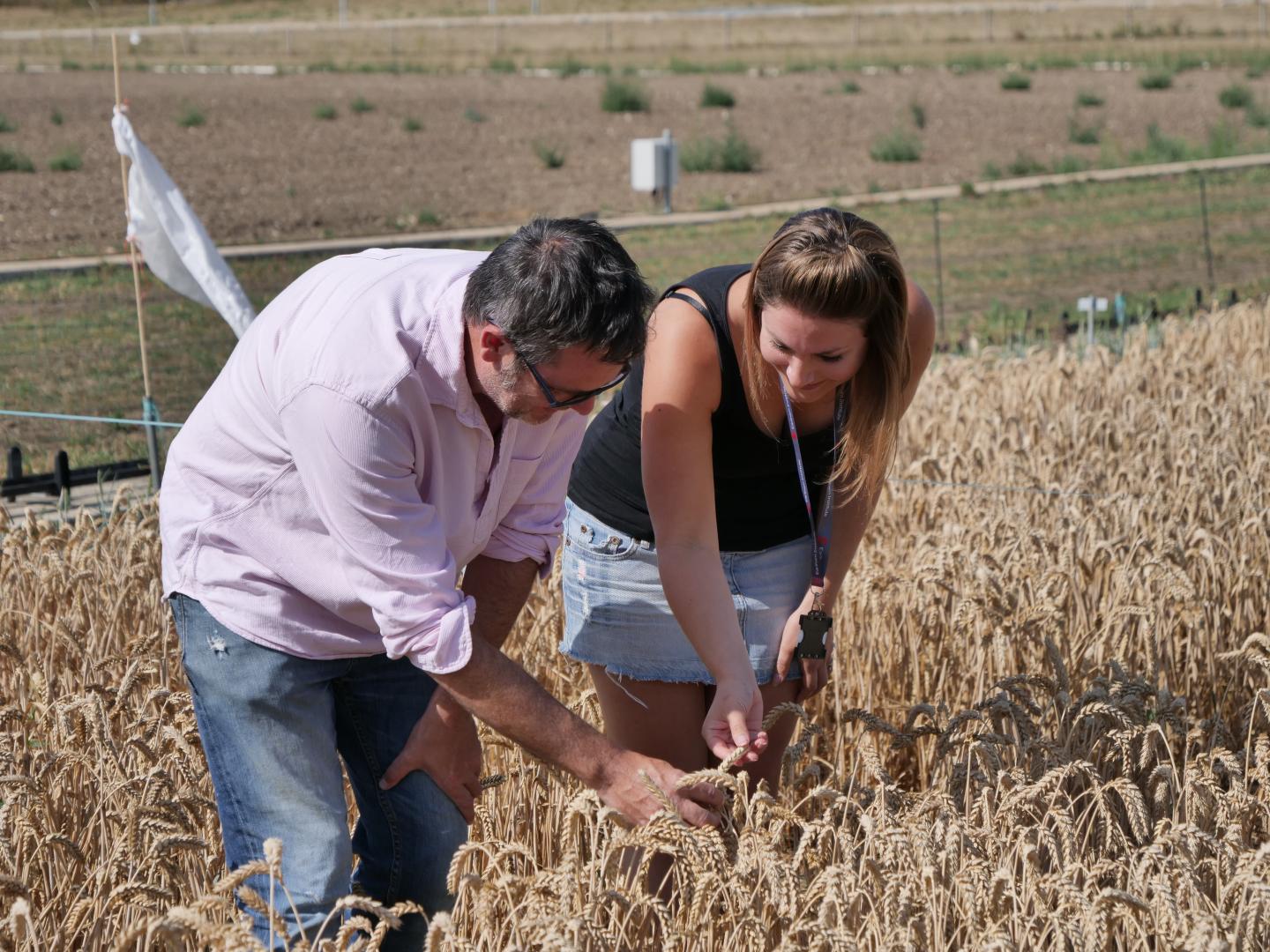
Credit: Earlham Institute
Globally, wheat, together with maize and rice, provides the most human nutrition. It can thrive in a whole range of different environments, even within a similar geographical region.
Exploring one hundred different wheat lines worldwide, the research team led by the Earlham Institute in collaboration with Helmholtz Zentrum München, University of Liverpool and the John Innes Centre have revealed a trove of epigenetic variation that was previously unknown to current genotyping methods.
The new findings link crop evolution and phenotypic change to agricultural conditions – allowing us to protect future yields with a climate resistant armour through new breeding methods – contributing to the success of this global crop as well as significant implications for the wheat community.
With DNA, it's not always about the sequence of As, Ts, Gs and Cs. Although they contain the vital code that lets us make proteins, there are many other aspects to a genome than just the gene sequences.
One aspect is epigenetics – changes in how genes are expressed. Extra to the DNA sequence, the individual letters might come attached with a 'methyl group'. Methylation is very important because it means that genes can be turned off, or the way DNA is stored can change, changing the way genetic information is read.
This is important because these changes can happen due to the environment, but are still inherited. This means, in certain conditions, if an epigenetic change happens that is beneficial, this can be passed on to the next generation.
The research team found geographical patterns in these epigenetic changes between the 100 landraces of wheat studied, which suggests that these changes have arisen due to environmental conditions in those local areas.
This is exciting because it means that breeders have a hidden tool up their wheat sleeve. Currently, it's all about SNPs – single changes in a DNA sequence that have an effect on disease or environmental resistance, for example. Now, even if the DNA sequence is the same, there might be subtle changes at the epigenetic level that we can use to improve how plants respond to local conditions.
Essentially, there are more tools to enable farmers to keep on growing the best possible crop for their local environment.
Group Leader Professor Anthony Hall at the Earlham institute, says: "We are very proud of our groundbreaking piece of fundamental work indicating that DNA methylation offers a broad and stable source of variation for wheat breeders.
"Our next step is to translate this fundamental work on DNA methylation to a technology that is transformative, relevant and accessible to wheat breeders for the development of new cultivars."
Dr Laura-Jayne Gardiner, Senior Postdoctoral Scientist, added: "What is really neat is, even though we are working with a hugely complex genome which is five times the size of the human genome, we're able to translate this discovery into a tool for breeders in likely to be just a few years. As a scientist, it's incredibly exciting that your research could have such an immediate impact."
###
Funded by ERA-CAPS, the ERA-Net for Coordinating Action in Plant Sciences, BBSRC, DFG and NSF, this research builds on Earlham Institute's previous epigenetic work on Chinese Spring wheat (Clavijo et al., Genome Research, 2017) using the advances in wheat genomic resources, as well as in preparation for the International Wheat Genome Sequencing Consortium.
Media Contact
Hayley London
[email protected]
01-603-450-107
http://www.earlham.ac.uk/
Original Source
http://www.earlham.ac.uk/newsroom/epic-genetic-hidden-story-wheat http://dx.doi.org/10.1101/gr.233551.117