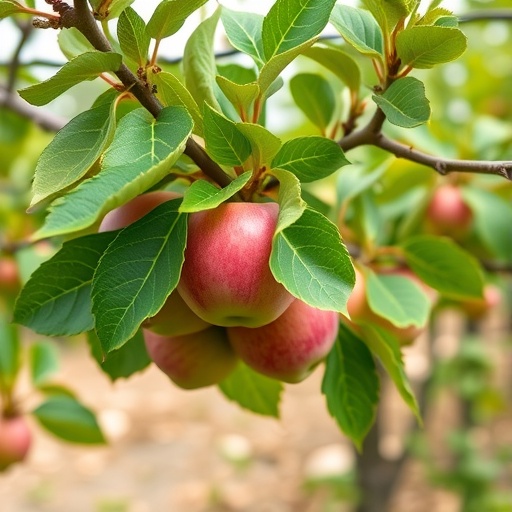
New research emerging from Cranfield University has cast a compelling spotlight on the environmental footprint of the fresh apple supply chain in the UK, revealing nuanced insights into the interplay between greenhouse gas emissions, water scarcity, and sourcing strategies. Over a comprehensive nine-year period, researchers undertook a rigorous assessment that encompassed every stage of the apple supply chain—from orchard cultivation through postharvest cold storage to transportation—comparing the impacts of apples grown domestically with those imported from Europe and the Southern Hemisphere.
Apples hold a significant place in British diets, ranking as the second most consumed fresh fruit after bananas. However, domestic production accounts for only about one-third of the total apples eaten, necessitating the importation of large quantities of fruit to satisfy year-round consumer demand. This reliance on imports introduces considerable environmental variables, particularly as apples travel vast distances and endure extended refrigerated storage. These factors have been shown to profoundly influence the total environmental cost of the fruit by the time it reaches the grocery shelf.
One of the study’s standout revelations concerns the blue water scarcity footprint—a measure of the strain on freshwater resources during production. The findings illustrated that UK-grown apples enjoy a near-negligible water scarcity impact, largely because British apple farms predominantly depend on natural rainfall rather than irrigation. This contrasts sharply with apples imported from regions like South Africa and Spain, where irrigation is necessary due to prevailing arid conditions. The resultant water footprint of these imported fruits is substantially elevated, highlighting a stark environmental divergence based purely on geography and water management practices.
Beyond water use, the study also dissected the greenhouse gas emissions associated with apple production. Intriguingly, apples cultivated in the UK, other parts of Europe, and Chile exhibit comparable emission levels on a per-kilogram basis during the production phase. This parity underscores that growing practices themselves are not the sole determinant of an apple’s environmental impact. Instead, emphasis shifts toward the postharvest phases, particularly cold storage, which emerged as a major contributor to total emissions.
The cold storage process, essential for preserving apple freshness during their journey from orchard to consumer, demands significant energy inputs. The researchers underscored that apples shipped from the Southern Hemisphere accumulate higher emissions overall due to the extended transportation distances combined with prolonged refrigeration periods. These extended supply chains exacerbate carbon footprints in ways that can eclipse the emissions accrued during growing stages.
Lead author Tim Hess, Emeritus Professor of Water and Food Systems at Cranfield University, emphasized the profound implications of these findings for supply chain decision-makers. He stated that regional sourcing of apples—favoring UK and Northern European production—not only offers benefits in reducing water stress but also maintains carbon emission levels analogous to overseas imports. This nuanced insight challenges conventional assumptions that imported fruits are inherently more sustainable due to lower production emissions in some climates.
The Cranfield team’s research further delineates multiple pathways for reducing the environmental impacts of apple supply chains. Key among these is the potential to enhance storage efficiency through advanced refrigeration technologies or alternative preservation methods that consume less energy. Transitioning energy sources powering cold storage facilities from fossil fuels to renewables constitutes another critical lever for emissions reduction.
Additionally, optimizing logistics to minimize transport distances, or shifting to lower-carbon modes of shipping, could markedly reduce the overall carbon load. The study also urges investments in sustainable water management techniques where irrigation remains necessary, ideally incorporating precision watering systems to minimize waste and water footprint.
Senior co-author Natalia Falagán, Senior Lecturer in Food Science and Technology, challenged entrenched views by highlighting the dominant role of postharvest management and energy sourcing in shaping the environmental impacts of fresh apples. She stressed that the sustainability of fruit supply chains transcends orchard practices, encompassing a far broader nexus of factors that require coordinated, climate-smart strategies well beyond the farm gate.
This research arrives at a crucial moment when consumers, retailers, and policymakers increasingly seek transparent metrics to evaluate the sustainability credentials of their food choices. It underscores the importance of a systems-level approach that interrogates the entire supply chain, rather than focusing exclusively on agricultural production, to identify intervention points that yield meaningful environmental benefits.
By marrying long-term empirical data with sophisticated analysis, Cranfield University’s study provides actionable intelligence that can inform sourcing policies, technological investments, and consumer behavior. At its core, the message is clear: the key to greener apples lies not just in where they are grown but in how they are handled, stored, and delivered.
The full research paper, titled How green are my apples? The greenhouse gas emissions and blue water scarcity footprint of fresh apple supply chain, offers an open-access deep dive into methodology and detailed findings, inviting further academic and commercial engagement. This work thus marks a significant advance in understanding the complex sustainability trade-offs inherent in global fruit supply chains and paves the way toward more resilient and climate-conscious food systems.
Subject of Research: Environmental Impact of Apple Supply Chains (Greenhouse Gas Emissions and Blue Water Scarcity)
Article Title: How green are my apples? The greenhouse gas emissions and blue water scarcity footprint of fresh apple supply chain
News Publication Date: 1-Feb-2026
Web References:
https://doi.org/10.1016/j.agwat.2025.110070
Keywords: Agriculture, Farming
Tags: apple supply chain lifecycle assessmentcomparative environmental analysis of apple regionsenvironmental impact of apple productionfresh fruit supply chain emissionsgreenhouse gas emissions in fruit supply chainsimpact of transportation on fruit sustainabilityimported apples carbon footprintrefrigerated storage environmental effectssustainable sourcing strategies for fruitUK domestic apple farming sustainabilitywater scarcity footprint in agricultureyear-round apple consumption environmental costs