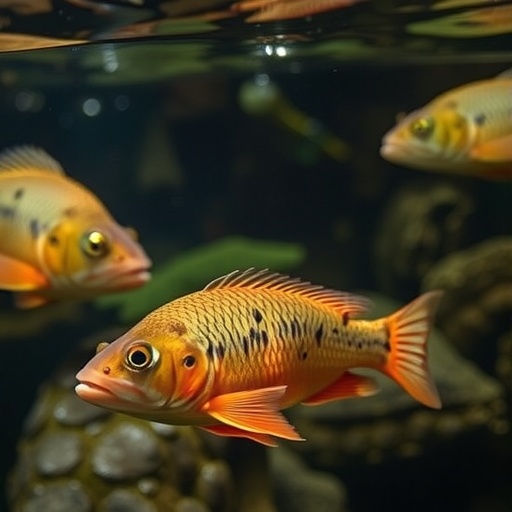
In a groundbreaking investigation published in Nature Communications, an international team led by Murphy, Olivos, and Arismendi has uncovered a complex interplay of environmental, taxonomic, and socioeconomic factors that predict the likelihood of freshwater fish species avoiding imperilment. Their study, set against the backdrop of growing biodiversity loss concerns, challenges traditional conservation paradigms and unveils new predictors crucial for safeguarding aquatic ecosystems.
Freshwater fish represent one of the most diverse vertebrate groups globally, occupying varied habitats that range from isolated mountain streams to expansive river basins. However, they are incredibly vulnerable to anthropogenic pressures, including habitat destruction, pollution, invasive species, and climate change. Despite decades of conservation efforts, many species remain understudied, with their risk of extinction inadequately assessed. The study led by Murphy et al. addresses this gap by taking a holistic approach that integrates ecological traits, environmental conditions, and human socioeconomic realities into a predictive framework.
The researchers harnessed an extensive dataset, synthesizing taxonomic classifications with environmental variables and human-driven socioeconomic indices across multiple freshwater ecosystems worldwide. By analyzing this multidimensional data, the team wanted to identify which species characteristics and external factors contribute to resilience against imperilment, the term used for being at risk of extinction. This approach departs from typical conservation assessments that focus predominantly on threat factors rather than protective elements.
One of the key revelations of the study highlights the profound influence of taxonomy on freshwater fish resilience. Certain taxonomic groups, especially within specific families and genera, exhibit inherent traits that confer a degree of robustness against environmental disturbances. These traits include reproductive strategies, lifespan, mobility, and physiological tolerance to changing water conditions. By mapping these taxonomic patterns alongside vulnerability data, Murphy and colleagues could discern which lineages are more predisposed to survival amid threats.
Environmental conditions emerged as another critical dimension influencing species’ non-imperilment. The study meticulously quantified aspects such as water temperature regimes, habitat complexity, flow variability, and water chemistry. Freshwater fishes inhabiting highly heterogeneous environments with microhabitat refuges tend to show greater resilience. The presence of complex habitats buffers species against rapid changes, enabling populations to maintain viable numbers despite disturbances.
Socioeconomic factors surprisingly played an equally pivotal role in fish conservation outcomes. The researchers correlated national-level socioeconomic indicators like GDP, human development index, infrastructural growth, and policy enforcement capabilities with species vulnerability data. Countries with stronger environmental regulations, informed governance, and robust conservation funding exhibited a notable propensity for sustaining freshwater fish biodiversity. This underscores that safeguarding aquatic life transcends ecological science—it is integrally linked to socio-political will and economic realities.
Murphy et al.’s methodology employed cutting-edge statistical modeling and machine learning techniques to integrate these diverse datasets and extract predictive insights. The models demonstrated remarkable accuracy in classifying species into imperilment risk categories based on the combination of taxonomic affinity, environmental attributes, and socioeconomic context. Such models are invaluable for prioritizing conservation interventions where resources are limited and data are sparse.
The study also illuminates how global patterns of freshwater fish imperilment are unevenly distributed, closely aligned with disparities in socioeconomic development and environmental stewardship. Highly biodiverse regions facing rapid economic growth without commensurate environmental safeguards emerge as hotspots for species vulnerability. Conversely, regions with stable governance and investment in ecological monitoring show signs of preserving their ichthyologic heritage better.
A striking implication of this research is the potential to transform conservation policy frameworks. By considering socioeconomic factors explicitly, organizations and governments can tailor conservation actions that are not only scientifically informed but socioeconomically feasible. This integrated perspective can guide strategic investments, infrastructure planning, and community engagement initiatives that collectively enhance freshwater biodiversity protection.
Moreover, the findings call attention to the need for multidisciplinary collaboration in tackling biodiversity crises. Conservation biologists, economists, policymakers, and local stakeholders must converge to design impactful strategies. The study by Murphy and team exemplifies such interdisciplinary scholarship, merging ecological data with socioeconomic analysis to yield actionable insights that purely biological studies might overlook.
Freshwaters represent a critical nexus for human well-being, supplying drinking water, food security, and cultural value. Protecting the fishes that inhabit these systems is therefore not merely an ecological imperative but a societal necessity. This research provides a data-driven compass for guiding global efforts toward achieving these interconnected goals amidst accelerating environmental change.
The authors also highlight future directions for research, urging enhanced data collection on understudied species and regions, especially in the Global South where data paucity impedes conservation. Enhanced remote sensing, citizen science, and international data-sharing platforms present promising avenues to expand knowledge and facilitate adaptive conservation management.
In a broader sense, this study serves as a clarion call against reductionist approaches to biodiversity conservation. By demonstrating the predictive power of integrated models encompassing environment, taxonomy, and human factors, Murphy et al. elevate conservation science to incorporate the human dimension explicitly—a necessary evolution in an era dominated by human-environment interactions.
Ultimately, the findings convey a message of cautious optimism. While freshwater fish populations face myriad threats, understanding the drivers of non-imperilment creates pathways for effective stewardship. It empowers conservationists to identify resilient species and habitats that can anchor restoration efforts and to recognize socio-political contexts where intervention is most critical.
As the global community grapples with the accelerating biodiversity crisis, studies like this provide critical knowledge scaffolding to support sustainable coexistence between human societies and freshwater ecosystems. By illuminating the intricate factors underpinning species’ survival, the research charts a course toward more nuanced and successful conservation strategies for some of the planet’s most vulnerable and vital lifeforms.
Subject of Research: The study examines how environmental characteristics, taxonomic factors, and socioeconomic conditions predict the likelihood that freshwater fish species avoid fall into imperilment or extinction risk.
Article Title: Environment, taxonomy, and socioeconomics predict non-imperilment in freshwater fishes.
Article References:
Murphy, C.A., Olivos, J.A., Arismendi, I. et al. Environment, taxonomy, and socioeconomics predict non-imperilment in freshwater fishes. Nat Commun 17, 1661 (2026). https://doi.org/10.1038/s41467-025-68154-w
Image Credits: AI Generated
DOI: https://doi.org/10.1038/s41467-025-68154-w
Tags: anthropogenic threats to freshwater fishaquatic habitat vulnerabilitybiodiversity loss in aquatic ecosystemsclimate change effects on freshwater fishecological traits and species imperilmentenvironmental predictors of fish safetyfreshwater fish conservationglobal freshwater biodiversity assessmentintegrative conservation strategies for freshwater ecosystemsinvasive species impact on aquatic lifesocioeconomic impacts on freshwater speciestaxonomic factors in species resilience