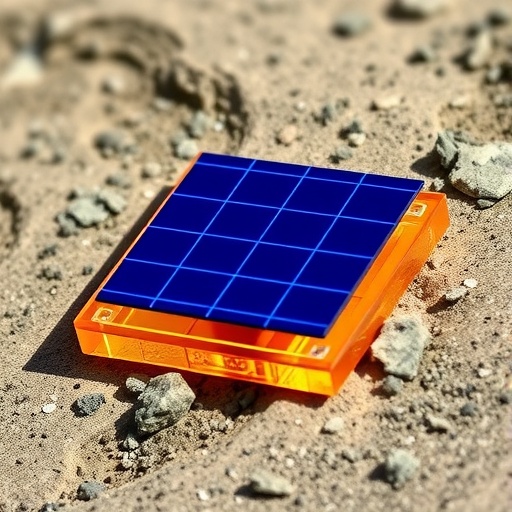
In a groundbreaking advancement for photovoltaic technology, a multidisciplinary team led by researchers at the University of Stuttgart has engineered perovskite solar cells with significantly enhanced environmental resilience and efficiency. The results, soon to be detailed in Nature Energy, unveil innovative material strategies that could propel perovskite-based photovoltaics closer to widespread commercial application by overcoming persistent stability challenges under variable and harsh conditions. This development represents a critical leap for perovskites, which have long been celebrated for their high power conversion efficiencies and cost-effective fabrication but hampered by insufficient durability.
Perovskite solar cells, distinguished by their crystalline structure, have captivated the solar research community due to their remarkable efficiency coupled with low-cost processing compared to traditional silicon photovoltaic technology. Nonetheless, they have struggled to maintain stable operation when exposed to light, thermal fluctuations, moisture, and mechanical stress. These external factors contribute to degradation pathways that limit the operational lifetime—a major bottleneck for commercialization. The Stuttgart-led researchers have tackled this issue through meticulous refinement of the perovskite material’s composition and microstructural engineering to fortify the solar cells against diverse environmental stressors without sacrificing performance.
Central to their approach is the use of triple-cation perovskite formulations, combining methylammonium, formamidinium, and cesium ions. This triad strikes an optimal balance by synergistically enhancing the material’s intrinsic stability and efficiency. Triple-cation perovskites, first systematically characterized by this group in 2016, harness the potential of precise compositional tuning to optimize optoelectronic properties, improve crystallization processes, and reduce defect densities. Their unique ability to be “tuned” by adjusting elemental ratios enables researchers to delicately balance the perovskite’s structural and electronic dynamics.
However, even with triple-cation architectures providing a stable baseline, the researchers identified grain boundaries—the interfaces between microscopic crystalline domains—as critical weak points vulnerable to mechanical and environmental degradation. These boundaries, analogous to the joints in pavement, must endure significant physical and chemical stress during operation. Crucially, failure at these grain boundaries compromises the entire solar cell’s structural integrity and efficiency. Recognizing this, the team innovatively introduced photoswitchable molecules specially engineered to infiltrate and fortify these grain boundary regions.
These photoswitchable molecules possess dynamic isomerization capabilities: they change shape upon exposure to light, enabling them to act as an adaptive buffer within the perovskite microstructure. By modulating their configuration responsively, these molecular agents absorb and dissipate mechanical tension induced by thermal cycling and illumination variations. This dynamic behavior mitigates the propagation of material defects that would otherwise accumulate and degrade device performance. The light-activated molecular modulation effectively enables the grain boundaries to self-adapt in situ, bolstering the overall durability of the solar cells under realistic, fluctuating environmental conditions.
To rigorously evaluate their stabilized perovskite solar cells, the team subjected samples to demanding laboratory simulations replicating the rigorous stresses encountered outdoors. These tests included prolonged ultraviolet (UV) exposure at elevated temperatures (65 degrees Celsius), as well as extensive thermal cycling from -40 degrees Celsius to +85 degrees Celsius over hundreds of iterations. Under these punishing stress scenarios, the perovskite devices incorporating photoswitchable molecules retained more than 95% of their initial photovoltaic efficiency. Strikingly, the cells achieved a power conversion efficiency of approximately 27%, a performance metric competitive with the latest silicon-based modules.
The synergy of enhanced operational stability combined with sustained high efficiency positions this novel material design as a promising candidate for scalable solar technologies. By extending the lifespan of perovskite solar cells while maintaining exceptional power output, it addresses two of the field’s most critical hurdles simultaneously. Such resilience ensures more reliable electricity generation over time, thus improving economic viability and accelerating the potential deployment of perovskite photovoltaics in real-world energy infrastructures.
Beyond stability, the work exemplifies how molecular engineering intertwined with materials science can unlock new frontiers for perovskite photovoltaics. The insight that grain boundary fortification via smart, photosensitive molecules can dynamically regulate mechanical stresses opens avenues for further functionalization strategies. It invites exploration of other stimuli-responsive molecules that might confer additional adaptive protections under diverse operational challenges, such as humidity and mechanical impact.
Moreover, this research underscores the importance of international collaboration, combining theoretical insights and experimental craftsmanship from teams across Germany, China, the United Kingdom, Spain, Italy, and Switzerland. Together, they have charted a path from fundamental understanding of perovskite chemistry to pragmatic solutions designed explicitly for end-use environments. Such comprehensive efforts are vital as emerging solar materials progress from laboratory curiosities into market-ready technologies.
Importantly, these findings have broader implications for the sustainable energy landscape amid ongoing climate imperatives. Affordable and high-performance solar cells capable of robust deployment in diverse climates can catalyze the transition from fossil fuels to clean, renewable electricity. The adaptability designed into this perovskite chemistry could allow installations in regions with fluctuating temperatures and variable solar radiation, expanding the geographical reach of solar energy solutions.
While silicon photovoltaics currently dominate the commercial market owing to their proven longevity and mature fabrication infrastructure, perovskite solar cells have the distinct advantage of versatile fabrication processes, including solution-based printing and lightweight flexible substrates. This attribute could enable novel applications such as building-integrated photovoltaics, portable power sources, and tandem solar modules that surpass silicon-only efficiency limits. The durability improvements presented here significantly narrow the gap limiting these opportunities.
Looking ahead, continued research is essential to translate these laboratory achievements into modules and systems ready for real-world deployment. Scaling synthesis of photoswitchable molecular additives and integrating them into manufacturing workflows will be critical steps. Additionally, long-term field testing under natural weather conditions will validate operational stability predictions. Future work might also explore combining this molecular approach with advanced encapsulation techniques to create comprehensive multi-barrier protective solutions.
In sum, the University of Stuttgart-led team’s pioneering approach advances perovskite solar cell technology by ingeniously manipulating molecular interactions at grain boundaries to yield unprecedented resilience against environmental assaults. This research presents a compelling vision for next-generation photovoltaics that seamlessly blend high efficiency, durability, and manufacturability. As these solar materials evolve, they promise to play a transformative role in delivering abundant, affordable clean energy worldwide.
Subject of Research:
Not applicable
Article Title:
Photoswitchable isomers to improve grain boundary resilience and perovskite solar cells stability under light cycling
News Publication Date:
25-Feb-2026
Web References:
https://doi.org/10.1038/s41560-026-01993-z
References:
Zhang, Z., Zhu, R., Li, G. et al. Photoswitchable isomers to improve grain boundary resilience and perovskite solar cells stability under light cycling. Nat Energy (2026).
Image Credits:
Weiwei Zuo
Keywords
Perovskite solar cells, photovoltaic efficiency, environmental stability, triple-cation perovskites, photoswitchable molecules, grain boundaries, molecular engineering, light cycling, thermal cycling, photovoltaic durability, energy materials, sustainable energy technology
Tags: commercial viability of perovskite solar cellsenhancing perovskite durabilityhigh efficiency low-cost solar cellsinnovative material strategies for solar cellsmoisture and thermal resistance perovskitesovercoming perovskite degradation pathwaysperovskite material microstructural engineeringperovskite solar cells environmental stabilityphotovoltaic technology advancementsstability challenges in perovskite photovoltaicstriple-cation perovskite formulationsUniversity of Stuttgart solar research