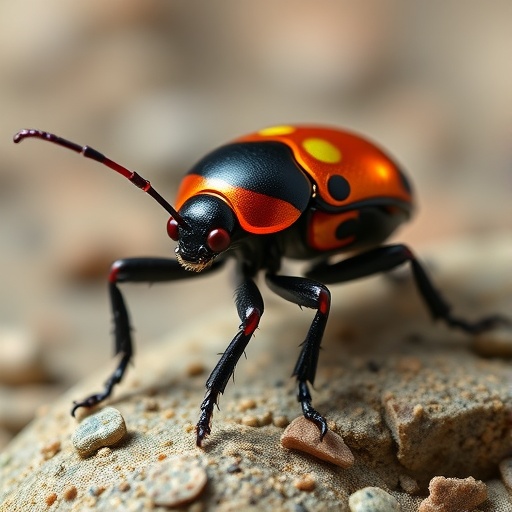
Insect-scale robotics, long hindered by limitations such as insufficient agility, fragility, and restricted onboard energy sources, is witnessing a transformative turn through the pioneering integration of living insects with sophisticated miniature stimulation systems. This fusion, known as terrestrial cyborg insects, leverages biological capabilities enhanced by modern engineering, creating a biohybrid platform capable of controlled locomotion. Recent breakthroughs led by researchers at the University of Queensland detail a novel approach to substantially improve the endurance and reliability of these systems through a biologically inspired electrical stimulation paradigm. Their work not only enhances sustained locomotion but also opens avenues for autonomous navigation, addressing longstanding challenges in this multidisciplinary field.
The research utilizes the darkling beetle, Zophobas morio, as a bio-robotic chassis, exploiting its robust terrestrial mobility. Electrodes implanted surgically into key sensory appendages—antennae and elytra—coupled with a wireless stimulation backpack mounted dorsally, enable precise neuromuscular control. Forward movement is driven by stimulating the elytra, while directional control is achieved via targeted antennal stimulation. Traditional methodologies applied continuous electrical pulses, but this study introduces a burst stimulation protocol that more closely mimics natural insect sensory firing patterns—a shift grounded in neurophysiological insight.
This burst stimulation consists of tightly controlled 100-millisecond pulse bursts separated by short 50-millisecond rest intervals, preserving identical voltage, pulse width, overall frequency, and stimulation intensity parameters compared to conventional continuous stimulation but modulating the temporal delivery of signals. Such temporal patterning proves crucial. Continuous stimulation protocols typically suffer from habituation effects and electrode-tissue interface degradation, leading to attenuated behavioral responses over time. By contrast, the burst method significantly mitigates this progressive decline, enabling more durable behavioral control across repeated trials.
An integrated feedback control system enhances the utility of burst stimulation. Real-time positional data, fused from a high-precision motion capture arrangement tracking the beetle within a 1.2-meter by 0.6-meter experimental arena, feed into a proportional controller algorithm. This controller dynamically adjusts antennal stimulation frequency to correct orientation errors relative to a predefined sinusoidal reference trajectory, thereby enabling closed-loop autonomous navigation. The system’s efficacy is demonstrated through careful quantification using metrics such as instantaneous turning angle, angular and linear velocities, tracking error, navigation success rate, and total stimulation energy expenditure.
Empirical outcomes reveal compelling advantages for burst stimulation. At frequencies between 34 and 40 Hz, the degradation rate in turning angle and peak angular velocity declined by approximately 30% and 88%, respectively, relative to continuous stimulation protocols. Moreover, burst stimulation increased mean turning angle response by about 52% without increasing stimulus intensity or power consumption, affirming its energy-efficient characteristic. Crucially, burst modulation preserved a stable frequency-response relationship across a broad 10 to 40 Hz range, a foundational attribute for effective closed-loop control applications.
The autonomous navigation performance of the biohybrid beetles under the burst stimulation regime achieved a 73% success rate in following the sinusoidal path, with average position tracking errors confined to approximately 12 millimeters. These results underscore the enhanced reliability and precision afforded by the physiologically attuned stimulation strategy. Analysis also revealed that minimizing the control update interval correlated positively with navigation efficiency, while excessive unilateral stimulation sequences detrimentally impacted behavioral responses and increased failure risk—insights that inform future controller optimization and robustness enhancement strategies.
Fundamentally, this study bridges the gap between neurobiological principles and bioelectronic engineering, showcasing that leveraging the intrinsic burst-firing characteristics of insect sensory neurons can substantially bolster the functionality and sustainability of cyborg insect locomotion systems. By minimizing habituation phenomena and maintaining stable behavioral output, burst stimulation emerges as a superior alternative to conventional continuous electrical control, propelling cyborg insect platforms closer to practical deployment outside constrained laboratory environments.
The implementation of such biohybrid systems holds transformative potential across applications requiring small-scale, agile terrestrial robots with minimal resource demands—ranging from environmental monitoring in challenging terrains to search-and-rescue operations in confined spaces. The findings invigorate ongoing discourse on the ethical, technical, and ecological impacts of cyborgizing living organisms, emphasizing the sophistication achievable when synthetic control systems harmonize with biological substrates rather than override them.
Beyond the immediate advancements in stimulation protocols, the research paves pathways for enhancing electrode design, wireless communication reliability, and energy management in cyborg insect platforms. Integrating multi-sensory feedback and adaptive learning algorithms promises further strides toward autonomous, robust, and energy-efficient robotic systems inspired by—and embedded within—the natural world’s intricacies.
The interdisciplinary nature of this breakthrough highlights the necessity for collaboration among neurobiologists, electrical engineers, roboticists, and ethicists, ensuring that future iterations of cyborg insects uphold principles of functionality, safety, and sustainability. By rooting stimulation methodologies in physiological realities, this work exemplifies how biologically informed engineering can revolutionize the emerging field of biohybrid robotics.
As terrestrial cyborg insects transition from proof-of-concept demonstrations to real-world applications, the insights from this burst stimulation framework offer a blueprint for overcoming pervasive challenges in long-term operational stability. This progress envisions a future where living robotic organisms possess the agility, autonomy, and endurance necessary to conduct complex tasks across diverse environments, heralding a new chapter in insect-scale robotics.
Subject of Research: Biohybrid robotics, Electrophysiological stimulation, Autonomous navigation, Terrestrial cyborg insects, Neuroengineering.
Article Title: Burst Stimulation for Sustained Locomotion Control and Autonomous Navigation of Terrestrial Cyborg Beetles
News Publication Date: March 9, 2026
Image Credits: Hai Nhan Le, University of Queensland
Keywords
Terrestrial cyborg insects, burst stimulation, locomotion control, autonomous navigation, darkling beetle, biohybrid robotics, neurostimulation, closed-loop control, bioelectronic engineering, habituation mitigation, wireless stimulation system, insect-scale robotics.
Tags: autonomous navigation in bio-robotsbiohybrid locomotion systemsbiologically inspired electrical stimulationburst electrical stimulation protocolenhanced endurance in robotic insectsinsect sensory appendage stimulationinsect-scale roboticsmultidisciplinary bio-robotics researchneuromuscular control in insectsterrestrial cyborg beetleswireless stimulation backpacksZophobas morio robotic applications