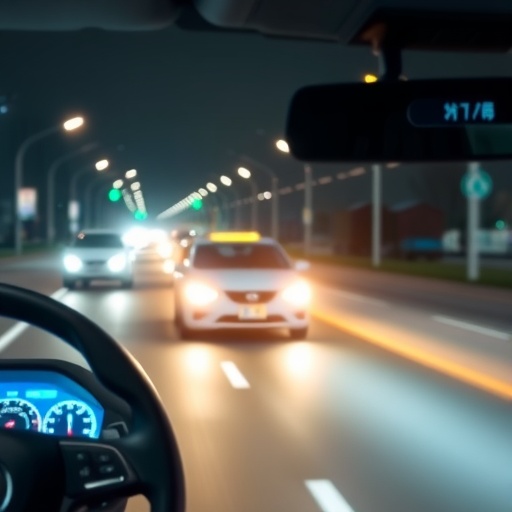
In the rapidly evolving field of autonomous driving, significant strides have been made to enhance the safety and efficiency of self-driving vehicles. A pivotal study led by researchers Ren and Xing introduces a novel approach that integrates Large Language Models (LLMs) with deep reinforcement learning (DRL), employing a contrastive safety regularization technique. This groundbreaking work, poised to redefine the paradigms of AI-driven transportation, embarks on a journey to create safer and smarter autonomous vehicles, promising to reshape the landscape of mobility.
The essence of the proposed approach lies in the innovative fusion of LLMs and DRL, which are renowned for their individual strengths but have traditionally operated in separate domains. By harnessing the comprehensive knowledge representation capabilities of LLMs, the researchers believe they can significantly improve the decision-making processes of autonomous systems. The adoption of this method aims to enhance the understanding of complex driving environments, which often presents a myriad of challenges that require adaptive and nuanced responses.
Deep reinforcement learning plays a crucial role in this framework by enabling autonomous vehicles to learn optimal behaviors through trial and error. In conventional DRL systems, agents learn from their experiences in simulated environments. However, the integration of LLMs allows these systems to interpret and contextualize vast amounts of real-world data, thus fostering a deeper understanding of the nuances inherent in driving scenarios. This synthesis not only enhances learning efficiency but also aligns the decision-making process with safer driving behaviors.
One of the most significant contributions of this research is the introduction of contrastive safety regularization. This concept is particularly important as it imposes constraints on the learning process to ensure that the autonomous agent adheres to safety protocols. By penalizing unsafe actions more severely and rewarding safe and compliant maneuvers, the system is trained to prioritize safety over aggressive or risky driving behaviors. This aligns with broader societal goals of ensuring that autonomous systems integrate seamlessly and safely into our transportation networks.
Moreover, the research indicates that the combination of contrastive safety regularization with LLM-guided reinforcement learning leads to safer exploration strategies during training. Instead of merely optimizing for performance metrics, this approach emphasizes the significance of adhering to safety principles while expanding the agent’s operational capabilities. This resilience against unsafe actions could be the key to addressing public concerns regarding the reliability and trustworthiness of autonomous driving technology.
The study also explores the potential of this integrative approach in real-world driving scenarios. The researchers conducted extensive simulations that incorporated a variety of driving conditions, including complex urban environments, highway driving, and adverse weather. These simulations tested the robustness of their framework, illustrating how the model not only performed competitively against traditional methods but also showcased improved decision-making in challenging circumstances.
Furthermore, Ren and Xing’s findings underscore the dynamic nature of urban traffic environments, where autonomous vehicles must constantly adapt to changing conditions and unpredictable human behaviors. The LLM component allows for a richer understanding of these dynamics by interpreting contextual cues from various data sources, including traffic signals, pedestrian movements, and road signs. This heightened awareness is essential for making informed, real-time decisions that prioritize passenger safety.
An additional dimension of this research is its implications for the broader deployment of autonomous vehicles. With regulatory bodies and urban planners increasingly interested in the integration of self-driving cars into public transport systems, the safety features emphasized in this research could influence policy decisions regarding the permissibility and deployment of such technologies. Demonstrated improvements in safety metrics may facilitate greater acceptance and quicker regulatory approvals for autonomous systems.
The implications of this research extend beyond safety. Efficient energy use in autonomous vehicles is another key consideration that often gets overshadowed by safety concerns. The framework that combines LLM and DRL may provide insights into optimizing vehicle routes and reducing energy consumption, contributing to sustainability efforts in transportation. Enhancing energy efficiency while maintaining safety standards could yield significant environmental benefits, aligning with global efforts to combat climate change.
The study also raises questions about the future of human-machine interaction in autonomous driving systems. As AI technologies become more sophisticated, the potential for seamless interaction between humans and autonomous vehicles increases. Insights from LLMs can enable these systems to communicate effectively with passengers, providing information about the vehicle’s status, route choices, and potential hazards ahead. This kind of interaction could foster trust and comfort in passengers, addressing one of the key barriers to widespread adoption of autonomous technologies.
By leveraging the advantages of both LLMs and DRL, the research opens a fascinating dialogue about the future landscape of autonomous vehicles. The integration of advanced AI techniques heralds a new era in which systems can learn more efficiently, adapt to complex environments, and maintain safety as a primary concern. As these models evolve, their practical applications in real-world scenarios could signal a technological revolution in transportation.
Looking ahead, it is crucial to address the challenges and limitations identified in this study. While the framework presents numerous advantages, the complexity of real-world environments and ethical considerations surrounding AI decision-making must be continuously evaluated. Future iterations of this research will likely need to address these complexities to refine the approach further.
In conclusion, Ren and Xing’s exploration into LLM-guided deep reinforcement learning with contrastive safety regularization represents a significant step forward in the autonomous driving field. By combining state-of-the-art AI approaches, the researchers have laid the groundwork for safer, more efficient, and intelligent driving systems that could redefine the future of mobility. The ongoing advancements in this domain will not only contribute to technological progress but also play a pivotal role in shaping societal attitudes towards autonomous transportation.
As the automotive industry stands on the brink of a transformative leap, the findings from this study provide a compelling blueprint for integrating safety with performance in autonomous systems. The intersection of LLMs and DRL—when approached with the right safety considerations—can empower the next generation of vehicles, making them not only smarter but also more attuned to the critical importance of safety in our everyday lives.
Subject of Research: Integration of Large Language Models (LLMs) with Deep Reinforcement Learning (DRL) for enhancing safety in autonomous driving.
Article Title: LLM-guided deep reinforcement learning with contrastive safety regularization for autonomous driving.
Article References:
Ren, H., Xing, Y. LLM-guided deep reinforcement learning with contrastive safety regularization for autonomous driving.
Discov Artif Intell (2026). https://doi.org/10.1007/s44163-025-00812-w
Image Credits: AI Generated
DOI: 10.1007/s44163-025-00812-w
Keywords: Autonomous driving, Deep Reinforcement Learning, Large Language Models, Safety, AI Integration, Transportation Technology
Tags: adaptive autonomous systemsAI in transportationautonomous driving safetyautonomous vehicle decision-makingcomplex driving environment understandingcontrastive safety regularizationdeep reinforcement learning applicationsenhancing self-driving vehicle efficiencyfusion of LLMs and DRLfuture of AI in autonomous vehiclesinnovative AI techniques for mobilityLLM-driven reinforcement learning