Credit: ©Science China Press
High salt intake is a well-known risk factor of hypertension and cardiovascular diseases. Reducing salt intake can significantly lower blood pressure and ameliorate target organ damage caused by hypertension. However, in the past three decades, several strategies have failed to decrease daily salt intake to an optimal level. Therefore, it is important to identify alternative approaches for reducing excessive salt intake and antagonizing high salt-induced hypertension.
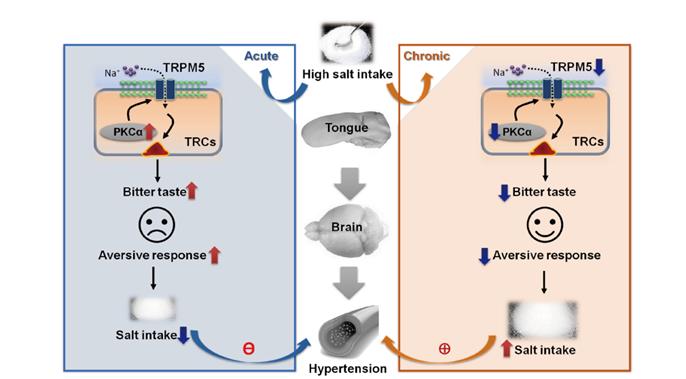
Salt taste perception is an important factor in determining salt intake at an individual level. Previous studies have shown that aversion induced by salt beyond the physiological concentration range is mediated by a bitter taste sensor-transient receptor potential channel M5 (TRPM5) in taste receptor cells. High salt stimuli might produce a bitter taste for a defensive response to reduce salt intake. Recently, Professor Zhiming Zhu’s team from Army Medical University found that acute high-salt stimulation activated TRPM5-mediated bitter taste and increased aversion reaction. However, long-term high salt intake impairs the activity of the TRPM5 by inhibiting protein kinase C (PKC) activity and PKC-dependent threonine phosphorylation. “The TRPM5-mediated aversion response to high salt is weakened, which results in a progressive increase of high salt intake and increased blood pressure in mice fed with long-term high-salt-diet.” Said Dr. Yuanting Cui, the first author of this work. These results were published in Hypertension recently.
On this basis, Professor Zhiming Zhu’s team continued to explore how to restore TRPM5 function damage caused by long-term high salt intake. They found that long-term dietary intervention with bitter melon extract (BME) restored the TRPM5-mediated aversion to high salt stimuli in tongue epithelium, thus reduced excessive salt intake, and improved the cardiovascular damage in mice. Mechanistically, dietary BME inhibited high salt-induced RhoA/Rho kinase activation, leading to reduced phosphorylation levels of myosin light chain kinase and myosin phosphatase targeting subunit 1. Furthermore, cucurbitacin E (CuE), the major active compound in BME, also inhibited vasoconstriction by attenuating L-type Ca2+ channel-induced Ca2+ influx in vascular smooth muscle cells. “We found that BME and CuE increased TRPM5 expression and function in tongue epithelium. Therefore, the mice fed with high salt plus BME diet showed a lower salt intake, and improved the high salt-induced hypertension and cardiac hypertrophy compared with mice only fed with high-salt diet.” said Dr. Hao Wu, the first author and Prof. Zhiming Zhu, the corresponding author of this work. These results were published in SCIENCE CHINA Life Sciences recently.
These encouraging results from Professor Zhu’s team provide further suggestions for promoting the use of dietary factors to reduce salt consumption. Enhancing bitter taste function by dietary bitter melon might provide a promising approach for antagonizing excessive salt intake and preventing of high salt-induced cardiovascular dysfunction.
###
These works were supported by grants from the Natural Science Foundation of China (81721001, 81630015, 31701023) and National Key Research and Development Project (2018YFA0800601).
See the article:
[1] Cui Y, Wu H, Li Q, et al. Impairment of Bitter Taste Sensor Transient Receptor Potential Channel M5-Mediated Aversion Aggravates High-Salt Intake and Hypertension. Hypertension. 2019;74(4):1021-1032. doi:10.1161/HYPERTENSIONAHA.119.13358. This article was published online in the Hypertension
[2] Wu H, Cui Y, He C, et al. Activation of the bitter taste sensor TRPM5 prevents high salt-induced cardiovascular dysfunction. Sci China Life Sci. 2020. doi:10.1007/s11427-019-1649-9.
https:/
Media Contact
Prof. Zhu
[email protected]
Related Journal Article
http://dx.