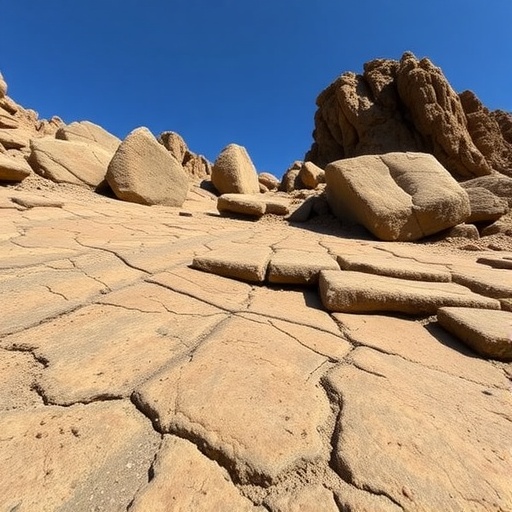
Cornell University researchers have unveiled groundbreaking insights into the potential of enhanced rock weathering as a formidable carbon sequestration technology, emphasizing the critical need for its widespread adoption, particularly in the Global South, to make a significant impact on mitigating global warming. This emerging method harnesses the natural geochemical processes associated with silicate rock dissolution, converting atmospheric carbon dioxide into stable mineral carbonates, effectively locking away carbon for millennia while simultaneously revitalizing agricultural lands.
The principle behind enhanced rock weathering is elegantly simple yet scientifically profound. Finely ground silicate rocks, such as basalt, are introduced into crop soils, where they initiate a cascade of chemical reactions. These reactions consume carbon dioxide directly from the atmosphere and transform it into bicarbonates, which eventually precipitate as carbonate minerals—durable forms of carbon storage. Beyond climate mitigation, the infusion of minerals like calcium, magnesium, and iron enriches the soil’s nutrient profile, enhances soil structure, reduces acidity, and can substantially boost crop yields. This dual benefit positions enhanced rock weathering as a transformative agricultural innovation with the potential to simultaneously address climate change and global food security.
In a recent study published in the journal Communications Sustainability, Cornell scientists developed comprehensive models projecting the future trajectories of enhanced rock weathering adoption on a global scale. The models integrate nuanced regional dynamics, social tipping points, and staggered adoption patterns—factors often overlooked in prior assessments which assumed uniform adoption worldwide. Their simulations suggest that by the end of this century, enhanced rock weathering could sequester up to one gigaton of carbon annually, a magnitude comparable to the emissions of a major industrialized nation.
The research highlights an inevitable transition in leadership for this technology’s uptake. While affluent, high-income countries are poised to spearhead early adoption due to greater technological access and infrastructure, the ascendancy of nations in the Global South—such as India and Brazil—is expected around 2050. These regions inherently provide optimal climatic conditions, characterized by higher temperatures and increased precipitation, which naturally accelerate the chemical weathering processes. The success of scaling enhanced rock weathering in these countries is also projected to foster equitable economic gains for smallholder farmers, creating new income streams through carbon credit schemes and enhanced agricultural productivity.
Assistant Professor Chuan Liao, one of the senior authors of the study, emphasizes that the modeled trajectories account for regional lags and critical social milestones that could either impede or accelerate the adoption rate. This approach provides a more realistic outlook compared to earlier models that oversimplified adoption patterns. Liao stresses the importance of international technology transfers and globally coordinated carbon markets in facilitating equitable access to this promising mitigation strategy, ensuring that benefits extend beyond wealthy nations and help close the gap for resource-limited communities.
The study’s authors also innovatively leveraged historical data on the dissemination of analogous agricultural technologies, such as synthetic fertilizers and irrigation systems, to inform their adoption models for enhanced rock weathering. By examining these precedents, the researchers were able to simulate staggered technology rollouts and project both conservative and aggressive adoption scenarios, adding robustness and credibility to their predictions. Notably, this layered approach captures the complexity of socio-economic and environmental variables influencing technology diffusion worldwide.
Private sector engagement with enhanced rock weathering has already commenced, signaling commercial viability and growing interest. Tech giants Microsoft and Stripe have funneled significant investments into this domain, viewing it as an integral component of their carbon removal portfolios. The method’s attractiveness is amplified by its capacity not only to generate durable carbon offsets but also to enhance soil health, reduce reliance on synthetic fertilizers, and mitigate soil acidification. These co-benefits could translate into tangible economic advantages for farmers, presenting a win-win solution for climate action and sustainable agriculture.
Benjamin Z. Houlton, Dean of Cornell’s College of Agriculture and Life Sciences and co-author of the study, underscores the imperative to refine scientific predictions around enhanced rock weathering’s efficacy. He highlights the potential for this approach to channel “carbon profits” directly into the pockets of farmers globally, thereby aligning environmental and economic incentives. Increased field research and direct engagement with farming communities are crucial next steps to validate models under real-world conditions and optimize deployment strategies.
The climate stabilization potential of enhanced rock weathering is further underscored by its scalability and longevity. Unlike many current carbon capture technologies that require complex infrastructure and energy-intensive processes, enhanced rock weathering leverages naturally occurring Earth systems. It complements other negative emissions technologies, offering a geographically distributed, low-tech, and cost-effective solution. This positions it as a critical component in achieving net-zero targets and limiting temperature rise in the long term.
However, challenges remain. The process depends heavily on logistical considerations such as mining, grinding, and transporting vast quantities of rock dust to farmlands, necessitating sustainable supply chains that minimize environmental impacts. Additionally, scientific uncertainties about the long-term dynamics of mineral carbon sequestration under varying ecological conditions call for rigorous monitoring frameworks. Policy incentives, international cooperation, and capacity-building efforts in developing regions are essential to overcome these hurdles and unlock the full potential of enhanced rock weathering.
This study’s findings mark a significant pivot toward considering the social, economic, and environmental complexities inherent in scaling carbon removal technologies. With global warming’s window for intervention narrowing, innovations like enhanced rock weathering present holistic pathways that integrate mitigation with adaptation, equity, and agricultural productivity. If embraced at scale—especially across the tropical and subtropical zones of the Global South—this technology could decisively shift the trajectory of global carbon emissions and contribute meaningfully to the planet’s climate resilience.
In summary, Cornell University’s research advances the understanding of enhanced rock weathering not only as a promising climate mitigation tool but as an inclusive socio-technical system that demands coordinated global action. The imminent challenge lies in translating these scientific insights into practical, equitable solutions that mobilize diverse stakeholders—from policymakers and corporations to farmers and communities—to collectively champion this innovative approach. Enhanced rock weathering’s future, therefore, hinges on transcending technological feasibility to embrace transformative social change conducive to a sustainable and just climate future.
Subject of Research: Enhanced Rock Weathering for Carbon Sequestration and Sustainable Agriculture
Article Title: Researchers Project Global Adoption Trajectories of Enhanced Rock Weathering for Climate Mitigation and Agricultural Benefits
News Publication Date: February 2026
Web References: https://doi.org/10.1038/s44458-026-00034-w; https://news.cornell.edu/stories/2026/02/widespread-enhanced-rock-weathering-could-slow-global-warming
References: Published article in Communications Sustainability, DOI: 10.1038/s44458-026-00034-w
Keywords: Carbon Sequestration, Enhanced Rock Weathering, Silicate Minerals, Climate Mitigation, Sustainable Agriculture, Global South, Carbon Removal Technologies, Soil Health, Agricultural Innovation, Technology Adoption Models, Carbon Markets, Geochemical Processes
Tags: basalt application in agricultureboosting crop yields with rock mineralscalcium magnesium iron soil amendmentscarbon dioxide removal in Global South agricultureenhanced rock weathering for carbon sequestrationlarge-scale carbon capture technologieslong-term carbon storage in soilsmineral carbonation for climate mitigationreducing soil acidity through rock weatheringsilicate rock dissolution processsoil nutrient enrichment with mineralssustainable agricultural practices for climate change