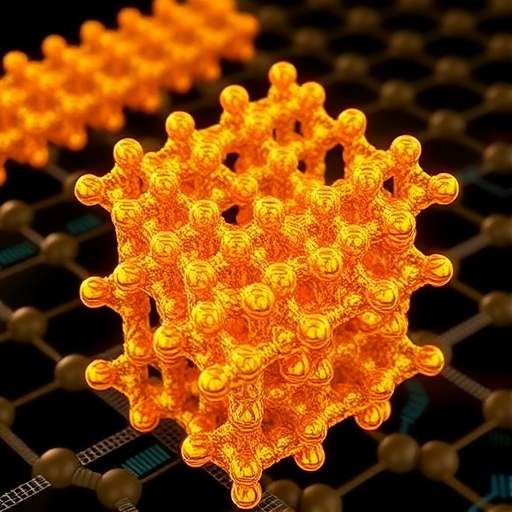
In recent years, the significance of hydrogen as a clean energy carrier has surged, sparking extensive research into efficient methods for hydrogen generation. A groundbreaking study spearheaded by Huang et al. has shed light on a promising new approach for enhancing the efficiency of the hydrogen evolution reaction (HER). This research introduces Ru-doped WS₂ (ruthenium-doped tungsten disulfide) nanosheets as a transformative catalyst, leaning on the intricate interplay of electronic structure and nanosheet morphology. By tailoring these parameters, the researchers have achieved remarkable advancements in hydrogen production, emphasizing the potential of this material in future energy applications.
The study systematically investigates the dual modulation of the electronic structure and nanosheet morphology in Ru-doped WS₂. This dual approach is pivotal as it addresses the inherent limitations of conventional catalysts that often falter under practical conditions. The researchers have established a clear correlation between the nanosheet morphology and catalytic performance, recognizing that the geometry of the catalyst at the nanoscale plays a crucial role in its ability to facilitate the HER effectively.
Doping WS₂ with ruthenium serves as a strategic maneuver to optimize the electronic properties of the catalyst. Ruthenium is known for its excellent electrocatalytic activity, making it an unparalleled addition to the WS₂ matrix. The study elucidates how the introduction of Ru modifies the electronic band structure of WS₂, resulting in enhanced charge transfer characteristics. This alteration significantly lowers the energy barrier for electron transfer during the HER, thus accelerating the reaction rate and improving overall efficiency.
One of the standout features of this research is the innovative synthesis technique employed to create the Ru-doped WS₂ nanosheets. By leveraging a meticulous chemical vapor deposition (CVD) method, the team was able to achieve a high degree of uniformity in the nanosheet morphology. This precision in the synthesis process allows for a more controlled study of how variations in shape and size influence the catalytic properties of the material. Such uniformity is often sought after but rarely achieved in the realm of nanomaterials.
The morphology of the Ru-doped WS₂ nanosheets has been characterized using advanced techniques such as scanning electron microscopy (SEM) and transmission electron microscopy (TEM). These imaging methods provide insights into the surface features and thickness of the nanosheets, which are integral to understanding their reactivity. The study findings suggest that specific nanosheet configurations are more conducive to HER, prompting the researchers to explore how different morphologies can be engineered for optimized performance.
Moreover, the implications of this research extend beyond just fundamental science. The findings are set to influence practical applications in renewable energy technologies. As the world pivots towards sustainable solutions for the energy crisis, the efficient production of hydrogen could serve as a catalyst for broader changes in energy generation and storage systems. The advancement of Ru-doped WS₂ as a leading candidate for hydrogen evolution may catalyze the transition to greener energy sources in various sectors, from transportation to industrial processes.
The integration of nanotechnology in energy applications signifies a shift in how researchers approach material design. The fusion of electronic enhancement strategies with nanoscale morphologies suggests a new paradigm in catalyst development. Future studies may further explore the synergistic effects observed in this research, paving the way for even more sophisticated materials capable of meeting the growing hydrogen demands on a global scale.
In summary, the combined efforts of Huang and colleagues have produced significant insights into the mechanistic underpinnings of HER catalysis through the lens of Ru-doped WS₂ nanosheets. Their findings highlight the importance of not only the material composition but also the architecture of the nano-catalysts in achieving unparalleled performance in hydrogen production. As research continues to unfold in this exciting field, Ru-doped WS₂ stands as a beacon of potential, promising a future where hydrogen plays a central role in our energy landscape.
In the context of energy security and environmental sustainability, the advancements driven by this study reflect a crucial step towards addressing the challenges of climate change and energy scarcity. While hydrogen has long been touted as the fuel of the future, it is innovations like these that will ultimately realize its true potential. The meticulous efforts of the research team serve as an essential reminder of the importance of interdisciplinary approaches to tackle complex energy problems and the need for continual advancements in material science.
As we forge ahead, the implications of Ru-doped WS₂ are likely to ripple through various applications. From portable fuel cells to large-scale industrial hydrogen production, the adaptability and efficacy of these nanosheets will undoubtedly be put to the test. The synergy between electronic architecture and nanosheet morphology reaffirms a key principle in materials science: that the whole is greater than the sum of its parts. This foundational insight may guide future research in the field, leading to the emergence of novel catalysts and energy solutions.
The journey of Ru-doped WS₂ into the realm of practical applications is just beginning. Following this research, it will be pivotal to explore the scalability of the synthesis methods employed. Transitioning from laboratory-scale to industrial-scale synthesis remains a significant hurdle, but the promise of high-efficiency catalysts like Ru-doped WS₂ provides motivation for sustainable development in the energy sector. Continued focus on the integration of advanced materials will be critical as we transition into an era of sustainable energy systems.
In conclusion, the synergistic regulation of electronic structure and nanosheet morphology in Ru-doped WS₂ represents a valuable contribution to the field of catalysis and hydrogen production. Huang et al.’s work not only underscores the potential of this novel catalyst but also sets a precedent for future research and development aimed at optimizing hydrogen evolution reactions. With a clear pathway established for high-efficiency catalysts, the research serves as a clarion call for scientists and engineers alike to harness the power of material innovation in driving the global transition towards renewable energy solutions.
Subject of Research:
Hydrogen evolution reaction efficiency through Ru-doped WS₂ nanosheets.
Article Title:
Synergistic regulation of electronic structure and nanosheet morphology in Ru-doped WS₂ for high-efficiency hydrogen evolution reaction.
Article References:
Huang, X., Zhang, Y., Yang, J. et al. Synergistic regulation of electronic structure and nanosheet morphology in Ru-doped WS₂ for high-efficiency hydrogen evolution reaction. Ionics (2025). https://doi.org/10.1007/s11581-025-06899-6
Image Credits:
AI Generated
DOI:
10.1007/s11581-025-06899-6
Keywords:
Hydrogen evolution, Ru-doped WS₂, catalysis, electronic structure, nanosheet morphology, sustainable energy.
Tags: advanced electrocatalytic materialscatalyst optimization strategiesclean energy carrierefficient hydrogen generation methodselectronic structure modulationhydrogen evolution reactionhydrogen production enhancementnanoscale catalyst performancenanosheet morphology in catalysisRu-doped WS2 nanosheetsruthenium as a catalysttransformative energy applications