Credit: by Hong-Fei Li, Xiao-Qi Liu, Chen Lyu, Jelena Gorbaciova, Li-Li Wen, Guo-Gang Shan, Peter. B. Wyatt, Huan-Qing Ye and William P. Gillin
Photonic Integrated Circuits (PICs), particularly those built from silicon, are being increasingly seen as the future of ultra-high-speed communications. However, despite nearly 30 years of research there is still no low-cost route to reliably integrating lasers or gain regions onto these devices. Current approaches, such as bonding III-V lasers directly to chips, or growing III-V structures directly onto silicon have been used but still don’t meet all the requirements of industry. Any technology that is developed will have to access the key long-distance C-band of wavelengths at around 1.5 μm, where the low-loss window for silica fibre lies.
Erbium doped materials are well known for their 1.5 μm emission and are the main-stay of the long-distance telecommunications network which utilise erbium doped fibre amplifiers. However, their weak absorption leads to a requirement for powerful fibre lasers to achieve population inversion. It is this problem that the use of organic sensitizers overcomes, allowing for compact efficient devices that can be integrated onto any substrate, including PICs. Much of the early work in this area suffered from low efficiency for the Er emission due to the quenching of the Er ions by local CH and OH oscillators. Whilst fully fluorinated materials have been shown to facilitate high efficiency for the Er ions the presence of the fluorine atoms have the side effect of increasing the HOMO energy which makes hole injection very difficult and hence they are poor materials for producing OLEDs.
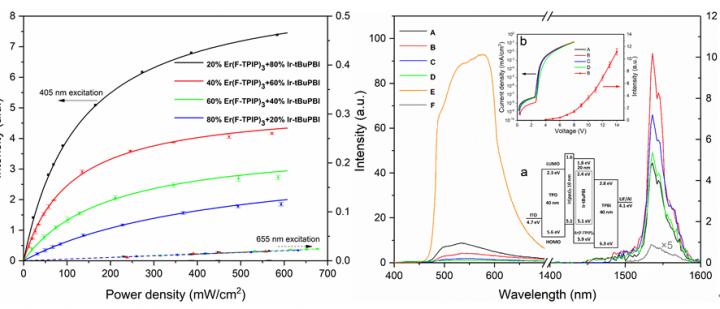
In a new paper published in Light Science & Application, scientists from Queen Mary University of London (UK), Chromosol Ltd. (UK) and Northeast Normal University (China) demonstrated an OLED that shown bright 1.5 μm electroluminescence due to enhanced Er emission. This performance is attributed to their innovative approach that makes the OLED’s emissive layer by compositing an organic phosphorescent iridium complex molecule with a separated organic erbium complex molecule. The selected organic iridium complex obeys minimal triplet-triplet annihilation for efficient triplet excitons which are excellent for coupling energy into the Er ions. Meanwhile, the fully-fluorinated organic ligands of the separated organic erbium complex form a protective shell to keep the Er ions from the quenching. The combination of these two advantages have enhanced the Er emission by a factor of up to 1600 with a high Er emission efficiency.
“We successfully demonstrate considerable sensitization for the Er3+ ion in a fully fluorinated complex Er(F-TPIP)3 by taking an organic phosphorescent complex Ir-tBuPBI as a sensitizer.” “…Ir-tBuPBI is chosen as the sensitizer because it exhibits a low TTA rate and efficiency roll-off but higher efficiency of PL and EL in a neat film than other non-doped Ir(III) materials…” “These features allow Ir-tBuPBI to provide efficient sensitization even at high concentrations. Er(F-TPIP)3 molecules have perfluorinated ligands and a large volume, approximately 2004 Å3… This enclosure keeps the C-H bonds on Ir-tBuPBI distant from the central Er3+ ion to reduce vibrational quenching.” The authors present their strategy.
The scientists conclude that “…the approach of separating the function of the high-efficiency Er3+ emitter from that of a sensitizer molecule that allows for considerable OLED performance to make a composite device, which shows that the use of protiated phosphorescent molecules is not greatly detrimental to the quantum efficiency of the Er3+ ions”.”…the demonstration highlights that future researchers can seek to optimize the individual performance of each component, rather than the current, difficult approach of seeking to design a single molecule with all the contradictory properties required”, suggest they.
###
Media Contact
William P. Gillin
[email protected]
Related Journal Article
http://dx.