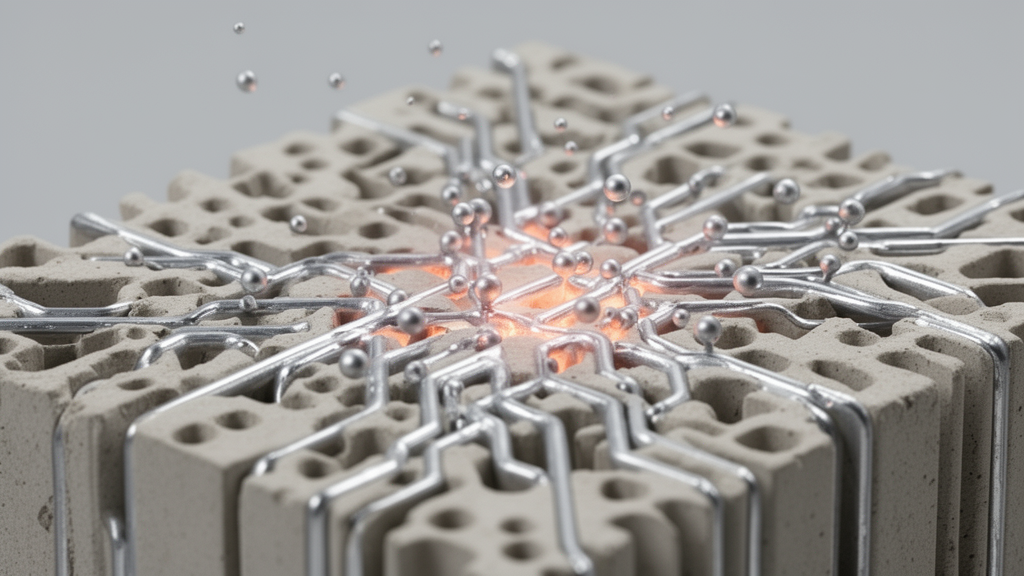
Naturally insulating kaolin ceramics have been successfully transformed into conductive and electrocatalytically active composite monoliths through a straightforward in-situ surface engineering method. A research team demonstrated that treating ceramic structures with specific polymer and metal salt formulations followed by thermal processing creates functional conductive networks directly on the substrate surfaces, offering an accessible route for electrochemical electrode fabrication.
In the experimental procedure, Egyptian kaolin cuboids served as the foundational substrate material. These ceramic monoliths were treated with poly(vinyl alcohol) solutions blended with transition metal precursors, specifically nickel acetate or copper acetate. Following the solution treatment, the cuboids underwent calcination under an inert atmosphere, which facilitated the simultaneous carbonization of the polymer and the reduction of the metal species directly across the ceramic surfaces.
Comprehensive structural characterization using X-ray diffraction and Raman spectroscopy confirmed the generation of graphitic carbon alongside zero-valent metallic nickel or copper nanoparticles. Complementary elemental mapping verified that conductive metal and carbon networks formed uniformly across the treated surfaces while preventing the formation of undesired metal oxides during the inert thermal decomposition process.
Surface morphology assessments performed via optical microscopy demonstrated substantial structural modifications on the ceramic blocks after the thermal treatment. The treated surfaces transitioned from their original state into rough conductive domains featuring interconnected conductive structures, confirming that the metal and carbon composite had formed a coherent, continuous surface architecture over the bulk monoliths.
Electrical measurements verified that the inherently non-conductive kaolin was successfully converted into conductive ceramic composite monoliths. Performance varied between the two transition metals, with nickel-treated samples displaying notably high electrical conductivity attributed to the strong catalytic activity of nickel in promoting graphitization of poly(vinyl alcohol). In comparison, the copper-treated cuboids exhibited progressive improvements in electrical conductivity as the overall copper loading increased.
The synthesized conductive monoliths were subsequently evaluated as self-supported electrocatalytic working electrodes for alkaline fuel oxidation reactions. Electrochemical tests revealed that nickel-treated cuboids provided robust catalytic activity toward the electrooxidation of urea, ammonia, and glycerol, whereas the copper-treated cuboids demonstrated promising catalytic performance specifically during glycerol oxidation in alkaline environments.
Overall, the experimental results substantiate a simple and low-cost strategy for converting widely available, naturally insulating kaolin ceramics into active composite electrodes. By generating catalytic transition metal nanoparticles embedded within graphitic carbon frameworks on monolithic supports, this approach establishes a functional platform for self-supported electrodes intended for electrochemical energy applications.
Subject of Research: In-situ metal and carbon surface engineering of kaolin ceramic monoliths for electrocatalysis
Article Title: A simple route toward conductive and electrocatalytically active kaolin ceramic monoliths via in-situ metal/carbon surface engineering
Article References: Barakat, N. A. M., & Ammar, A. A. A. (2026). A simple route toward conductive and electrocatalytically active kaolin ceramic monoliths via in-situ metal/carbon surface engineering. Discover Applied Sciences. https://doi.org/10.1007/s42452-026-09551-8
Image Credits: AI Generated
DOI: 10.1007/s42452-026-09551-8
Keywords: kaolin ceramics, ceramic monoliths, surface engineering, poly(vinyl alcohol), nickel acetate, copper acetate, inert calcination, graphitic carbon, metallic nanoparticles, conductive ceramics, electrocatalysis, alkaline fuel oxidation, urea electrooxidation, ammonia electrooxidation, glycerol electrooxidation, composite electrodes, materials science
News Source: Denise Maddox. (November 22, 2026). Engineers Transform Insulating Kaolin Ceramics into Conductive Monoliths for Fuel Oxidation. Scienmag.