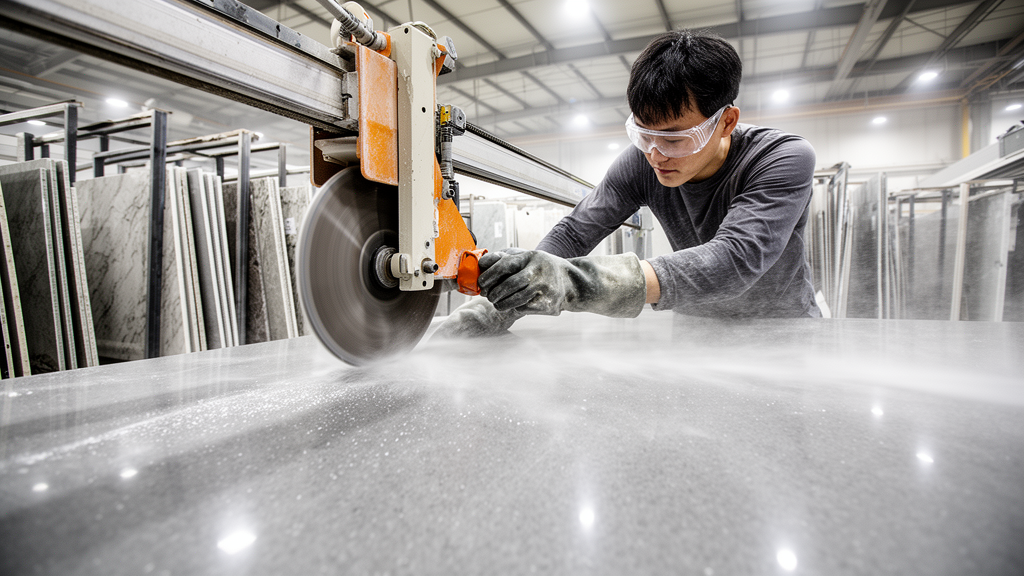
A detailed clinical case series and occupational exposure investigation conducted at the Pneumoconiosis Clinic of Seoul St. Mary’s Hospital has found that exposure to quartz-rich engineered stone can precipitate severe and accelerated silicosis among stoneworkers who accumulated decades of mixed mineral dust exposure. Engineered stone, also widely designated as artificial stone, reconstituted stone, agglomerated quartz, or silica conglomerate, is a composite slab manufactured by binding crushed quartz aggregate with unsaturated polyester or acrylic resins and pigments. While natural granite typically features a crystalline silica content ranging between 10 percent and 45 percent, and natural marble generally contains less than 5 percent crystalline silica, engineered stone slabs consistently feature a silica fraction between 85 percent and 95 percent by weight. The investigation highlights that in South Korea, where craftspeople frequently transitioned across distinct architectural material eras throughout multi-decade careers, even a relatively brief window of engineered stone fabrication superimposed on historical stone dust exposure was linked to advanced structural lung pathology and rapid loss of respiratory capacity.
The study protocol combined a systematic narrative review of national trade statistics, workforce surveys, adjudicated compensation records, and domestic workplace air measurements with a retrospective clinical case series evaluating stoneworkers evaluated during March 2026. The clinical evaluation drew from a broad institutional attendance of 405 patients who presented with various occupational respiratory disorders, including coal workers’ pneumoconiosis, asbestosis, silicosis, humidifier-disinfectant injury, and occupational malignancies. Among the 405 clinic attendees, 241 individuals had verified occupational histories of silica exposure, and 141 held a confirmed medical discharge diagnosis of silicosis. Clinicians identified 17 individuals with documented exposure to engineered stone processing and screened them against rigorous entry criteria requiring radiographic evidence of pneumoconiosis graded under International Labour Office standards, confirmed engineered stone cutting or polishing, and at least one full year of serial spirometry follow-up. Five male patients satisfied all qualifying criteria for severe or rapidly progressing disease, which required progressive massive fibrosis, an annualized absolute decline in forced vital capacity of at least 150 milliliters per year, or accelerated disease at presentation.
Analysis of South Korea’s industrial evolution reveals two parallel material trajectories rather than a direct linear substitution across construction products. In flooring, staircases, and institutional surfaces, historical on-site cast cementitious terrazzo, traditionally termed Dokkidashi and composed of Portland cement blended with marble, limestone, or mixed aggregate ground in situ, was progressively replaced by factory-finished precast terrazzo tiles beginning in the late 1980s. In the separate kitchen countertop and bathroom interior stream, traditional quarried granite was first challenged by polymer solid-surface panels, often marketed as artificial marble and composed of acrylic or polyester resins filled with aluminum trihydrate, before high-quartz engineered stone entered widespread commercial use during the 2000s. The critical occupational factor identified by the researchers is that individual Korean stoneworkers, rather than architectural specifications, bridged these separate material eras. Workers who entered the construction trades during the 1970s and 1980s grinding cementitious terrazzo or shaping natural granite accumulated decades of variable dust exposures before encountering engineered stone in the final chapters of their working lives.
Toxicological risks across these distinct stone-surface substrates diverge markedly in both intensity and chemical composition depending on the exact material handled and tasks executed. Historical on-site cementitious terrazzo formulated with marble or limestone aggregate produced alkaline cement dust and irritant particulates with low quartz concentrations, although formulations containing granite chips or requiring dry repair grinding could still generate meaningful respirable crystalline silica. Acrylic and polyester solid-surface products containing aluminum trihydrate filler produce sanding dust, adhesives, and volatile organic compounds during fabrication but present negligible crystalline silica hazards, typically measuring below 1 percent quartz. In sharp contrast, engineered stone constitutes an intense respirable crystalline silica hazard, generating freshly fractured fine particles during cutting, routing, edging, and polishing that drive profound alveolar macrophage injury, persistent oxidative stress, systemic inflammation, and unyielding fibrotic scarring. In addition to progressive fibrotic destruction, occupational inhalation of crystalline silica in the forms of quartz and cristobalite is recognized by the International Agency for Research on Cancer as a proven Group 1 human lung carcinogen.
Domestic workplace exposure benchmarks compiled in the review demonstrate that engineered stone fabrication routinely overwhelms regulatory safety thresholds, even under nominally wet working conditions. Direct site evaluations conducted in December 2018 by the Institute of Occupation and Environment at a small Korean countertop fabrication plant, known as C company, documented personal eight-hour time-weighted average quartz exposures of 0.122 milligrams per cubic meter during cutting and edge polishing, which exceeded the Korean occupational exposure limit of 0.05 milligrams per cubic meter by 2.4-fold. Personal sampling for hole-cutting and edge-finishing tasks recorded quartz concentrations reaching 0.179 milligrams per cubic meter, representing an exceedance of 3.6 times the regulatory threshold, alongside airborne cristobalite concentrations of 0.026 milligrams per cubic meter. Mineralogical analysis using X-ray diffraction of four engineered stone slabs handled at the facility revealed quartz contents of 65 percent, 70 percent, and 100 percent in three products, while the fourth product comprised 24 percent quartz, 28 percent cristobalite, and 13 percent resin binder, confirming that commercially fabricated slabs in Korea occupy the highest range of international silica content.
These elevated airborne exposures occurred despite C company operating a partitioned, continuous wet workflow with dedicated walls separating cutting and polishing stations. The investigation revealed that workers frequently engaged in dry edge grinding and compressed-air blowing at the margins of cutouts to inspect seam tolerances and basin openings, embedding high-dust dry procedures directly within nominally wet fabrication cycles. When contrasted with other domestic stone environments, the engineered stone measurements proved uniquely intense. A benchmark survey of Korean natural stone grinding reported a geometric mean quartz exposure of 0.170 milligrams per cubic meter with 93.3 percent of samples exceeding regulatory limits, whereas an outdoor building stone installation field study documented a mean respirable crystalline silica concentration of 0.043 milligrams per cubic meter. Although outdoor installation tasks generated substantial respirable dust averaging 0.489 milligrams per cubic meter, the enclosed fabrication of high-silica composite slabs generated far greater concentrations of respirable crystalline quartz and biologically reactive cristobalite.
The five male patients included in the clinical trajectory series presented a median age of 67 years, with ages spanning from 66 to 71 years. Their occupational histories documented substantial stone-trade careers ranging between 34 and 50 years, with a median of 40 years, yet their specific exposure to engineered stone accounted for only 3 to 7 years, representing a median of 6 years. Confounding by tobacco smoke was minimal: two workers were lifelong never-smokers, and the remaining three reported cumulative smoking exposures of 10 pack-years or less. None of the five stoneworkers reported consistent use of adequate respiratory protective equipment during fabrication tasks. High-resolution computed tomography confirmed that all five patients exhibited progressive massive fibrosis or complicated pneumoconiosis, characterized by bilateral conglomerate fibrotic masses measuring at least one centimeter, extensive structural distortion, and upper-lobe perilymphatic nodular conglomeration, frequently accompanied by severe exertional dyspnea classified as grade 4 on the modified Medical Research Council scale.
Longitudinal spirometric monitoring across a median follow-up of 5.6 years revealed profound functional impairment, with a median annual decline in forced vital capacity of −0.14 liters per year, spanning an individual range from −0.11 to −0.47 liters per year. Over the multi-year observation window, patients exhibited a median cumulative vital capacity loss of −1.09 liters, with individual cumulative decrements reaching as high as −2.60 liters. Parallel reductions were recorded in forced expiratory volume in one second, which declined at rates between −0.08 and −0.27 liters per year, establishing a severe and progressive restrictive functional defect. Notably, the most precipitous functional loss occurred in a 69-year-old lifelong never-smoker who had worked 34 years in stone fabrication, including seven years grinding cementitious terrazzo and natural stone, 21 years cutting solid-surface panels, and a final six years handling engineered stone. This patient’s forced vital capacity plunged from 96 percent of predicted normal down to 26 percent, exhibiting a biphasic acceleration that escalated from −0.24 liters per year across the first 3.2 years to −0.77 liters per year over the concluding 2.4 years.
Researchers observed that the clinical presentation in South Korea represents a distinctive multi-era phenotype when contrasted with outbreaks documented in Spain, Israel, Australia, and the United States, where affected fabricators have predominantly been younger individuals who experienced rapid disease onset after shorter latencies without prior mineral dust exposure. In the Korean series, brief periods of high-intensity engineered stone processing acted as a late-career accelerator superimposed upon decades of mixed background dust inhalation. An analysis of 32 adjudicated stone-trade compensation cases examined between 2000 and 2021 revealed that engineered stone was documented in only four cases, appearing only from 2019 onward, and was predominantly recognized under clinical classifications of chronic obstructive pulmonary disease or lung cancer rather than pure silicosis. The study authors noted that diagnostic routing among older stoneworkers frequently directs patients toward obstructive airway diagnoses, potentially obscuring underlying silicotic fibrosis unless comprehensive radiological imaging is systematically performed.
The study outlines critical limitations, including the retrospective single-center design, the small sample size derived from a tertiary pulmonary referral clinic, and the absence of a control cohort of similarly aged stoneworkers lacking engineered stone exposure. National workforce estimates remain constrained because Korean industrial classification codes combine stone fabrication with broader manufacturing and construction trades, and customs codes group engineered stone within general cement and concrete articles. Nevertheless, the investigators conclude that current workplace safeguards require urgent structural overhaul. Recommended measures include lowering the domestic occupational exposure limit of 0.05 milligrams per cubic meter toward more protective health targets, enforcing mandatory bans on dry cutting, edge grinding, and compressed-air blowing, and establishing comprehensive surveillance programs equipped with high-resolution computed tomography to evaluate workers exposed across changing industrial material eras.
Subject of Research: Respirable crystalline silica exposure and progressive silicosis associated with engineered stone fabrication in South Korea
Article Title: Artificial stone and silicosis: the Korean experience
Article References: Myong, J.-P. (2026). Artificial stone and silicosis: the Korean experience. Journal of Occupational Medicine and Toxicology, 21(1), Article 28. https://doi.org/10.1186/s12995-026-00528-2
Image Credits: AI Generated
DOI: 10.1186/s12995-026-00528-2
Keywords: engineered stone, artificial stone, silicosis, respirable crystalline silica, progressive massive fibrosis, occupational medicine, quartz dust, cristobalite, pulmonary function, forced vital capacity, occupational exposure limit, workplace safety, stone fabrication, pneumoconiosis, terrazzo, South Korea, industrial hygiene, lung pathology
News Source: Ophelia Keating. (November 17, 2026). Engineered Stone Exposure Accelerates Severe Lung Decline in South Korean Stoneworkers. Scienmag.