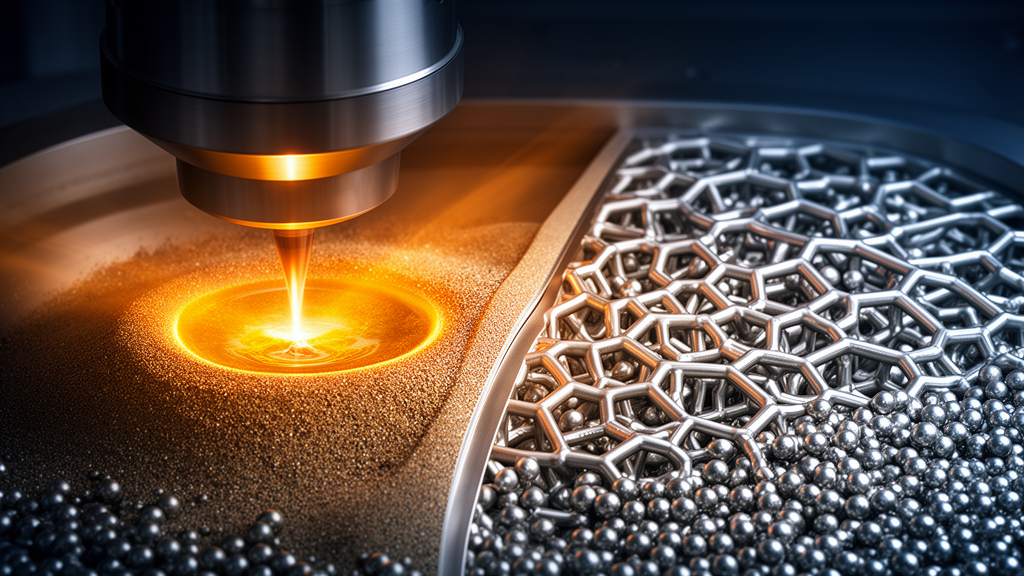
A review of metallic laser powder bed fusion indicates that the steep thermal gradients, repeated remelting cycles, and rapid solidification rates typical of the additive manufacturing process can be systematically harnessed to engineer local microstructural heterogeneity rather than treated solely as processing defects. Researchers led by Xianliang Sheng at the Liaocheng Vocational College of Science and Technology analyzed recent literature to show how intentional variations across material interfaces, grain morphologies, crystallographic textures, and auxiliary melt-pool fields redirect mechanical failure, suppress hot cracking, and assign site-specific properties within a single component. Rather than relying on post-build homogenization or strictly uniform grain structures, the authors argue that local architectural variations can effectively tolerate unavoidable metallurgical flaws while maintaining component durability under demanding service conditions.
During laser powder bed fusion, components are synthesized track by track and melt pool by melt pool, with each laser pass imposing a localized solidification path, thermal history, and defect population. The resulting microstructural evolution depends primarily on the melt pool’s temperature gradient and solidification growth rate. A high ratio of temperature gradient to growth rate typically promotes directional columnar grain growth, whereas a lower ratio combined with adequate undercooling and nucleation sites favors the formation of equiaxed grains. Rapid cooling also restricts solute diffusion, triggering non-equilibrium solute segregation and fine cellular or dendritic substructures. While these non-equilibrium conditions risk producing porosity, residual stress, and microcracks, the review synthesizes evidence demonstrating that strategically designed microstructural heterogeneity can alter crack initiation and propagation paths to shield critical load-bearing regions.
In multi-material additive manufacturing, interfacial heterogeneity acts as an active regulator of mechanical failure when joining dissimilar alloys. Because adjoining metals often possess sharply contrasting melting points, coefficients of thermal expansion, and thermal conductivities, unoptimized direct bonding frequently generates severe tensile residual stresses and lack-of-fusion defects. For instance, joining 316L stainless steel directly with copper alloys such as C18400 causes interfacial pores and cracking due to copper’s elevated reflectivity and thermal conductivity. However, researchers demonstrated that build sequence heavily dictates crack formation; printing CuZr before 316L stainless steel reduced thermal mismatch cracking compared to the reverse build sequence. Furthermore, sound metallurgical bonding without interface failure has been achieved in maraging steel paired with H13 tool steel and 316L stainless steel paired with Hastelloy X, with tensile fracture shifting entirely away from the bonded zone into weaker base metal.
To mitigate sharp property mismatches at multi-material boundaries, compositional grading and functional interlayers provide compliant transition zones that relieve concentrated stresses. Introducing intermediate compositional steps through in situ powder mixing or synthesized interlayers accommodates discrepancies in elastic modulus and thermal expansion, preventing the formation of continuous brittle intermetallic films that degrade interfacial ductility. The review emphasizes that interfacial quality should not be judged merely by density or hardness across polished cross-sections. Instead, robust defect tolerance requires verifying crack deflection, crack branching, and energy dissipation under realistic mechanical demands, including cyclic fatigue, impact, bending, and thermal shock loading conditions where interfacial debonding most readily initiates.
Within single-alloy systems, grain and phase heterogeneity can be engineered via in situ alloying and inoculation to suppress solidification cracking and hot tearing. Introducing particulate inoculants provides abundant heterogeneous nucleation sites, lowering the thermodynamic nucleation barrier and promoting a columnar-to-equiaxed transition during solidification. In crack-susceptible high-strength aluminum alloys, additions of zirconium or scandium facilitate equiaxed grain formation, effectively interrupting continuous columnar grain boundaries that serve as paths for hot cracking. Inoculation-assisted grain refinement in aluminum-magnesium alloys and nano-functionalized aluminum alloys significantly broadens the printability window, although researchers note that gains in yield strength must be balanced against potential decreases in tensile elongation.
Similar inoculation strategies apply to stainless steels, where the addition of titanium carbide or titanium diboride nanoparticles into 316L stainless steel refines the austenitic matrix while introducing secondary particle strengthening. The incorporated ceramic particles act simultaneously as heterogeneous nucleation sites, dislocation motion barriers, and grain-boundary pinning agents, driving elevated yield strength at ambient and high temperatures through Orowan strengthening and load transfer. In ferritic stainless steels, titanium additions form oxide or oxynitride precipitates that provide crystallographic matching for grain refinement. However, the review cautions that excessive nanoparticle loading can trigger particle agglomeration, poor powder flowability, and localized embrittlement, demonstrating that optimal defect tolerance requires balancing refined equiaxed grains at high-risk crack sites with ductile matrix regions elsewhere.
Texture engineering offers a non-compositional pathway to manipulate local mechanical behavior by varying scanning strategies across a single nominal material. Because individual grain orientations dictate Schmid factors and the resolved shear stresses required to activate crystallographic slip systems, spatial adjustments in laser scan patterns can establish distinct orientation domains within a part. Researchers have demonstrated layer-wise programming of crystallographic texture in 316L stainless steel, even encoding machine-readable optical patterns directly into solid metal. Mechanically, strongly textured zones can provide elevated directional stiffness and yield resistance along primary loading vectors, while adjacent untextured or weakly textured zones accommodate plastic deformation and blunt propagating fatigue cracks without the risk of foreign particle agglomeration.
Auxiliary external fields provide an active, non-compositional method to control melt-pool dynamics and solidification kinetics during laser powder bed fusion. Applying static magnetic fields induces Lorentz forces through interactions with thermoelectric currents, altering convective fluid flow in the liquid melt pool, suppressing lack-of-fusion voids, weakening unwanted texture, and refining grain structures. In AlSi7Mg alloys, online static magnetic field application simultaneously improved tensile strength and ductility by optimizing melt convection. Similarly, ultrasonic vibration applied during the printing of GH5188 superalloy promotes acoustic melt stirring, enhances bubble degassing, breaks up dendrite arms, and aids particle dispersion, decoupling trade-offs between component density and microstructure refinement during processing.
The review outlines a practical engineering framework for defect-tolerant heterogeneity design structured around four central questions: identifying the critical failure mode, selecting the appropriate microstructural length scale to modify, anticipating property trade-offs introduced by local heterogeneity, and experimentally validating performance under service conditions. Conventional additive manufacturing evaluation often prioritizes global relative density or baseline tensile yield strength, which overlooks how microstructural variations behave under cyclic or multiaxial loads. A defect-tolerant approach treats localized differences in composition, grain size, and texture as design variables that redirect stresses, slow crack growth rates, and prevent catastrophic failures even when minor manufacturing defects persist.
Translating site-specific heterogeneity engineering into industrial manufacturing requires overcoming key technical limitations, including process complexity, raw material quality control, and the absence of standardized testing protocols. Powder recycling and morphology variations directly affect powder-bed packing, laser energy absorption, and melt-pool stability, influencing the reproducibility of engineered microstructures. Furthermore, external auxiliary fields and scan-path thermal profiles are highly sensitive to overall part geometry, making parameter transfer between small test coupons and large, complex industrial components difficult. The authors conclude that integrating multiphysics solidification simulations, thermodynamic calculations, machine-learning process models, and in situ monitoring will be essential to establish reliable process-structure-property relationships that advance laser powder bed fusion into a precise microstructure design platform.
To establish the boundaries of these techniques, the authors evaluated how defect-tolerant heterogeneity engineering compares against traditional metallurgy routes such as casting, forging, welding, and bulk heat treatment. While casting and forging offer low complexity, they remain restricted by elemental segregation and strict geometry constraints. Conventional welding concentrates heavily on interface bonding but introduces pronounced residual stresses, and global heat treatments cannot readily impose site-specific microstructural variations. In contrast, laser powder bed fusion provides high local property control and flexible interface design, though it incurs higher manufacturing complexity, reduced production speeds, and increased operating costs that necessitate selective application across critical engineering components.
The review also details specific powder feedstock dynamics that govern the reproducibility of site-specific microstructures before melting occurs. Variations in particle size distribution directly shift powder packing density and bed spreading behavior, which alters local laser absorption characteristics and transient melt-pool stability. Particle morphology influences flowability, and non-spherical shapes introduce density variations across successive powder layers. For reactive alloys, surface oxygen contamination and progressive chemical shifts from repeated powder recycling alter oxide formation and melt-pool wetting behavior. Consequently, achieving consistent site-specific microstructures requires treating raw powder characteristics and reuse cycles as active design variables rather than static inputs.
Looking toward future implementation, the researchers emphasize integrating artificial intelligence and computational materials tools to overcome empirical trial-and-error bottlenecks. Machine-learning algorithms can correlate process parameters, local thermal history, and mechanical properties to map robust processing windows across new alloy systems. In parallel, thermodynamic CALPHAD modeling, phase-field simulations, and high-throughput screening provide foundational insight into solute partitioning, phase stability, and columnar-to-equiaxed transitions. Combining these predictive physics-based models with real-time process monitoring enables digital twin architectures that can adaptively regulate local thermal conditions during additive manufacturing runs.
Subject of Research: Defect-tolerant and site-specific heterogeneity engineering in laser powder bed fusion metallic alloys
Article Title: Defect-tolerant and site-specific heterogeneity engineering in laser powder bed fusion metallic alloys
Article References: Zhang, Y., Zhang, G., Sheng, X., Shi, W., Xu, J., Lv, X., Shang, C., & Wang, X. (2026). Defect-tolerant and site-specific heterogeneity engineering in laser powder bed fusion metallic alloys. Frontiers in Mechanical Engineering, 12, 1987664. https://doi.org/10.3389/fmech.2026.1987664
Image Credits: AI Generated
DOI: 10.3389/fmech.2026.1987664
Keywords: laser powder bed fusion, additive manufacturing, heterogeneity engineering, defect tolerance, microstructure design, grain refinement, columnar to equiaxed transition, inoculation, interfacial bonding, multi-material additive manufacturing, crystallographic texture, scan strategy, auxiliary magnetic fields, melt pool convection, solidification cracking, residual stress
News Source: Denise Maddox. (November 19, 2026). Engineered Microstructural Heterogeneity Improves Defect Tolerance in Laser Powder Bed Fusion. Scienmag.