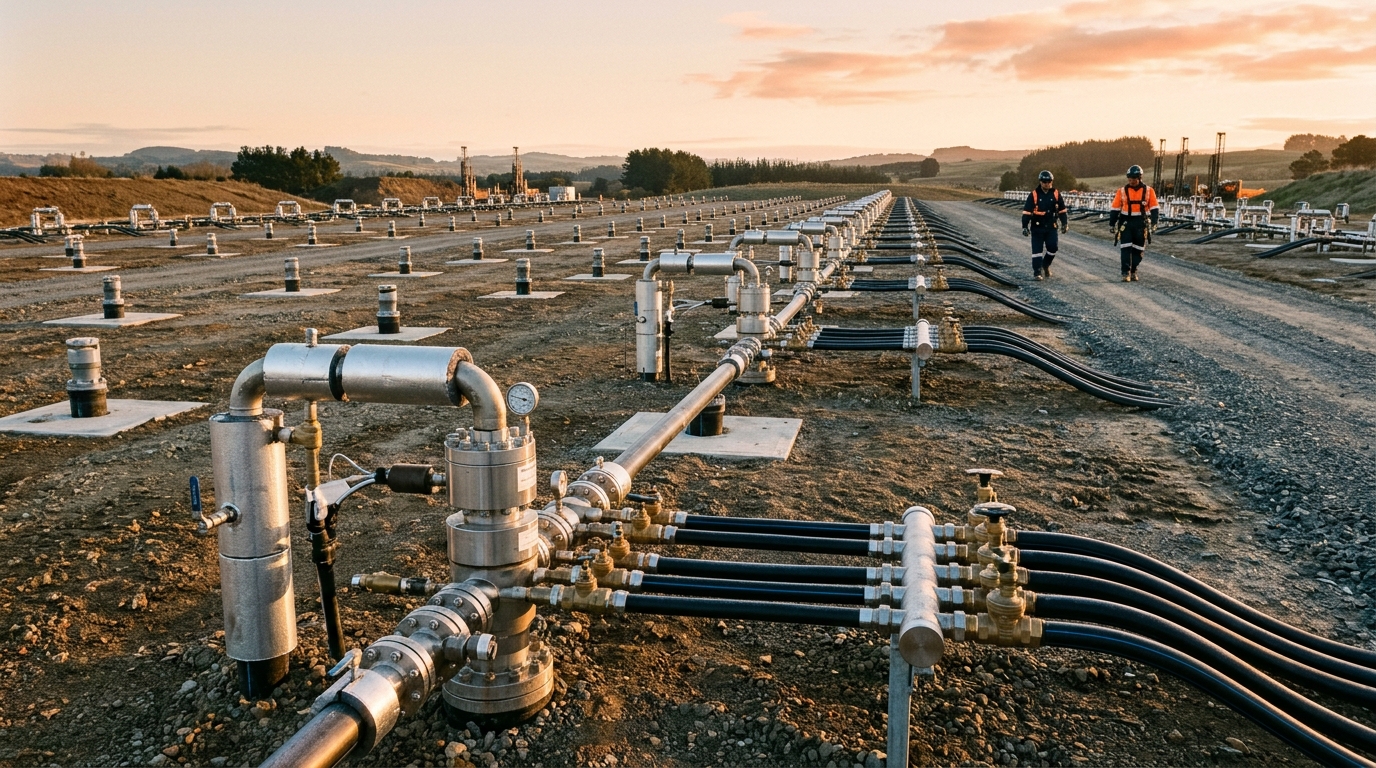
Artificial groundwater circulation using paired injection and extraction wells can substantially lower heat accumulation around borehole heat-exchanger arrays, even in geologically heterogeneous settings, according to a new modeling study published in the journal Geothermal Energy. Researchers built a single-platform MODFLOW 6 model that couples the Groundwater Flow and Groundwater Energy packages to simulate a nine-borehole array within a five-layer aquifer system, quantifying how much an engineered well doublet cools the subsurface under both confined and unconfined conditions.
The team first ran a vertical discretization analysis and adopted a mesh fine enough to resolve temperature structure between aquifer layers. On that mesh, they tested circulation rates ranging from zero to 66 cubic meters per day. The results show that forced circulation lowers ten-year temperatures near the borehole array by as much as 8.7 degrees Celsius, with unconfined cases remaining slightly warmer than confined cases at equal circulation rates.
Borehole heat exchangers are widely used to extract shallow geothermal heat, but sustained operation can warm the ground around the array, reducing efficiency over time. The study addresses this problem directly: instead of relying on natural groundwater flow to carry heat away, the model deploys a well doublet that actively advects heat away from the borehole field by pumping and injecting water.
A central contribution of the work is its treatment of geological heterogeneity. The researchers examined how unresolved variability in hydraulic conductivity affects the efficiency of the well-doublet heat-mitigation strategy. Groundwater circulation consistently reduced subsurface temperatures across the scenarios tested, but uncertainty in groundwater temperature predictions grew when the model did not resolve the heterogeneous conductivity field: temperatures varied by up to 4 degrees Celsius among realizations, while the ensemble-mean temperature differed from that of the corresponding homogeneous aquifer by approximately 1 degree Celsius.
Correlation structure mattered as well. Shorter hydraulic-conductivity correlation lengths yielded lower average temperatures, indicating that the spatial scale of geological variability influences how effectively the doublet flushes heat from the array. The authors also found that partially saturated layers, where relevant, modestly elevate groundwater temperatures and should be accounted for in site assessments.
From these simulations the researchers distilled process-based design guidance. They recommend high-resolution characterization of the geothermal site as important for the efficient design of geothermal energy systems. They advise deploying well doublets and tuning pumping and injection rates to advect heat away from the borehole array, while recognizing diminishing returns at high rates. They further suggest preferentially siting borehole fields along high hydraulic conductivity pathways identified during site characterization, and accounting for partially saturated layers where they occur.
The diminishing-returns finding carries practical weight for operators. Because cooling benefits do not scale indefinitely with circulation rate, pumping beyond an optimal range would consume energy without proportionate thermal gains. Tuning the rate to the site’s conductivity structure therefore becomes a key design decision rather than an afterthought.
The study’s scope is simulation-based: it quantifies cooling benefits and heterogeneity-driven uncertainty in a modeled nine-borehole, five-layer aquifer system rather than reporting field measurements from an operating installation. Even so, the magnitude of the modeled effect is notable. A reduction of up to 8.7 degrees Celsius in ten-year temperatures near the array suggests that engineered circulation could materially extend the useful performance of ground-source systems that would otherwise accumulate heat over decades of operation.
The work also underscores why site characterization deserves investment before drilling. With unresolved conductivity heterogeneity producing temperature prediction spreads of up to 4 degrees Celsius among realizations, two sites that look identical in a homogeneous model could behave quite differently once real geological variability is present. High-resolution characterization, the authors conclude, is important for the efficient design of geothermal energy systems.
Subject of Research: Numerical modeling of artificial groundwater circulation to mitigate heat accumulation around geothermal borehole heat-exchanger arrays in heterogeneous aquifers.
Article Title: Heterogeneity matters: cooling gains from artificial groundwater circulation in geothermal borehole fields
Article References: Huang, H.-Y., Pandey, U., Lin, Y.-F. F., Stumpf, A., & Tartakovsky, A. M. (2026). Heterogeneity matters: cooling gains from artificial groundwater circulation in geothermal borehole fields. Geothermal Energy. https://doi.org/10.1186/s40517-026-00419-z
Image Credits: AI Generated
DOI: 10.1186/s40517-026-00419-z
Keywords: geothermal energy, borehole heat exchanger, groundwater circulation, well doublet, MODFLOW 6, aquifer heterogeneity, hydraulic conductivity, heat accumulation, site characterization, confined and unconfined conditions, Heterogeneity, matters
News Source: Denise Maddox. (November 6, 2026). Engineered groundwater circulation cools geothermal borehole arrays by up to 8.7 degrees Celsius. Scienmag.