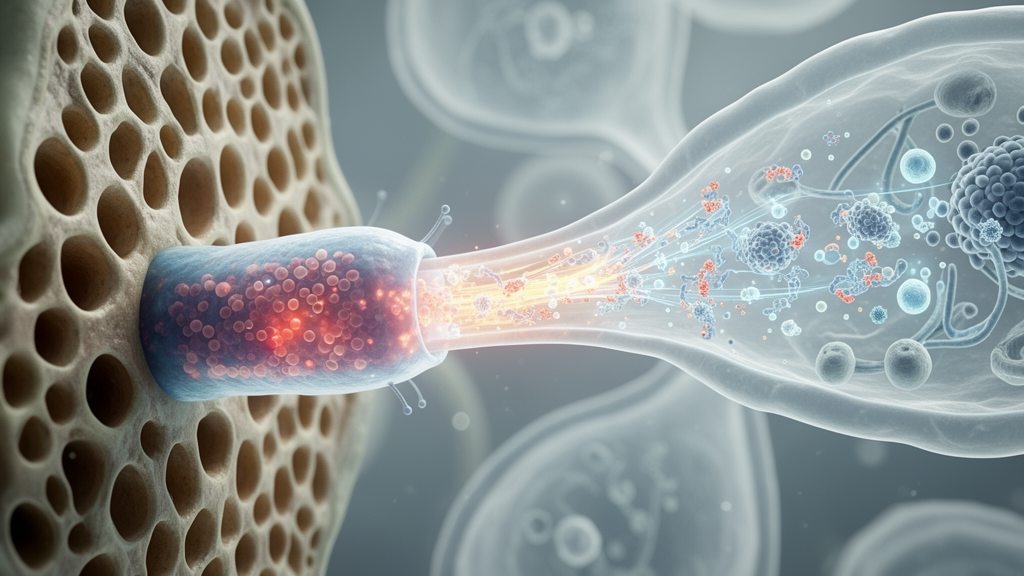
Plant biotechnology has long faced an intractable technical hurdle in delivering functional proteins directly across rigid plant cell walls, but researchers have now demonstrated that extracellular contractile injection systems repurposed from bacteria can accomplish targeted protein delivery into living plant tissues. The Photorhabdus virulence cassette, known as the PVC, represents a naturally occurring phage tail-like bacterial nanomachine that pathogenic bacteria employ to inject effector proteins into insect host cells. To adapt this macromolecular injection apparatus for agricultural and botanical applications, investigators systematically re-engineered the tail fibres of the PVC complexes to selectively recognize FLAGELLIN SENSITIVE 2, an abundant receptor localized on the surface of plant cells. By substituting the natural recognition elements with synthetic targeting moieties designed to bind this specific plant surface receptor, the team evaluated whether these contractile injection structures could be redirected away from their ancestral insect hosts to introduce diverse macromolecular cargoes into plant models.
The engineering strategy centered on designing and characterizing an extensive library of PVC variants targeting the FLAGELLIN SENSITIVE 2 receptor, evaluating their capacity to encapsulate and transport both native and non-native protein payloads into plant cells. The tested cargo proteins included visual marker constructs such as fluorescent proteins, enzymatic drivers such as Cre recombinase, and complex genome-modifying machinery including the R2 retroelement genome editor. To evaluate intracellular delivery and functionality, the engineered PVC particles were introduced into protoplasts and intact leaf tissues of wild-type Arabidopsis thaliana and Nicotiana benthamiana. In wild-type specimens, engineered PVCs successfully delivered functional Cre recombinase with cellular delivery efficiencies reaching up to sixteen percent. The translocation of active enzyme demonstrated that the delivered proteins remained catalytically active following mechanical injection through the exterior envelope of intact plant target cells.
Delivery efficiency demonstrated a direct mechanistic dependence on the presence and density of the surface receptor target, scaling consistently with cellular receptor abundance. When tested in genetically modified Arabidopsis lines overexpressing the FLAGELLIN SENSITIVE 2 receptor, the proportion of targeted leaf cells receiving the injected enzyme increased markedly, reaching seventy-five percent across the evaluated leaf tissue. Beyond basic recombinase activity, the investigative team deployed PVC particles loaded with the R2 retroelement protein, which mediated the targeted genomic insertion of an exogenous reporter gene directly into the plant nuclear genome and drove subsequent expression of the integrated sequence. These experimental demonstrations confirm that the modular contractile system can stably deliver complex catalytic editors to generate genomic modifications, establishing a functional framework where particle tail-fibre designs dictate cellular targeting while internal cargo selection specifies the downstream biological effect.
A critical consideration during receptor-targeted engineering was determining whether cargo delivery relied on receptor internalization or triggered unintended immune defense cascades within the host flora. Engagement of FLAGELLIN SENSITIVE 2 by its canonical flg22 ligand typically stimulates immune signaling pathways and initiates rapid receptor endocytosis. However, experimental assays revealed that protein delivery persisted without interruption when clathrin-mediated endocytosis was chemically or genetically blocked, as well as when competitive flg22 receptor antagonists were administered during infiltration. These observations established that cargo entry into the plant cytoplasm does not require receptor internalization and that the physical binding of engineered tail fibres can be decoupled from downstream defensive immune activation. Consequently, the mechanism underlying delivery corresponds to direct mechanical penetration across the cellular envelope rather than endocytic uptake, allowing plant surface proteins to act as neutral docking sites without triggering native signaling pathways.
Investigation of synthetic tail-fibre geometry showed that delivery efficiencies remained comparable across distinct PVC variants constructed with varying linker lengths flanking the flg22 peptide epitope, indicating that epitope accessibility did not represent a primary limiting factor under the tested experimental conditions. Nevertheless, comparative kinetic analyses showed that reporter signal accumulated substantially more slowly in intact leaf tissues than in wall-less protoplasts. This temporal delay reflects the physical resistance of the plant cell wall, which impedes the passive diffusion of large PVC complexes and restricts direct access to plasma membrane receptors, although differing rates of reporter delivery, accumulation, and transcriptional expression between intact tissues and protoplasts may also influence these kinetics. Resolving how wall architecture, particle diffusion, and receptor topography jointly govern delivery dynamics remains critical for establishing universal design principles across divergent plant species and specialized tissues.
To produce the contractile nanomachines, researchers utilized a domesticated PVCpnf gene locus divided into structural and cargo expression units, designated pStructural and pCargo. Using site-directed mutagenesis, an endogenous BsaI restriction site was eliminated from the original pCargo plasmid to render it fully compatible with Golden Gate Assembly. Synthetic constructs were assembled using high-fidelity polymerase amplification, restriction endonuclease digestion, and ligase reactions before transformation into competent bacterial hosts, including NEB Turbo cells and EPI300 expression strains for bulk particle production. All loaded cargo proteins were engineered with an amino-terminal fusion containing the Pdp1 amino-terminal domain to mediate packaging into the PVC core, linked by a flexible glycine-serine linker, a FLAG epitope tag, and a bipartite nuclear localization sequence. Additionally, a carboxy-terminal HiBiT peptide tag was appended to all cargo constructs to enable chemiluminescent detection and quantitative tracking of protein loading and transfer.
Computational structural modeling supported the rational engineering of the contractile complexes, utilizing ColabFold version 1.5.5, an AlphaFold2 implementation combining Google Colab workflows with sequence alignments generated through MMseqs2. General monomeric protein structures were modeled using the standard AlphaFold2-ptm parameters, whereas the Pvc13 tail-fibre complexes were evaluated as homotrimeric assemblies using AlphaFold2-multimer-v3 with default multiple sequence alignment settings. Three-dimensional molecular structural predictions were rendered, aligned, and customized using PyMOL Molecular Graphics System version 3.1.3 to inspect the steric display of targeting epitopes on the trimeric fibre tips. Experimental plant specimens, including Nicotiana benthamiana and Arabidopsis thaliana Columbia-0 ecotypes, were cultivated in controlled-environment growth chambers maintained at twenty-two degrees Celsius during sixteen-hour light cycles and twenty degrees Celsius during eight-hour dark cycles at fifty-five percent relative humidity.
In vivo delivery validations in intact plant foliage utilized fully expanded third or fourth leaves from three- to four-week-old Nicotiana benthamiana or third rosette leaves from three- to four-week-old Arabidopsis plants grown under identical conditions. Leaf panels were pre-treated by syringe infiltration with Agrobacterium tumefaciens strain GV3101 carrying appropriate reporter plasmids, the p19 viral silencing suppressor, and the pSOUP helper plasmid, suspended in infiltration buffer containing MES, magnesium chloride, and acetosyringone. Following twenty-four hours of incubation to establish reporter expression, purified Cre-loaded or R2-loaded PVC particles resuspended in HEPES buffer at one milligram per milliliter were infiltrated into the identical leaf regions using needleless syringes. In experiments evaluating receptor overexpression, an Agrobacterium strain encoding the receptor was introduced three days prior to reporter introduction, followed one day later by PVC particle challenge, ensuring optimal receptor display across the leaf lamina.
Quantitative assessment of intracellular enzymatic activity relied on confocal laser scanning microscopy conducted seventy-two hours post-infiltration on leaf discs excised adjacent to injection sites. Microscopic evaluations on a Leica STELLARIS 8 FALCON system employed water immersion optics at twenty-times magnification, utilizing laser excitation lines at 434 nanometers, 517 nanometers, and 587 nanometers to monitor mTurquoise2, yellow fluorescent protein, and mCherry signals, respectively. For each experimental condition, three to four biological replicates from independent plants were analyzed across more than eight non-overlapping technical fields of view, which were rendered in FIJI and quantified through custom Python processing scripts. PVC recombination activity was formally defined as the ratio of nuclei exhibiting yellow fluorescent protein expression relative to the total number of transformed cells expressing the internal mCherry reference marker.
To evaluate stable genome modification and transcriptional consequences, researchers combined nested polymerase chain reaction amplicon sequencing with droplet digital PCR assays on nucleic acids extracted from infiltrated tissues. Inversion-excision junctions from Cre recombination and integration junctions from R2 retroelement insertions were amplified using high-fidelity master mixes, resolved on agarose gels, purified, and sequenced by amplicon sequencing to confirm precise nucleotide junctions. Quantitative reverse transcriptase PCR and reverse transcriptase droplet digital PCR with fluorescent probes confirmed that spliced transcripts arose from integrated payloads without non-specific template contamination. Statistical analyses performed in Prism and Python evaluated data across independent biological replicates using two-sided one-way analysis of variance and Tukey post hoc corrections at a significance threshold of P less than 0.05, establishing that engineered extracellular contractile injection systems provide an adaptable, receptor-guided platform for targeted protein delivery into intact plant tissues.
Subject of Research: Receptor-mediated protein delivery into plant cells using engineered bacterial contractile injection systems
Article Title: An extracellular contractile injection system for receptor-mediated protein delivery into plant cells
Article References: Legendre, M. G., Muchenje, K. T., Heredia, A., Colee, C., Wang, Y., Pistilli, V. H., & Demirer, G. S. (2026). An extracellular contractile injection system for receptor-mediated protein delivery into plant cells. Nature Nanotechnology. https://doi.org/10.1038/s41565-026-02323-w
Image Credits: AI Generated
DOI: 10.1038/s41565-026-02323-w
Keywords: extracellular contractile injection system, Photorhabdus virulence cassette, FLS2 receptor, plant biotechnology, protein delivery, Cre recombinase, R2 retroelement, genome editing, Arabidopsis thaliana, Nicotiana benthamiana, molecular nanomachine, agroinfiltration, confocal microscopy, droplet digital PCR, AlphaFold2
News Source: Denise Maddox. (November 18, 2026). Engineered Bacterial Injection Systems Deliver Functional Proteins into Targeted Plant Cells. Scienmag.