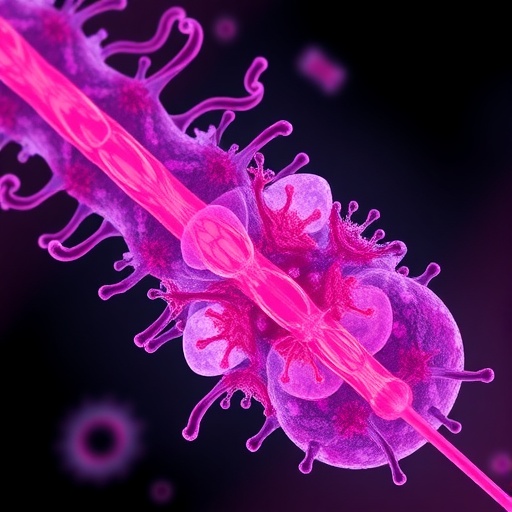
In a groundbreaking study set to redefine cellular biology and protein homeostasis, researchers have unveiled the molecular mechanisms behind a novel cellular assembly that bridges endosomes and phagophores, facilitating the degradation of membrane and extracellular proteins. This discovery not only illuminates a pivotal pathway in cellular maintenance but also opens new avenues for therapeutic interventions targeting protein aggregation diseases and membrane-associated disorders.
Cells continuously maintain their integrity and function by managing damaged or surplus proteins, particularly those embedded in membranes or existing extracellularly. While intracellular proteins have been extensively studied, the turnover and degradation of membrane-bound and extracellular proteins remain enigmatic. Now, a team led by Wang, P., Sun, H., and An, P., published in Nature Communications, has identified specialized endosome-phagophore linking assemblies that orchestrate the recognition, sequestration, and degradation of these proteins, revealing a complex and highly regulated process at the cellular level.
At the heart of this process lies the intricate crosstalk between endosomes—membrane-bound compartments tasked with sorting and trafficking proteins—and phagophores, the nascent double-membraned structures that initiate autophagy. Autophagy, an essential catabolic process, enables cells to degrade and recycle cytoplasmic content. The newly discovered linking assemblies serve as dynamic molecular connectors between these two entities, facilitating the transfer of membrane and extracellular proteins to autophagic machinery for degradation.
These endosome-phagophore linkers appear to be multi-protein complexes that tether the limiting membranes of endosomes to the expanding phagophore structures. High-resolution imaging and biochemical assays have revealed that these assemblies are composed of scaffold proteins equipped with membrane-binding domains capable of recognizing specific lipid compositions found in endosomal membranes. This specificity ensures that only appropriate cargoes destined for degradation are engulfed.
Adding a new dimension to the understanding of autophagic cargo selection, the research illustrates how post-translational modifications on membrane proteins act as molecular tags that direct them to these endosome-phagophore linkers. Ubiquitination patterns, in particular, signal the need for degradation, recruiting adaptor proteins that mediate the assembly of the bridging complexes. This molecular code ensures precision in targeting, avoiding inadvertent degradation of functional proteins.
Functionally, the linking assemblies facilitate the maturation of phagophores into autophagosomes by supplying membrane material and cargo simultaneously. This dual role suggests a coordinated mechanism integrating vesicular trafficking with autophagic engulfment, underscoring the cell’s efficiency in resource management and proteostasis.
Furthermore, the study employed advanced live-cell imaging techniques, such as fluorescence resonance energy transfer (FRET) and electron tomography, to visualize the dynamic formation and resolution of these endosome-phagophore linkers in real time. Such visualization provided unprecedented insight into the temporal and spatial regulation of membrane protein degradation, establishing a new paradigm in intracellular trafficking research.
Beyond basic cellular processes, the implications of this discovery resonate in the context of human health and disease. Dysregulation of membrane protein turnover is implicated in neurodegenerative diseases like Alzheimer’s and Parkinson’s, where accumulation of aberrant proteins disrupts cellular homeostasis. By elucidating the mechanisms governing degradation of these proteins, the findings offer promising targets for pharmacological modulation aimed at enhancing cellular clearance mechanisms.
In addition, certain cancers exploit autophagic pathways to survive under nutrient deprivation and stress. Understanding the assembly and regulation of these linking complexes could lead to novel strategies to disrupt tumor survival mechanisms, enhancing the efficacy of anti-cancer therapies.
The research also highlights the evolutionary conservation of this mechanism across eukaryotes, with homologous proteins identified in yeast and mammalian systems. This conservation suggests a fundamental role for endosome-phagophore linkers in cellular homeostasis, further emphasizing their significance in biology.
Integral to the study was the use of CRISPR-Cas9 mediated gene editing to selectively disrupt components of the linking assemblies. Cells lacking these proteins exhibited impaired degradation of membrane and extracellular proteins, accumulating potentially toxic material. Restoration of the linkers reversed these phenotypes, confirming their essential role.
Complementary proteomic analyses further characterized the composition of these assemblies, unveiling the presence of regulatory subunits responsive to cellular stress signals. These subunits modulate the assembly dynamics, adjusting the degradation capacity according to cellular needs, showcasing an elegant feedback mechanism.
Overall, the identification and characterization of endosome-phagophore linking assemblies mark a significant advancement in understanding cellular quality control pathways. The mechanistic insights provide a molecular framework that bridges previously disconnected fields of vesicular trafficking and autophagy, highlighting an intricate system of protein turnover that maintains cellular health.
As scientists continue to unravel these molecular details, the therapeutic potential of manipulating these assemblies becomes increasingly apparent. Future research aiming to modulate this pathway could yield innovative treatments for a spectrum of diseases rooted in protein aggregation and membrane trafficking defects.
This transformative study not only expands the horizons of cell biology but also exemplifies the power of integrated interdisciplinary approaches—combining molecular biology, advanced imaging, and genetic technologies—to unlock the mysteries of cellular function and disease.
Subject of Research: Cellular mechanisms involved in the degradation of membrane and extracellular proteins via endosome-phagophore linking assemblies.
Article Title: Endosome-phagophore linking assemblies for the degradation of membrane/extracellular proteins.
Article References:
Wang, P., Sun, H., An, P. et al. Endosome-phagophore linking assemblies for the degradation of membrane/extracellular proteins. Nat Commun (2025). https://doi.org/10.1038/s41467-025-67805-2
Image Credits: AI Generated
Tags: autophagy and protein recyclingcellular protein homeostasiscrosstalk in cellular degradation processesendosomal trafficking pathwaysendosome-phagophore complexesextracellular protein managementgroundbreaking cellular biology researchmembrane protein degradation mechanismsmembrane-associated disorder treatmentsmolecular connectors in cell biologyregulation of membrane protein turnovertherapeutic interventions for protein aggregation