Credit: HZDR / G.S. Cañón Bermúdez
While birds are able to naturally perceive the Earth's magnetic field and use it for orientation, humans have so far not come close to replicate this feat – at least, until now. Researchers at the Helmholtz-Zentrum Dresden-Rossendorf (HZDR) in Germany have developed an electronic skin (e-skin) with magnetosensitive capabilities, sensitive enough to detect and digitize body motion in the Earth's magnetic field. As this e-skin is extremely thin and malleable, it can easily be affixed to human skin to create a bionic analog of a compass. This might not only help people with orientation issues, but also facilitate interaction with objects in virtual and augmented reality. The results have been published in the journal Nature Electronics (DOI: 10.1038/s41928-018-0161-6).
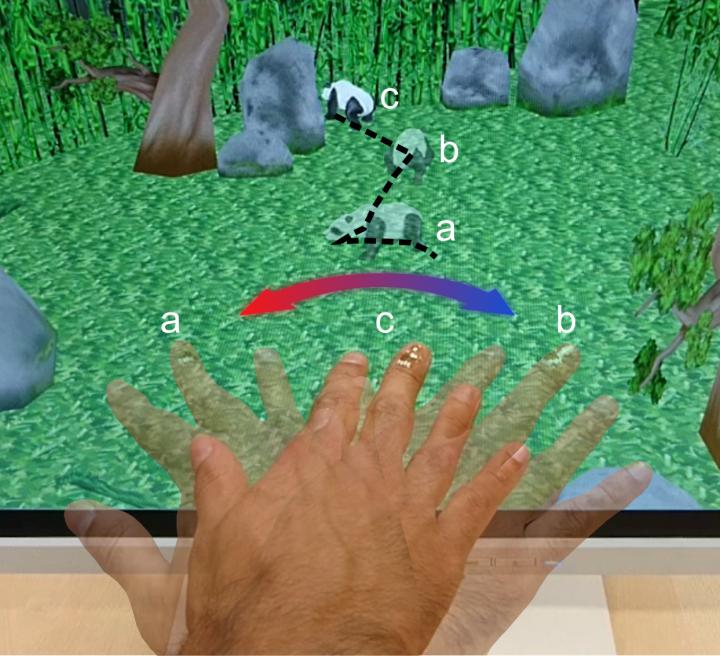
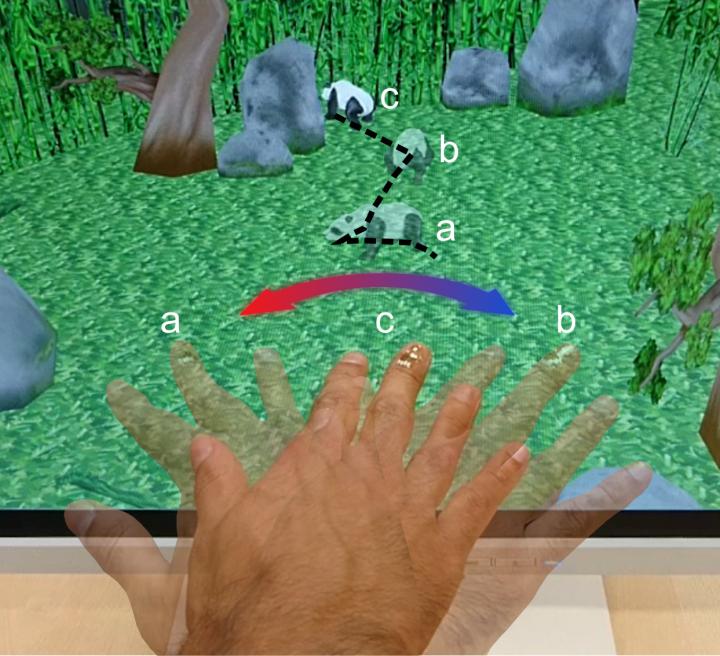
Just swipe your hand to the left and the virtual panda on the screen will start making its way towards the bottom left. Swipe your hand to the right and you can make the black-and-white animal face the opposite direction. This demonstration is reminiscent of the famous scene from the movie Minority Report where lead actor Tom Cruise controls a computer with nothing but hand gestures. What was science fiction 16 years ago, has now become reality thanks to Dr. Denys Makarov and his team of HZDR researchers. Neither bulky gloves, cumbersome glasses, nor sophisticated camera systems are required to control the panda's path. All it takes is a sliver of polymer foil, no more than a thousandth of a millimeter thick, attached to a finger – and the Earth's magnetic field.
"The foil is equipped with magnetic field sensors that can pick up geomagnetic fields," says the lead author Gilbert Santiago Cañón Bermúdez. "We are talking about 40 to 60 microtesla – that is 1,000 times weaker than a magnetic field of a typical fridge magnet." This is the first demonstration of highly compliant electronic skins capable of controlling virtual objects relying on the interaction with geomagnetic fields. The previous demonstrations still required the use of an external permanent magnet: "Our sensors enable the wearer to continuously ascertain his orientation with respect to the earth's magnetic field. Therefore, if he or the body part hosting the sensor changes orientation, the sensor captures the motion, which is then transferred and digitized to operate in the virtual world."
Just like a regular compass
The sensors, which are ultrathin strips of the magnetic material permalloy, work on the principle of the so-called anisotropic magneto-resistive effect, as Cañón Bermúdez explains: "It means that the electric resistance of these layers changes depending on their orientation in relation to an outer magnetic field. In order to align them specifically with the Earth's magnetic field, we decorated these ferromagnetic strips with slabs of conductive material, in this case gold, arranged at a 45-degree angle. Thus, the electric current can only flow at this angle, which changes the response of the sensor to render it most sensitive around very small fields. The voltage is strongest when the sensors point north and weakest when they point south." The researchers conducted outdoor experiments to demonstrate that their idea works in practical settings.
With a sensor attached to his index finger, the user started out from the north, first heading west, then south and back again – causing the voltage to rise and fall again accordingly. The cardinal directions that were displayed matched those shown on a traditional compass used as a reference. "This shows that we were able to develop the first soft and ultrathin portable sensor which can reproduce the functionality of a conventional compass and prospectively grant artificial magnetoception to humans," Bermúdez says. But that is not all. The researchers were also able to transfer the principle to virtual reality, using their magnetic sensors to control a digital panda in the computer game engine, Panda3D.
In these experiments, pointing to the north corresponded to a movement of the panda to the left, pointing to the south to a movement to the right. When the hand was on the left, i.e. magnetic north, the panda in the virtual world started moving in that direction. When it swiped in the opposite direction, the animal turned on its heels. "We were able to transfer the real-world geomagnetic stimuli straight into the virtual realm," Denys Makarov summarizes. As the sensors can withstand extreme bending and twisting without losing their functionality, the researchers see great potential for the practical use of their sensors not only as a way to access virtual reality. "Psychologists, for instance, could study the effects of magnetoception in humans more precisely, without bulky devices or cumbersome experimental setups, which are prone to bias the results," Gilbert Santiago Cañón Bermúdez projects.
###
__Publication:
G.S. Cañón Bermúdez, H. Fuchs, L. Bischoff, J. Fassbender, D. Makarov: Electronic-skin compasses for geomagnetic field driven artificial magnetoception and interactive electronics, in Nature Electronics, 2018 (DOI: 10.1038/s41928-018-0161-6)
__For more information contact:
Dr. Denys Makarov | Gilbert Santiago Cañón Bermúdez
Institute of Ion Beam Physics and Materials Research at HZDR
Phone +49 351 260-3273 | -2572
Mail: [email protected]">[email protected] | [email protected]">[email protected]
__Media contact:
Simon Schmitt | Science editor
Phone: +49 351 260-3400 | email: [email protected]">[email protected]
Helmholtz-Zentrum Dresden-Rossendorf | Bautzner Landstr. 400 | 01328 Dresden / Germany |
http://www.hzdr.de
The Helmholtz-Zentrum Dresden-Rossendorf (HZDR) performs – as an independent German research center – research in the fields of energy, health, and matter. We focus on answering the following questions:
* How can energy and resources be utilized in an efficient, safe, and sustainable way?
* How can malignant tumors be more precisely visualized, characterized, and more effectively treated?
* How do matter and materials behave under the influence of strong fields and in smallest dimensions?
To help answer these research questions, HZDR operates large-scale facilities, which are also used by visiting researchers: the Ion Beam Center, the High-Magnetic Field Laboratory Dresden, and the ELBE Center for High-Power Radiation Sources.
HZDR is a member of the Helmholtz Association and has five sites (Dresden, Freiberg, Grenoble, Leipzig, Schenefeld near Hamburg) with almost 1,200 members of staff, of whom about 500 are scientists, including 150 Ph.D. candidates.
Media Contact
Simon Schmitt
[email protected]
49-351-260-3400
@HZDR_Dresden
http://www.hzdr.de/db/Cms?pNid=0
Original Source
http://www.hzdr.de/presse/sensor_erdmagnetfeld http://dx.doi.org/10.1038/s41928-018-0161-6