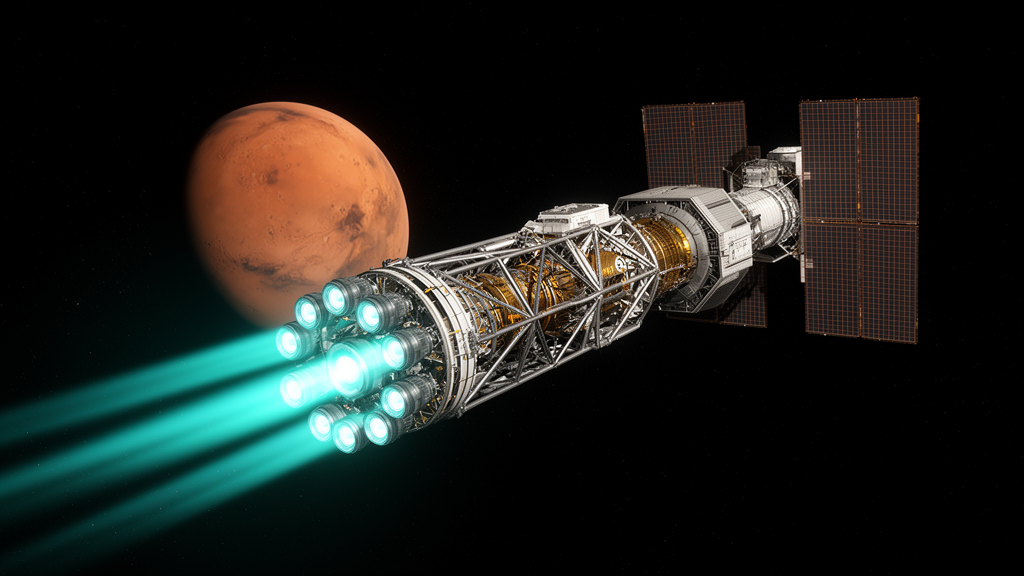
A recent review published in EPJ Techniques and Instrumentation evaluates the feasibility of using a cluster of electric thrusters (CET) for the International Nuclear Power and Propulsion System (INPPS) flagship. The study analyzes whether solely electric propulsion systems can support both robotic and crewed interplanetary missions to Mars and the Jupiter moon Europa without the need for chemical propulsion. The research, led by Frank Jansen and an international consortium of experts, focuses on the selection of specific thruster types developed by European, Japanese, and US institutions to meet the rigorous power and thrust requirements of these deep space trajectories.
The INPPS flagship is designed as a high-power space transportation tug with a hybrid power supply. It features a megawatt-class nuclear reactor capable of supplying up to 1 megawatt of electric energy to the propulsion system. Additionally, the spacecraft includes a secondary solar photovoltaic ring that provides approximately 10 kilowatts of power at the locations of Mars and Europa, serving as a backup in case of primary power supply failures.
The core of the propulsion system is the Cluster of Electric Thrusters, which combines multiple single thrusters to achieve the high total thrust numbers necessary for interplanetary travel. The study calculates that 750 kilowatts of the total reactor power is allocated for operating the thruster cluster, while the remaining 250 kilowatts are reserved for other non-nuclear subsystems on board the flagship.
The review examines several strategic configurations for the CET, including clusters composed exclusively of European thrusters, combinations of German and European units, and mixed arrays involving Japanese and US technology. The analysis determines that robotic and crewed missions to Mars and Europa are realizable using electric propulsion alone. However, the study identifies a significant limitation: no preselected electric thruster type is currently capable of generating the high thrust required for the final deceleration phase when returning from Mars to Earth. This specific trajectory section remains a challenge that may require reconsideration of trajectory calculations or the addition of chemical thrusters for braking.
Among the analyzed options, a configuration using only German electric thrusters is deemed feasible and preferred for the flagship. The German thruster cluster has a total mass of approximately 3,901.5 kilograms, including power processing units and propellant feeding systems. This mass is well below the determined limit of 10 percent of the spacecraft’s initial 100-ton start mass, making it a technically robust option for the mission.
A broader European configuration was also evaluated, incorporating thrusters from Italy, France, and Austria in addition to German units. This cluster includes the Italian HT20k hall-effect thruster, the French PPS-20k, and the Austrian NEO10 field emission thruster. The total mass of this European-only propulsion system is approximately 4,784.1 kilograms. The study highlights that the Austrian NEO10 thruster is particularly effective for low-thrust phases, allowing for accurate modulation of thrust levels during specific trajectory sections. This precision helps maintain the spacecraft’s trajectory with minimal propellant consumption.
The study also explores international combinations, such as a cluster mixing European, Japanese, and US thrusters. This configuration includes the NASA-457M v2 hall-effect thruster and the JAXA XP-6, alongside European units. While this mixed cluster is capable of achieving thrust levels for most trajectory sections, it is considered less optimal than the European-based options. The US thrusters require a higher quantity, such as 14 units of the NASA-457M v2, to achieve the same high-thrust levels that can be reached with just seven German HiPARC arcjets. The total mass for this international cluster is approximately 5,603.8 kilograms.
One of the key findings is that a configuration consisting only of Japanese and DEMOCRITOS ion thrusters is not feasible for the mission. The DEMOCRITOS IT-500 ion thruster is unable to achieve the required thrust levels during the peak acceleration phase of the transfer to Jupiter. Consequently, this specific combination is excluded from further study as a primary propulsion option. The study emphasizes that the selection of thrusters is heavily dependent on their current Technology Readiness Level and their ability to modulate thrust accurately to match mission requirements.
The mission timeline proposed in the study involves a first autonomous robotic flight from Earth to Mars, followed by a transfer to Europa. The calculated orbits include a journey from Earth to Mars between October 2026 and January 2028, a return to Earth between September 2028 and July 2029, and a final transfer to Jupiter between October 2031 and December 2035. This first interplanetary journey is intended to transport up to 18 tons of payload to Mars, allowing for scientific monitoring of the planet and its moons for nearly eight months before the flagship returns to Earth orbit for maintenance and reconfiguration.
Following the robotic mission, the study envisions a second INPPS flagship being prepared for a crewed flight to Mars. The space qualification of the nuclear power source tug is foreseen between 2028 and 2030, while the detailed study of using 22 international electric thrusters in the cluster supports the feasibility of crewed and robotic journeys to Mars and Europa. The authors conclude that the European or European/DEMOCRITOS based thruster cluster design is presumably the optimal selection, as it allows for reasonable modulation of thrust levels with moderate thruster quantities.
The project involves contributions from multiple international entities, including NASA Glenn Research Center, JAXA, and Ariane Germany, with the Institute of Advanced Studies in Brazil participating as a guest observer.
For a given propellant mass, electric thrusters achieve higher velocities, which translates to a greater mass transport capacity and reduced flight times to destinations such as Mars and Europa. The use of nuclear electric energy allows for the operation of electric thrusters at high power levels, exceeding 20 kilowatts, which is essential for achieving the necessary thrust levels for interplanetary travel.
The choice of thrusters also considers the potential for redundancy, allowing for alternative thruster types to be used in case of inadvertent failures, thereby enhancing the reliability of the propulsion system.
The study outlines a plan for thermal vacuum chamber tests to diagnose the selected thrusters in a cluster configuration and analyze their interactions. The endurance of the thrusters is a key consideration, with tests designed to simulate the long-duration operation required for interplanetary missions.
Subject of Research: Feasibility of electric thruster clusters for the INPPS nuclear space tug missions to Mars and Europa
Article Title: Cluster of electric thrusters for astronautic and robotic INPPS flagship space flights to Mars and Europa moon
Article References: Jansen, F., Andreussi, T., Cesarretti, G., Ehresmann, M., Grill, J., Herdrich, G., Funaki, I., Girard, N., Grundmann, J. T., Krejci, D., Leiter, H., Masson, F., Maiwald, V., Misuri, T., Oriol, S., Piragino, A., Reissner, A., & Schanz, L. (2023). Cluster of electric thrusters for astronautic and robotic INPPS flagship space flights to Mars and Europa moon. EPJ Techniques and Instrumentation, 10(1), Article 10. https://doi.org/10.1140/epjti/s40485-023-00097-2
Image Credits: AI Generated
DOI: 10.1140/epjti/s40485-023-00097-2
Keywords: Electric Propulsion, INPPS, Nuclear Space Tug, Mars Mission, Europa Mission, Spacecraft Design, Thruster Cluster, Interplanetary Travel, Cluster, electric, thrusters, astronautic
News Source: Denise Maddox. (November 9, 2026). Electric Thruster Clusters Enable Nuclear Space Tug Missions to Mars. Scienmag.