• HOME
  • NEWS
  • EXPLORE
    • CAREER
      • Companies
      • Jobs
    • EVENTS
    • iGEM
      • News
      • Team
    • PHOTOS
    • VIDEO
    • WIKI
  • BLOG
  • COMMUNITY
    • FACEBOOK
    • INSTAGRAM
    • TWITTER
Tuesday, March 31, 2026
BIOENGINEER.ORG
No Result
View All Result
  • Login
  • HOME
  • NEWS
  • EXPLORE
    • CAREER
      • Companies
      • Jobs
        • Lecturer
        • PhD Studentship
        • Postdoc
        • Research Assistant
    • EVENTS
    • iGEM
      • News
      • Team
    • PHOTOS
    • VIDEO
    • WIKI
  • BLOG
  • COMMUNITY
    • FACEBOOK
    • INSTAGRAM
    • TWITTER
  • HOME
  • NEWS
  • EXPLORE
    • CAREER
      • Companies
      • Jobs
        • Lecturer
        • PhD Studentship
        • Postdoc
        • Research Assistant
    • EVENTS
    • iGEM
      • News
      • Team
    • PHOTOS
    • VIDEO
    • WIKI
  • BLOG
  • COMMUNITY
    • FACEBOOK
    • INSTAGRAM
    • TWITTER
No Result
View All Result
Bioengineer.org
No Result
View All Result
Home NEWS Science News Chemistry

Efficient triplet pair separation in dibenzopentalene derivatives

Bioengineer by Bioengineer
May 28, 2019
in Chemistry
Reading Time: 2 mins read
0
IMAGE
Share on FacebookShare on TwitterShare on LinkedinShare on RedditShare on Telegram

IMAGE

Credit: ©Science China Press

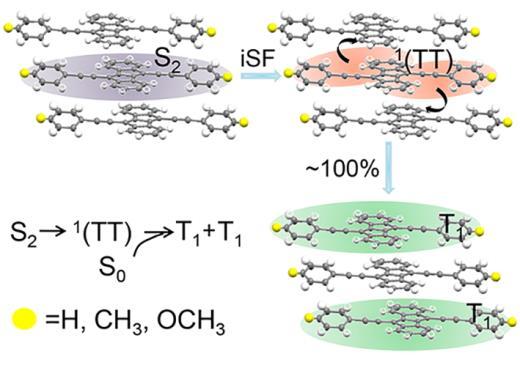
Singlet exciton fission (SF) was considered as an attractive avenue to boost the solar cell efficiencies beyond the Shockley-Queisser limit. In conventional materials, the mechanism of SF is an intermolecular process (named as intermolecular SF, xSF), in which one singlet excited chromophore couples electronically with another ground-state neighbor to form a correlated 1(TT) state (triplet pair). The triplet pair then splits into two independent triplet excited states (T1) at two different molecules.

As a result of the intermolecular nature of the xSF process, its efficiency is significantly influenced by the varied intermolecular electronic coupling degree due to uncontrollable molecular packing and structural order. Intramolecular SF (iSF), in which the essential electronic coupling term can be easily designed and controlled within one molecule, presents a preferable and applicable solution. The disentanglement of the correlated 1(TT) state to produce two long-lived individual triplets is of crucial importance for efficient extraction of excitation energy for photoelectric conversion. However, due to the high binding energy and the confinement of diffusional separation of the two coupled triplets on one molecule, harnessing the triplet energy efficiently via iSF remains a big challenge.

Recently, Professor Fu Hongbing’s group in Capital Normal University studied the evolution of 1(TT) in dibenzopentalene derivatives. The modification of molecular structure tuned the molecular packing distances and displacements.

More importantly, highly efficient triplet pair state separation took place in polycrystalline films with almost 100% yield, irrespective of different intermolecular interactions in these systems. These results suggest the feasibility of converting one correlated 1(TT) to two free T1 efficiently in iSF system and is meaningful for further application in bulk heterojunction organic solar cells.

###

See the article:
Liu Y, Wu Y, Wang L, Wang L, Yao J, Fu H. Efficient triplet pair separation from intramolecular singlet fission in dibenzopentalene derivatives. Sci. China Chem., 2019, DOI: 10.1007/s11426-019-9482-y
http://engine.scichina.com/publisher/scp/journal/SCC/doi/10.1007/s11426-019-9482-y?slug=fulltext

Media Contact
Fu Hongbing
[email protected]

Related Journal Article

http://dx.doi.org/10.1007/s11426-019-9482-y

Tags: Chemistry/Physics/Materials Sciences
Share12Tweet8Share2ShareShareShare2

Related Posts

Optimizing Cabin Design for Maximum Aircraft Evacuation Efficiency

Optimizing Cabin Design for Maximum Aircraft Evacuation Efficiency

March 31, 2026
SwRI Research Reveals a More Complex Magnetic Engine Powering the Sun

SwRI Research Reveals a More Complex Magnetic Engine Powering the Sun

March 31, 2026

Super-Spreading Coacervate Enables Strong Underwater Adhesion

March 31, 2026

By 2100, Climate Change May Turn Unhealthy Air Into a Daily Reality

March 31, 2026
Please login to join discussion

POPULAR NEWS

  • blank

    Revolutionary AI Model Enhances Precision in Detecting Food Contamination

    96 shares
    Share 38 Tweet 24
  • Imagine a Social Media Feed That Challenges Your Views Instead of Reinforcing Them

    1006 shares
    Share 398 Tweet 249
  • Promising Outcomes from First Clinical Trials of Gene Regulation in Epilepsy

    51 shares
    Share 20 Tweet 13
  • Advancements in EV Battery Technology to Surpass Climate Change-Induced Degradation

    45 shares
    Share 18 Tweet 11

About

We bring you the latest biotechnology news from best research centers and universities around the world. Check our website.

Follow us

Recent News

Global Spread of Multidrug-Resistant Ural Lineage TB

Neonatal Outcomes With Meconium: Suctioning Impact

SNHG10 Drives Pancreatic Cancer Growth and Drug Resistance

Subscribe to Blog via Email

Enter your email address to subscribe to this blog and receive notifications of new posts by email.

Join 78 other subscribers
  • Contact Us

Bioengineer.org © Copyright 2023 All Rights Reserved.

Welcome Back!

Login to your account below

Forgotten Password?

Retrieve your password

Please enter your username or email address to reset your password.

Log In
No Result
View All Result
  • Homepages
    • Home Page 1
    • Home Page 2
  • News
  • National
  • Business
  • Health
  • Lifestyle
  • Science

Bioengineer.org © Copyright 2023 All Rights Reserved.