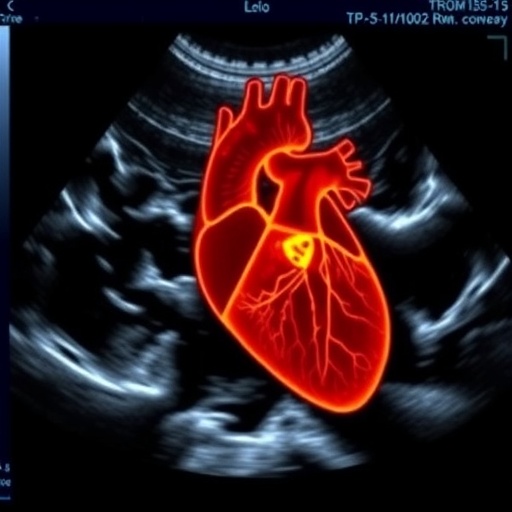
In a groundbreaking leap forward for medical imaging and artificial intelligence, researchers have unveiled Echo-Vision-FM, a sophisticated pre-training and fine-tuning framework designed explicitly for echocardiogram video interpretation. This innovative foundation model, detailed by Zhang, Wu, Ding, and colleagues in a forthcoming 2025 publication in Nature Communications, promises to transform how clinicians analyze and understand cardiac function from echocardiographic videos, a cornerstone diagnostic tool for cardiovascular health.
Echocardiography has long been esteemed for its real-time visualization of the heart’s structure and motion, offering clinicians critical insights into cardiac pathologies without the risks associated with more invasive procedures. However, interpreting echocardiograms demands significant expertise and experience, particularly when navigating voluminous video data where subtle spatial and temporal patterns are paramount. Traditional analyses rely heavily on manual evaluation or narrowly focused algorithms limited to static images or specific measurements, constraining the depth and precision of diagnostic outputs.
Addressing these limitations, the Echo-Vision-FM framework harnesses advances in deep learning and video foundation models to elevate echocardiogram analysis to unprecedented levels. Central to this approach is the model’s pre-training on vast corpora of unlabeled echocardiogram videos, allowing it to autonomously discover complex visual and temporal features inherent to cardiac function without human annotation. This self-supervised learning paradigm enables the model to internalize nuanced motion dynamics, anatomical variations, and pathological signatures embedded within echocardiographic sequences, building a versatile and rich feature representation.
Following this comprehensive pre-training phase, Echo-Vision-FM undergoes fine-tuning tailored to specific downstream clinical tasks, such as disease classification, quantification of cardiac chamber dimensions, or detection of valvular abnormalities. By leveraging supervised learning on expertly annotated datasets, the framework adapts the generalized video foundation knowledge to yield precise and clinically actionable predictions. This two-step process significantly reduces the need for large annotated datasets—historically a bottleneck in specialized medical AI development—while maximizing accuracy and robustness.
The architecture underpinning Echo-Vision-FM is informed by vision transformers and recurrent neural networks, capable of integrating spatial and temporal contexts seamlessly. Unlike prior models that treat frames independently, Echo-Vision-FM capitalizes on temporal continuity to discern patterns that evolve dynamically across video frames. This approach mimics the cognitive processing performed by cardiologists when evaluating wall motion abnormalities, ejection fractions, or subtle arrhythmogenic potentials over cardiac cycles, thereby bridging the gap between automated analysis and clinical reasoning.
Moreover, the model incorporates multi-modal fusion techniques by integrating echocardiogram video data with auxiliary information such as Doppler flow measurements and electrocardiogram signals. This holistic perspective enriches the anatomical and functional understanding, enhancing the detection of nuanced pathologies that might otherwise elude isolated modalities. Such integrative learning reflects a profound paradigm shift, positioning Echo-Vision-FM not merely as a tool for image interpretation but as a comprehensive cardiac assessment assistant.
Crucially, the team has meticulously validated the framework’s performance across diverse cohorts and ultrasound machines, demonstrating impressive generalizability and robustness. In multi-center trials, Echo-Vision-FM consistently achieved state-of-the-art accuracy surpassing conventional convolutional neural networks and classical machine learning baselines. This resilience to variations in echocardiographic protocols and image quality is vital for real-world clinical deployment, ensuring equitable performance across different healthcare settings.
Beyond improving diagnostic accuracy, Echo-Vision-FM holds promise for augmenting workflow efficiency. By automating labor-intensive tasks such as frame selection, segmentation, and preliminary diagnosis, the model frees cardiologists to focus on complex clinical decision-making. The researchers envision integration of Echo-Vision-FM within ultrasound systems and cloud platforms, facilitating real-time feedback during image acquisition and post-examination analysis, ultimately shortening time-to-diagnosis and enhancing patient care pathways.
The implications for personalized medicine are equally profound. By capturing subtle, patient-specific cardiac dynamics across time, Echo-Vision-FM can enable longitudinal monitoring with unprecedented sensitivity. This offers prospects for early detection of disease progression, monitoring therapeutic responses, and tailoring interventions to individual cardiac phenotypes. Furthermore, the model’s foundational video representations can be extended to other cardiovascular imaging modalities and pathologies, indicating a broad applicability in cardiovascular AI.
Nevertheless, the authors acknowledge challenges that remain. Interpretability of deep learning models in medicine is critical, prompting ongoing efforts to develop explainable AI modules that elucidate model reasoning to clinicians transparently. Data privacy and ethical considerations are also paramount, necessitating rigorous frameworks to secure sensitive patient data while fostering collaborative AI innovation across institutions.
Looking ahead, the research team is exploring enhancements via federated learning to enable decentralized training without data sharing, aiming to harness global echocardiographic repositories while safeguarding privacy. Additionally, multimodal expansions incorporating genetic and clinical metadata hold potential to advance integrative cardiac phenotyping. The release of Echo-Vision-FM as an open-source foundation model invites the broader research community to build upon this transformative platform.
In sum, Echo-Vision-FM stands at the forefront of a revolution in cardiovascular diagnostics, marrying the power of advanced video-based deep learning with decades of clinical echocardiography expertise. By unlocking the rich temporal and spatial complexities of echocardiogram videos, this framework embodies a leap toward more accurate, efficient, and personalized cardiac care. As it transitions from research to clinical integration in the coming years, Echo-Vision-FM could well redefine the standards of cardiac imaging and interpretation, potentially saving countless lives by enabling earlier and more precise diagnoses.
This pioneering work exemplifies the rapid convergence of artificial intelligence and medical imaging, harnessing pre-training and fine-tuning methodologies to surmount the obstacles of limited annotations and heterogeneous data. Echo-Vision-FM’s success underscores the transformative potential of foundation models in specialized domains, suggesting a future where AI-driven video analysis is standard in cardiology and beyond. As healthcare increasingly embraces digital innovation, this novel framework heralds a paradigm where complex dynamic biological signals can be decoded with unprecedented clarity and scale.
The promising trajectory of Echo-Vision-FM offers a vivid glimpse into the potential for next-generation AI models to revolutionize disease detection and monitoring. By empowering clinicians with enhanced diagnostic tools grounded in cutting-edge machine learning, this framework illuminates a path toward greater accuracy, efficiency, and personalized interventions in cardiovascular medicine. It represents a significant stride forward, affirming the vital role of interdisciplinary collaboration in addressing some of medicine’s most enduring challenges.
As the clinical community eagerly anticipates broader availability and validation, Echo-Vision-FM sets the stage for a future where artificial intelligence augments human expertise in safeguarding cardiac health. The model’s foundation in robust pre-training and adaptive fine-tuning embodies a scalable template for development across other medical video domains, propelling the field toward fully integrated, AI-empowered diagnostic ecosystems. The coming years will be critical in translating this technological promise into tangible health benefits, underscoring the immense potential at the intersection of AI and cardiology.
Subject of Research: Development of a pre-training and fine-tuning AI framework for echocardiogram video analysis
Article Title: Echo-Vision-FM: a pre-training and fine-tuning framework for echocardiogram video vision foundation model
Article References:
Zhang, Z., Wu, Q., Ding, S. et al. Echo-Vision-FM: a pre-training and fine-tuning framework for echocardiogram video vision foundation model. Nat Commun (2025). https://doi.org/10.1038/s41467-025-66340-4
Image Credits: AI Generated
Tags: advancements in cardiac imagingartificial intelligence in medical imagingautomated echocardiogram interpretationcardiovascular health technologydeep learning for cardiac diagnosticsEcho-Vision-FM frameworkEchocardiogram video analysisfine-tuning AI for healthcaremachine learning for echocardiographypre-training echocardiogram modelsself-supervised learning in medicinevideo foundation models in healthcare