

• HOME
  • NEWS
  • EXPLORE
    • CAREER
      • Companies
      • Jobs
    • EVENTS
    • iGEM
      • News
      • Team
    • PHOTOS
    • VIDEO
    • WIKI
  • BLOG
  • COMMUNITY
    • FACEBOOK
    • INSTAGRAM
    • TWITTER
Wednesday, April 1, 2026
BIOENGINEER.ORG
No Result
View All Result
  • Login
  • HOME
  • NEWS
  • EXPLORE
    • CAREER
      • Companies
      • Jobs
        • Lecturer
        • PhD Studentship
        • Postdoc
        • Research Assistant
    • EVENTS
    • iGEM
      • News
      • Team
    • PHOTOS
    • VIDEO
    • WIKI
  • BLOG
  • COMMUNITY
    • FACEBOOK
    • INSTAGRAM
    • TWITTER
  • HOME
  • NEWS
  • EXPLORE
    • CAREER
      • Companies
      • Jobs
        • Lecturer
        • PhD Studentship
        • Postdoc
        • Research Assistant
    • EVENTS
    • iGEM
      • News
      • Team
    • PHOTOS
    • VIDEO
    • WIKI
  • BLOG
  • COMMUNITY
    • FACEBOOK
    • INSTAGRAM
    • TWITTER
No Result
View All Result
Bioengineer.org
No Result
View All Result
Home NEWS Science News Biology

Eating triggers endorphin release in the brain

Bioengineer by Bioengineer
August 28, 2017
in Biology
Reading Time: 2 mins read
0
Share on FacebookShare on TwitterShare on LinkedinShare on RedditShare on Telegram
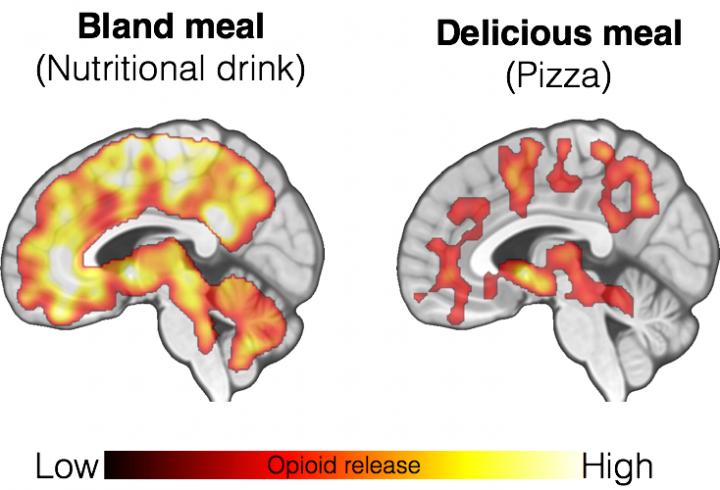
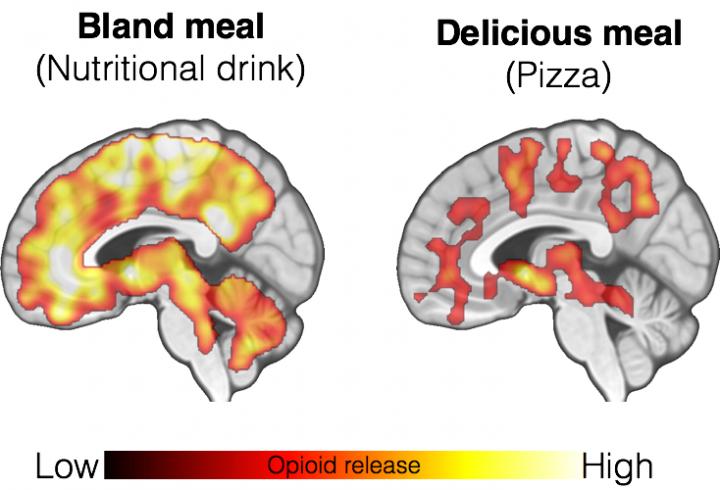
IMAGE

Credit: Turku PET Centre

Finnish researchers have revealed how eating stimulates brain's endogenous opioid system to signal pleasure and satiety.

The recent results obtained by researchers from Turku PET Centre have revealed that eating leads to widespread opioid release in the brain, likely signalling feelings of satiety and pleasure.

Eating a delicious pizza led to significant increase of pleasant feelings, whereas consumption of calorie-matched nutritional drink did not. However, both types of meals induced significant release of endogenous opioids in the brain.

Opioids are associated with pleasure and euphoria. The study revealed that a significant amount of endorphins is released in the entire brain after eating the pizza and, surprisingly, even more are released after the consumption of the tasteless nutritional drink. The magnitude of the opioid release was independent of the pleasure associated with eating. According to the researchers, it is likely that the endogenous opioid system regulates both feelings of pleasure and satiety.

-The opioid system regulates eating and appetite, and we have previously found that its dysfunctions are a hallmark of morbid obesity. The present results suggest that overeating may continuously overstimulate the opioid system, thus directly contributing to development of obesity. These findings open new opportunities for treating overeating and the development of obesity, says Professor Lauri Nummenmaa from Turku PET Centre.

– It was a surprise that endorphins are released in the entire brain and that the nutritional drink had a larger impact. This creates a basis for future research and hopefully we will find ways to study and describe the development and predictors of addiction, obesity and eating disorders, says Researcher, M.D., PhD. Jetro Tuulari.

The study was conducted using positron emission tomography (PET). The participants were injected with a radioactive compound binding to their brain's opioid receptors. Radioactivity in the brain was measured three times with the PET camera: after a palatable meal (pizza), after a non-palatable meal (liquid meal) and after an overnight fast.

The research was funded by the Academy of Finland and the findings were published in The Journal of Neuroscience: http://www.jneurosci.org/content/early/2017/07/26/JNEUROSCI.0976-17.2017

###

Media Contact

Lauri Nummenmaa
[email protected]
358-505-747-933

http://www.utu.fi/en/

Original Source

https://www.utu.fi/en/news/news/Pages/Eating-Triggers-Endorphin-Release-in-the-Brain.aspx http://dx.doi.org/10.1523/JNEUROSCI.0976-17.2017


Share15Tweet8Share2ShareShareShare2

Related Posts

Do Your Genes Influence How Lifestyle Choices Affect Aging?

Do Your Genes Influence How Lifestyle Choices Affect Aging?

April 1, 2026
Combining Single-Cell Multiomics Unlocks Precise Identification of Rare Cell Types and States

Combining Single-Cell Multiomics Unlocks Precise Identification of Rare Cell Types and States

March 31, 2026

Genetically Engineered Marmosets Pave the Way for Advancements in Human Deafness Research

March 31, 2026

How Great Hammerhead Sharks Outsmart Ocean Temperature Swings: Insights from FIU Researchers

March 31, 2026
Please login to join discussion

POPULAR NEWS

  • blank

    Revolutionary AI Model Enhances Precision in Detecting Food Contamination

    96 shares
    Share 38 Tweet 24
  • Imagine a Social Media Feed That Challenges Your Views Instead of Reinforcing Them

    1006 shares
    Share 398 Tweet 249
  • Promising Outcomes from First Clinical Trials of Gene Regulation in Epilepsy

    51 shares
    Share 20 Tweet 13
  • Popular Anti-Aging Compound Linked to Damage in Corpus Callosum, Study Finds

    43 shares
    Share 17 Tweet 11

About

We bring you the latest biotechnology news from best research centers and universities around the world. Check our website.

Follow us

Recent News

Tracking Research on Adult Outcomes After Complex Perinatal History

Unveiling the Biological Pathways Linking Pesticides to Cancer Risk: New Study Sheds Light on Environmental Health Impacts

Inequities in Family Engagement Within the NICU

Subscribe to Blog via Email

Success! An email was just sent to confirm your subscription. Please find the email now and click 'Confirm' to start subscribing.

Join 78 other subscribers
  • Contact Us

Bioengineer.org © Copyright 2023 All Rights Reserved.

Welcome Back!

Login to your account below

Forgotten Password?

Retrieve your password

Please enter your username or email address to reset your password.

Log In
No Result
View All Result
  • Homepages
    • Home Page 1
    • Home Page 2
  • News
  • National
  • Business
  • Health
  • Lifestyle
  • Science

Bioengineer.org © Copyright 2023 All Rights Reserved.
